


Does growth hormone supplementation improve oocyte competence and IVF outcomes in patients with poor embryonic development? A randomized controlled trial
- PMID: 32434490
- PMCID: PMC7238549
- DOI: 10.1186/s12884-020-03004-9
Does growth hormone supplementation improve oocyte competence and IVF outcomes in patients with poor embryonic development? A randomized controlled trial
Abstract
Background: Many studies have demonstrated the benefits of the addition of growth hormone (GH) to the controlled ovarian stimulation protocol in vitro fertilization (IVF) cycles in poor-respond patients, but the effect of GH on patients with poor embryonic development remain unclear. This paper was designed to investigate the efficacy of GH co-treatment during IVF for the patients with poor embryonic development.
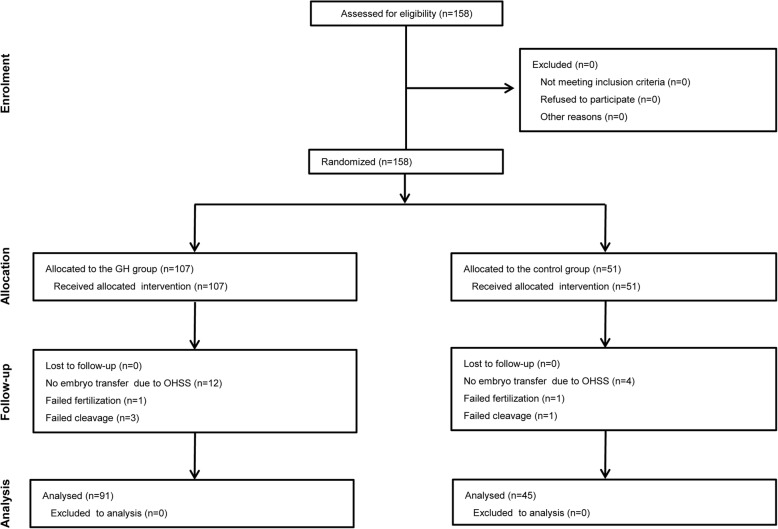
Method: A randomized controlled trial including 158 patients with poor embryo development was conducted between July 2017 and February 2019. One hundred and seven patients were randomized for GH treatment (GH group) and 51 patients for untreated (control group). The primary end-points were the clinical pregnancy and live birth rates in the two groups. The oocyte competence were assessed through calculating the mitochondrial DNA (mtDNA) copy number in corresponding cumulus granulosa cells (CGCs). Quantitative PCR were used for calculation of mtDNA copy number.
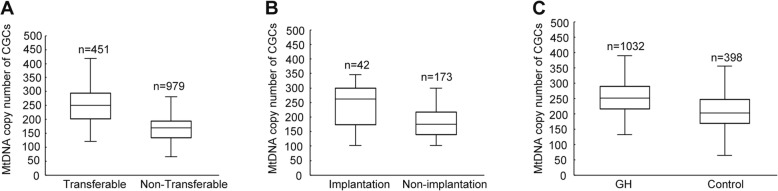
Results: Relative to the control group, GH co-treatment resulted in a significantly higher number of retrieved oocytes (10.29 ± 5.92 versus 8.16 ± 4.17, P = 0.023) and cleaved embryos (6.73 ± 4.25 versus 5.29 ± 3.23, P = 0.036). The implantation rate, clinical pregnancy rates per cycle, and live birth rate per cycle were higher in the GH group than in the control group (36.00% versus 17.86%, P = 0.005; 43.93% versus 19.61%, P = 0.005; 41.12% versus 17.65%, P = 0.006). CGCs of the GH group had significantly higher mtDNA copy numbers than CGCs of the control group (252 versus 204, P < 0.001).
Conclusions: These data provided further evidence to indicate that GH supplementation may support more live births during IVF, in patients with poor embryonic development. It also appears that oocytes generated under GH co-treatment have a better developmental competence.
Trial registration: ChiCTR1900021992 posted March 19, 2019 (retrospectively registered).
Keywords: Growth hormone; In vitro fertilization; Mitochondrial DNA; Oocyte competence; Poor embryonic development.
Conflict of interest statement
The authors declare that they have no conflict of interests.
Figures
References
-
- Oron G, Son WY, Buckett W, Tulandi T, Holzer H. The association between embryo quality and perinatal outcome of singletons born after single embryo transfers: a pilot study. Hum Reprod. 2014;29(7):1444–1451. - PubMed
-
- Yan L, Yang M, Guo H, Yang L, Wu J, Li R, et al. Single-cell RNA-Seq profiling of human preimplantation embryos and embryonic stem cells. Nat Struct Mol Biol. 2013;20(9):1131–1139. - PubMed
-
- Gosden RG. Oogenesis as a foundation for embryogenesis. Mol Cell Endocrinol. 2002;186(2):149–153. - PubMed
Publication types
MeSH terms
Substances
Grants and funding
LinkOut - more resources
Full Text Sources
