


Epidemiology of psoriasis in hard-to-treat body locations: data from the Danish skin cohort
- PMID: 32434510
- PMCID: PMC7238562
- DOI: 10.1186/s12895-020-00099-7
Epidemiology of psoriasis in hard-to-treat body locations: data from the Danish skin cohort
Abstract
Background: Having psoriasis in hard-to-treat areas, i.e. the scalp, face, palms, soles, nails, and genitals, respectively, can impair patients' quality of life. We investigated the prevalence of hard-to-treat body locations of psoriasis, and described patients' clinical and demographic characteristics, and quality of life impacts in a population-based cohort.
Methods: We performed a cross-sectional study using a total of 4016 adults (≥18 years) with psoriasis from the Danish Skin Cohort. Groups were compared to patients without involvement of hard-to-treat areas.
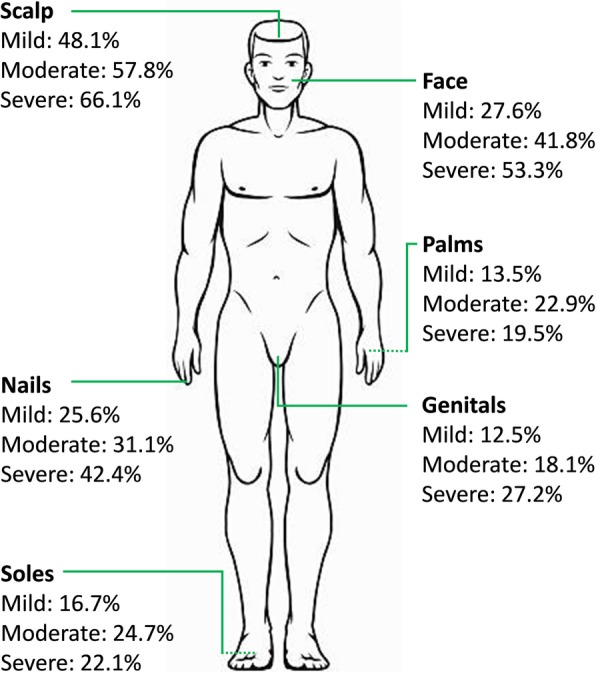
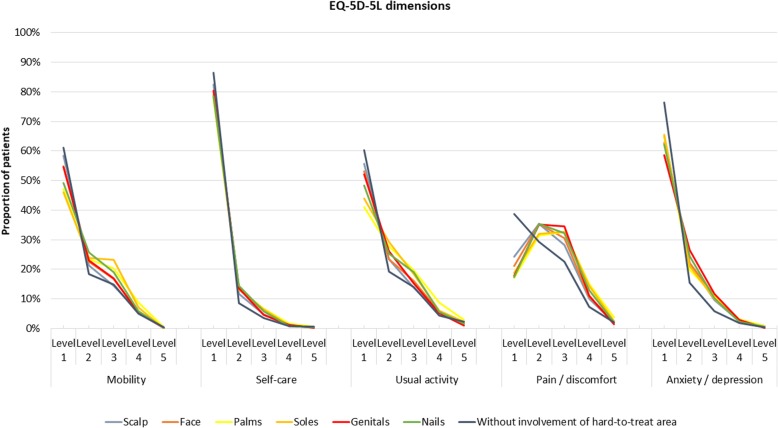
Results: The most frequently affected hard-to-treat area was the scalp (43.0%), followed by the face (29.9%), nails (24.5%), soles (15.6%), genitals (14.1%), and palms (13.7%), respectively. Higher prevalence was generally seen with increasing psoriasis severity. Among all patients 64.8, 42.4, and 21.9% of patients had involvement of ≥1, ≥2, or ≥ 3 hard-to-treat areas. Those with involvement of certain hard-to-treat areas such as hands, feet, and genitals had clinically relevant DLQI impairments. Having involvement of one hard-to-treat area was significantly associated with other hard-to-treat areas affected even after adjusting for age, sex, and psoriasis severity.
Conclusion: Psoriasis commonly affects hard-to-treat locations, even in patients with mild disease. For some of these areas, patient-reported disease burden, e.g. as measured by DLQI, is impaired.
Keywords: Epidemiology; Genital; Hard to treat; Nails; Psoriasis.
Conflict of interest statement
Dr. Egeberg has received research funding from Pfizer, Eli Lilly, the Danish National Psoriasis Foundation, and the Kgl Hofbundtmager Aage Bang Foundation, and honoraria as consultant and/or speaker from Almirall, Leo Pharma, Samsung Bioepis Co., Ltd., Pfizer, Eli Lilly and Company, Novartis, Galderma, Dermavant, Bristol-Myers Squibb, and Janssen Pharmaceuticals. Drs. See, Garrelts, and Burge are currently employed by Eli Lilly and Company.
Figures
References
-
- Parisi R, Symmons DP, Griffiths CE, Ashcroft DM. Identification, Management of P, associated ComorbidiTy project t: global epidemiology of psoriasis: a systematic review of incidence and prevalence. J Investig Dermatol. 2013;133(2):377–385. - PubMed
-
- Danielsen K, Olsen AO, Wilsgaard T, Furberg AS. Is the prevalence of psoriasis increasing? A 30-year follow-up of a population-based cohort. Br J Dermatol. 2013;168(6):1303–1310. - PubMed
-
- Raval K, Lofland JH, Waters H, Piech CT. Disease and treatment burden of psoriasis: examining the impact of biologics. J Drugs Dermatol. 2011;10(2):189–196. - PubMed
-
- Augustin M, Sommer R, Kirsten N, Danckworth A, Radtke MA, Reich K, Thaci D, Boehncke WH, Langenbruch A, Mrowietz U. Topology of psoriasis in routine care - results from a high-resolution analysis in 2,009 patients. Br J Dermatol. 2018;181:358–365. - PubMed
Publication types
MeSH terms
Grants and funding
LinkOut - more resources
Full Text Sources
Medical
