


Heat-not-burn tobacco, electronic cigarettes, and combustible cigarette use among Japanese adolescents: a nationwide population survey 2017
- PMID: 32434517
- PMCID: PMC7240931
- DOI: 10.1186/s12889-020-08916-x
Heat-not-burn tobacco, electronic cigarettes, and combustible cigarette use among Japanese adolescents: a nationwide population survey 2017
Abstract
Background: From among the global public health concerns, smoking remains one of the most crucial challenges. Especially for adolescents, the increase in the use of electronic cigarettes is controversial, as its use may lead to established smoking. In Japan, where a unique tobacco regulation system exists, the heat-not-burn tobacco market has been growing. However, the prevalence and association of combustible cigarettes and new tobacco-related products have not yet been closely investigated among Japanese adolescents. This study aimed to clarify the prevalence of smoking among adolescents, including new types of tobacco-related products, and to compare the characteristics of their users.
Methods: The 2017 Lifestyle Survey of Adolescents is a nationally-representative survey collected in Japan. From the national school directory, 98 junior high schools and 86 high schools were randomly sampled throughout Japan. The students completed an anonymous questionnaire at school. We calculated the prevalence of use for each type of tobacco product. Then, the use of a combination of products and the characteristics of different types of products were examined.
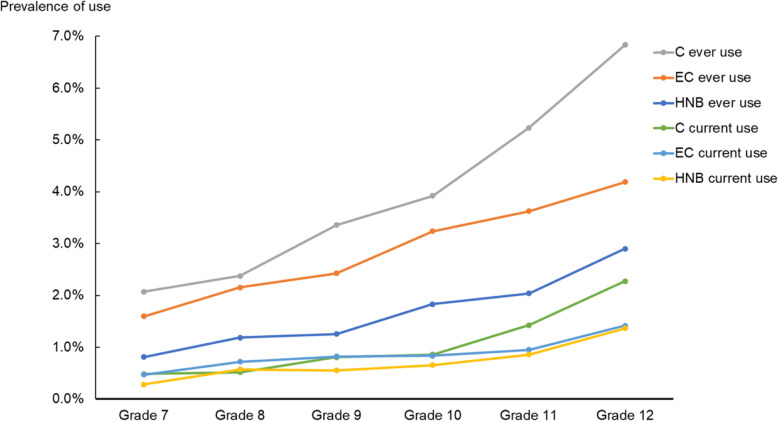
Results: In total, 64,152 students from 48 junior high schools and 55 high schools were included the analysis (school response rate = 56%, Mage = 15.7 years, 53.9% boys). The age-adjusted rate of ever (current) use of electronic cigarettes was 2.1% (0.7%) in junior high school and 3.5% (1.0%) in high school; that of combustible cigarettes was 2.6% (0.6%) in junior high school and 5.1% (1.5%) in high school. The rate of heat-not-burn tobacco use was lower relative to other products: 1.1% (0.5%) in junior high school and 2.2% (0.9%) in high school. An examination of the combined use of the three products identified a high number of dual users. Comparisons between different types of users indicated different backgrounds for combustible cigarette users and new product users.
Conclusions: The prevalence of new tobacco-alternative products is growing in popularity among Japanese adolescents. Dual use is common, and many adolescents use new products only. Moreover, e-cigarettes might attract a broader range of groups to smoking. Continuous monitoring and research are needed to investigate their influence as a possible gateway to tobacco smoking.
Keywords: Adolescents; Cigarette smoking; E-cigarettes; Heat-not-burn tobacco; Prevalence; Smoking; Tobacco use.
Conflict of interest statement
The authors declare that they have no competing interests.
Figures
References
-
- Forouzanfar MH, Alexander L, Anderson HR, Bachman VF, Biryukov S, Brauer M, et al. Global, regional, and national comparative risk assessment of 79 behavioural, environmental and occupational, and metabolic risks or clusters of risks in 188 countries, 1990-2013: a systematic analysis for the global burden of disease study 2013. Lancet. 2015;386(10010):2287–2323. doi: 10.1016/S0140-6736(15)00128-2. - DOI - PMC - PubMed
-
- World Health Organization . Tobacco fact sheet. 2019.
-
- World Health Organization. Health effects of smoking among young people. https://www.who.int/tobacco/control/populations/youth_health_effects/en/. Accessed 8 July 2019.
-
- Ministry of Health Lab . The latest tobacco information. 2018.
MeSH terms
Grants and funding
LinkOut - more resources
Full Text Sources
Other Literature Sources
Medical
