


The Safety Profile of Intentional or Iatrogenic Sacrifice of the Artery of Adamkiewciz and Its Vicinity's Spinal Segmental Arteries: A Systematic Review
- PMID: 32435568
- PMCID: PMC7222674
- DOI: 10.1177/2192568219845652
The Safety Profile of Intentional or Iatrogenic Sacrifice of the Artery of Adamkiewciz and Its Vicinity's Spinal Segmental Arteries: A Systematic Review
Abstract
Study design: Systematic review.
Objectives: There is paucity of consensus on whether (1) the artery of Adamkiewicz (AoA) and (2) the number of contiguous segmental spinal arteries (SSAs) that can be safely ligated without causing spinal cord ischemia. The objective of this review is to determine the risk of motor neurological deficits from iatrogenic sacrifice of the (1) AoA and (2) its vicinity's SSAs.
Methods: Systematic review of the spine and vascular surgery was carried out in accordance to PRISMA guidelines. Outcomes in terms of risk of postoperative motor neurological deficit with occlusion of the AoA, bilateral contiguous SSAs, or unilateral contiguous SSAs were analyzed.
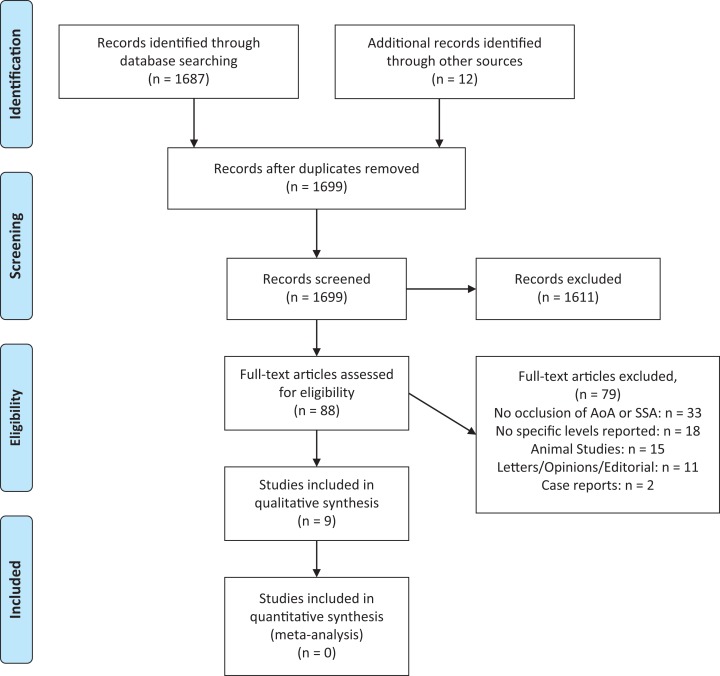
Results: Ten articles, all retrospective case series, were included. Three studies (total N = 50) demonstrated a postoperative neurological deficit risk of 4.0% when the AoA is occluded. When 1 to 6 pairs of SSAs (without knowledge of AoA location) were ligated, the postoperative neurological deficit risk was 0.6%, as compared with 5.4% when more than 6 bilateral pairs of SSAs were ligated (relative risk [RR] = 0.105, 95% CI 0.013-0.841, P = .0337). For unilateral ligation of SSAs of two to nine levels, the risk of postoperative neurological deficit does not exceed 1.3%.
Conclusion: The current best evidence indicates that (1) occlusion of the AoA and (2) occlusion of up to 6 pairs of SSAs is associated with a low risk of postoperative neurological deficit. This limited number of low quality studies restrict the ability to draw definitive conclusions. Ligation of AoA and SSAs should only be undertaken when absolutely required to mitigate the small but devastating risk of paralysis.
Keywords: artery of Adamkiewicz; iatrogenic; occlusion; postoperative complication; radiculomedullary artery; spinal cord injury; spinal cord ischemia; spinal segmental artery.
© The Author(s) 2019.
Conflict of interest statement
Declaration of Conflicting Interests: The author(s) declared no potential conflicts of interest with respect to the research, authorship, and/or publication of this article.
Figures
References
-
- Romanes GJ. The arterial blood supply of the human spinal cord. Paraplegia. 1965;2:199–207. - PubMed
-
- Sliwa JA, Maclean IC. Ischemic myelopathy: a review of spinal vasculature and related clinical syndromes. Arch Phys Med Rehabil. 1992;73:365–372. - PubMed
-
- Skalski JH, Zembala M. Albert Wojciech Adamkiewicz: the discoverer of the variable vascularity of the spinal cord. Ann Thorac Surg. 2005;80:1971–1975. - PubMed
-
- Lazorthes G, Gouaze A, Zadeh JO, Santini JJ, Lazorthes Y, Burdin P. Arterial vascularization of the spinal cord. Recent studies of the anastomotic substitution pathways. J Neurosurg. 1971;35:253–262. - PubMed
Publication types
LinkOut - more resources
Full Text Sources
