


Antimicrobial Treatment Patterns and Illness Outcome Among United States Patients With Plague, 1942-2018
- PMID: 32435801
- PMCID: PMC10908292
- DOI: 10.1093/cid/ciz1227
Antimicrobial Treatment Patterns and Illness Outcome Among United States Patients With Plague, 1942-2018
Abstract
Background: Plague is a rare and severe zoonotic illness with limited empiric evidence to support treatment recommendations. We summarize treatment information for all patients with plague in the United States (US) as collected under the auspices of public health surveillance.
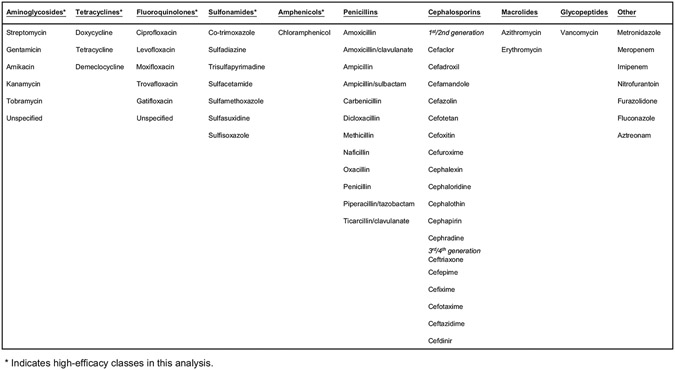
Methods: We reviewed use of specific antimicrobials and illness outcome among cases of plague reported from 1942-2018. Antimicrobials were a priori classified into high-efficacy (aminoglycosides, tetracyclines, fluoroquinolones, sulfonamides, and chloramphenicol) and limited-efficacy classes (all others). Logistic regression models were created to describe associations between use of specific antimicrobial classes and illness outcome while controlling for potential confounding factors.
Results: Among 533 total reported plague cases during 1942-2018, 426 (80%) received high-efficacy antimicrobial therapy. Mortality differed significantly among those receiving high-efficacy therapy (9%) and only limited-efficacy therapy (51%). Aminoglycosides and tetracyclines were used more commonly than other classes, and their use was associated with increased odds of survival of plague. Gentamicin use was associated with higher mortality than streptomycin, and aminoglycoside use was linked to higher mortality than for tetracyclines. Fluoroquinolones have been used in treatment of >30% of patients in recent years and limited data suggest clinical effectiveness.
Conclusions: Most US patients with plague have received effective antimicrobials. Aminoglycosides and tetracyclines substantially improve survival of plague, and fluoroquinolones may be equally as effective, yet lack sufficient data. Early recognition and early treatment with any of these antimicrobial classes remain the most important steps to improving survival of plague.
Keywords: Yersinia pestis; plague; surveillance; treatment.
Published by Oxford University Press for the Infectious Diseases Society of America 2020.
Conflict of interest statement
Figures


References
-
- Pollitzer R. Plague. Geneva, Switzerland: World Health Organization, 1954.
-
- Dennis DT, Gage KL, Gratz ND, Poland JD, Tikhomirov E. Plague manual: epidemiology, distribution, surveillance and control. Geneva, Switzerland: World Health Organization, 1999.
-
- Mead PS. Yersinia species (including plague). In: Bennett JE, Dolin R, Blaser MJ. Principles and practice of infectious diseases. 8th ed, vol. 2. Philadelphia: Elsevier, 2015:2607–18.
Publication types
MeSH terms
Substances
Grants and funding
LinkOut - more resources
Full Text Sources
Medical
