


Clinical spectrum and prognostic value of TP53 mutations in circulating tumor DNA from breast cancer patients in China
- PMID: 32436611
- PMCID: PMC7307233
- DOI: 10.1002/cac2.12032
Clinical spectrum and prognostic value of TP53 mutations in circulating tumor DNA from breast cancer patients in China
Abstract
Background: TP53 mutations are common in breast cancer. There is currently no large-scale cohort study to investigate the TP53 landscape in breast cancer patients from China. The predictive value of TP53 mutations for the efficacy of human epidermal growth factor receptor 2 (HER2)-targeted therapy in breast cancer remains controversial. In the present study, we aimed to analyze the clinical spectrum and prognostic value of TP53 mutations in circulating tumor DNA (ctDNA) from breast cancer patients in China.
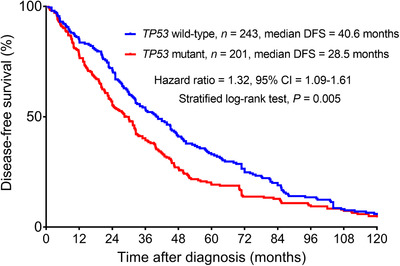
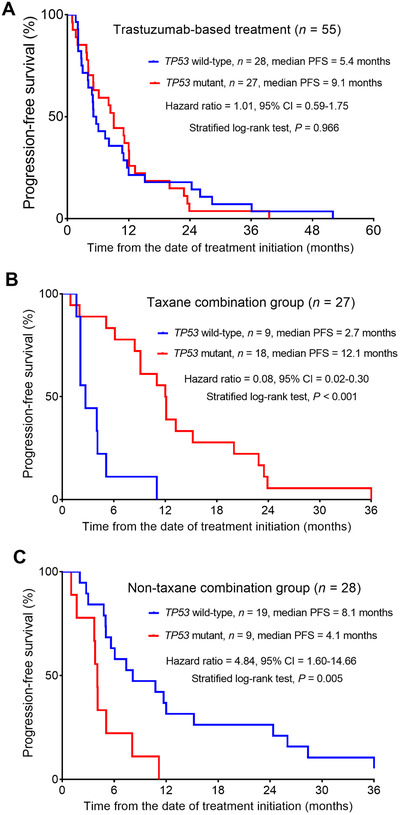
Methods: We retrospectively analyzed the clinical data and TP53 mutation features in ctDNA samples from 804 patients with metastatic breast cancer. TP53 mutations were detected by target region capture-based next-generation sequencing. The relationship between TP53 mutation status and disease-free survival (DFS) was analyzed in 444 patients with metastatic breast cancer. Moreover, the relationship between TP53 mutation status and progression-free survival (PFS) was analyzed in 55 HER2-positive patients treated with first-line trastuzumab-based therapy. Kaplan-Meier analysis was performed to estimate the survival curves of the different subgroups, and the log-rank test was used to compare the curves. A Cox regression model was used to estimate multivariable-adjusted hazard ratios and their 95% confidence intervals (CIs) associated with the DFS and PFS.
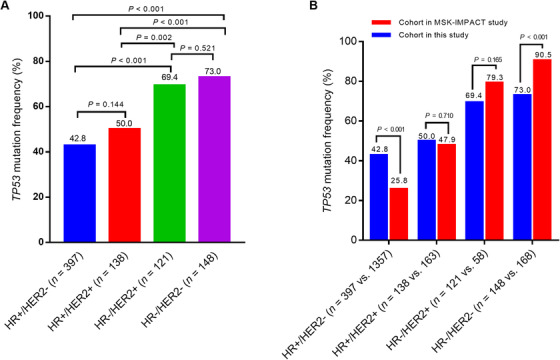
Results: Among the 804 investigated patients, 431 (53.6%) patients harbored TP53 mutations. TP53 mutations were differentially distributed among different molecular subtypes of breast cancer (P < 0.05). Patients with TP53 mutations had a shorter DFS than those with wild-type TP53 (hazard ratio = 1.32, 95% CI = 1.09-1.61, P = 0.005). TP53 mutations in exons 5-8 were associated with worse outcome (hazard ratio = 1.50, 95% CI = 1.11-2.03, P = 0.009). However, TP53 mutation status was not significantly associated with PFS in HER2-positive patients who received first-line trastuzumab-based therapy (P = 0.966). Interestingly, in the taxane combination group, patients with TP53 mutations exhibited longer PFS than those without TP53 mutations (hazard ratio = 0.08, 95% CI = 0.02-0.30, P < 0.001). However, in the non-taxane combination group, patients with TP53 mutations displayed shorter PFS than those with wild-type TP53 (hazard ratio = 4.84, 95% CI = 1.60-14.66, P = 0.005).
Conclusions: TP53 mutations in exons 5-8 may be an independent prognostic marker for short DFS in patients with metastatic breast cancer. TP53 mutations had opposite effects on trastuzumab-treated patients treated with and without taxanes.
Keywords: Chinese; TP53 mutation; breast cancer; circulating tumor DNA; next-generation sequencing; prognosis; taxanes; trastuzumab.
© 2020 The Authors. Cancer Communications published by John Wiley & Sons Australia, Ltd. on behalf of Sun Yat-sen University Cancer Center.
Conflict of interest statement
The authors declare that they have no competing interests.
Figures
References
-
- Vousden KH, Lu X. Live or let die: the cell's response to p53. Nat Rev Cancer. 2002;2(8):594‐604. - PubMed
-
- Silwal‐Pandit L, Vollan HK, Chin SF, Rueda OM, McKinney S, Osako T, et al. TP53 mutation spectrum in breast cancer is subtype specific and has distinct prognostic relevance. Clin Cancer Res. 2014;20(13):3569‐80. - PubMed
Publication types
MeSH terms
Substances
Grants and funding
LinkOut - more resources
Full Text Sources
Medical
Research Materials
Miscellaneous
