


Editorial
doi: 10.1164/rccm.202005-1906ED.
Home Nitric Oxide Therapy for COVID-19
Affiliations
- PMID: 32437250
- PMCID: PMC7328337
- DOI: 10.1164/rccm.202005-1906ED
Item in Clipboard
Editorial
Home Nitric Oxide Therapy for COVID-19
Am J Respir Crit Care Med.
.
No abstract available
Figures
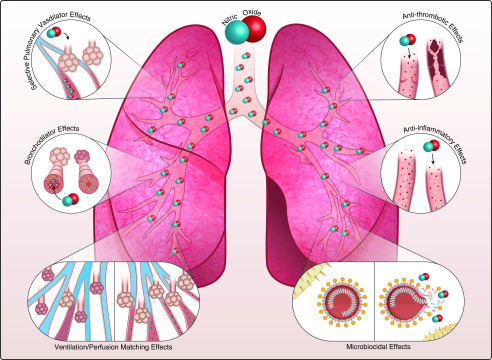
Summary of major therapeutic properties of inhaled nitric oxide gas (NO). From
top left: inhaled NO gas is known to be a selective pulmonary vasodilator. NO
can improve right heart function and decrease pulmonary vasoconstriction in
subjects with acute and chronic pulmonary hypertension. Middle left vignette:
breathing NO gas is shown to improve ventilation and provide bronchodilation in
mild asthmatic subjects. Bottom left vignette: NO gas in the alveolar space
improves oxygenation by increasing blood flow to ventilated lung units (i.e.,
improvement of ventilation perfusion matching). Top and middle right vignettes:
in vitro and in vivo data showed that NO
gas can act as an antiinflammatory and antithrombotic agent. Bottom right
vignette: NO donors and NO gas showed antibacterial and antiviral properties in
in vitro studies and early clinical investigations. The
extent of benefits of these six therapeutic pathways of NO gas in coronavirus
disease (COVID-19) infection are now under investigation. Some of those studies
testing NO therapeutic properties are highlighted in Table 1.
Comment on
-
Outpatient Inhaled Nitric Oxide in a Patient with Vasoreactive Idiopathic Pulmonary Arterial Hypertension and COVID-19 Infection.Am J Respir Crit Care Med. 2020 Jul 1;202(1):130-132. doi: 10.1164/rccm.202004-0937LE. Am J Respir Crit Care Med. 2020. PMID: 32369396 Free PMC article. No abstract available.
References
-
- Richardson S, Hirsch JS, Narasimhan M, Crawford JM, McGinn T, Davidson KW, et al. the Northwell COVID-19 Research Consortium. Presenting characteristics, comorbidities, and outcomes among 5700 patients hospitalized with COVID-19 in the New York City area. JAMA. [online ahead of print] 22 Apr 2020; DOI: 10.1001/jama.2020.6775. - PMC - PubMed
Publication types
MeSH terms
Substances
Grants and funding
LinkOut - more resources
Full Text Sources
Other Literature Sources
