


Engage for Equity: A Long-Term Study of Community-Based Participatory Research and Community-Engaged Research Practices and Outcomes
- PMID: 32437293
- PMCID: PMC8093095
- DOI: 10.1177/1090198119897075
Engage for Equity: A Long-Term Study of Community-Based Participatory Research and Community-Engaged Research Practices and Outcomes
Abstract
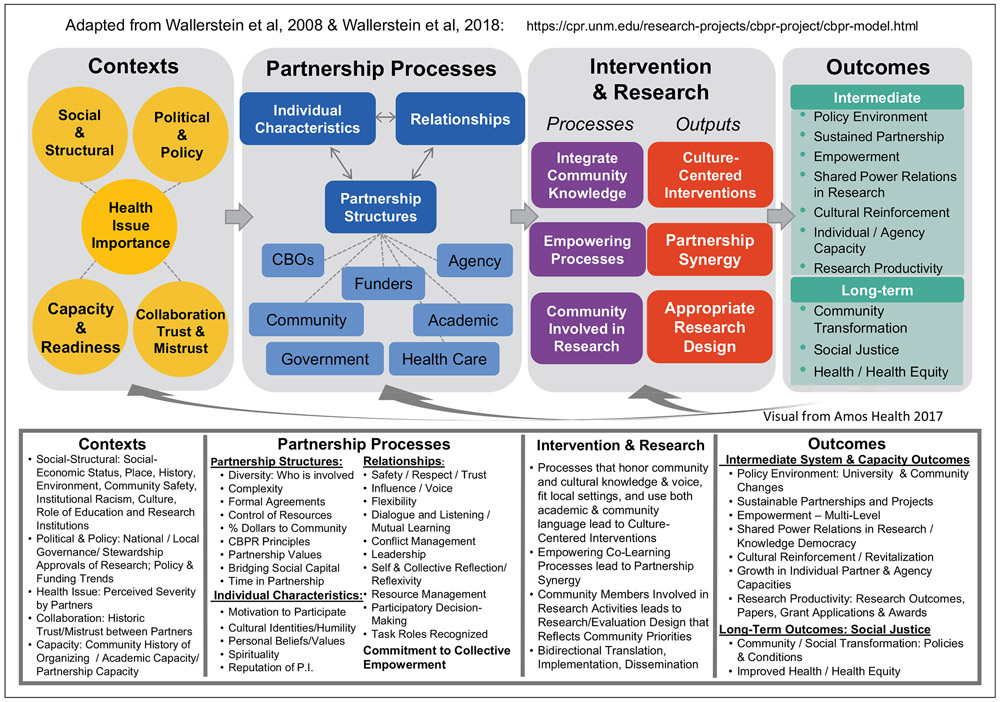
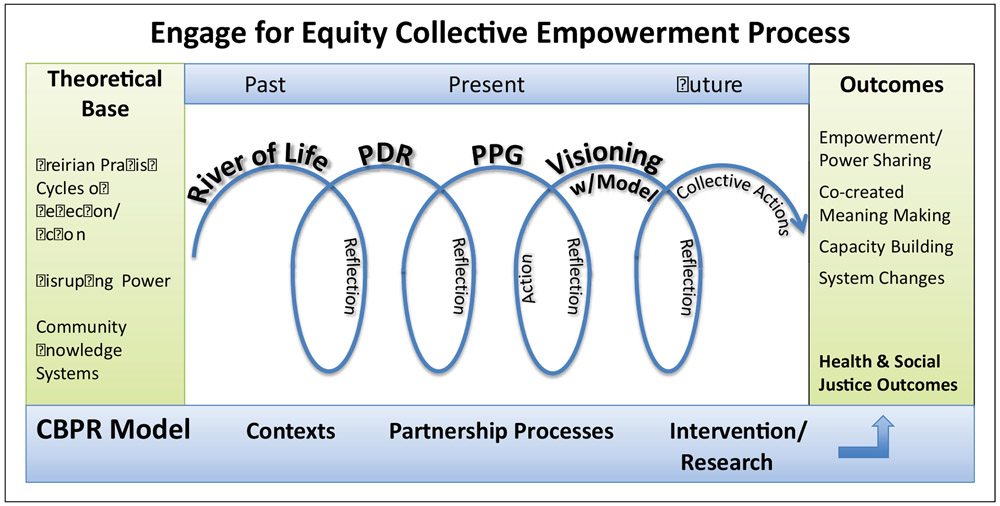
Community-based participatory research (CBPR) and community-engaged research have been established in the past 25 years as valued research approaches within health education, public health, and other health and social sciences for their effectiveness in reducing inequities. While early literature focused on partnering principles and processes, within the past decade, individual studies, as well as systematic reviews, have increasingly documented outcomes in community support and empowerment, sustained partnerships, healthier behaviors, policy changes, and health improvements. Despite enhanced focus on research and health outcomes, the science lags behind the practice. CBPR partnering pathways that result in outcomes remain little understood, with few studies documenting best practices. Since 2006, the University of New Mexico Center for Participatory Research with the University of Washington's Indigenous Wellness Research Institute and partners across the country has engaged in targeted investigations to fill this gap in the science. Our inquiry, spanning three stages of National Institutes of Health funding, has sought to identify which partnering practices, under which contexts and conditions, have capacity to contribute to health, research, and community outcomes. This article presents the research design of our current grant, Engage for Equity, including its history, social justice principles, theoretical bases, measures, intervention tools and resources, and preliminary findings about collective empowerment as our middle range theory of change. We end with lessons learned and recommendations for partnerships to engage in collective reflexive practice to strengthen internal power-sharing and capacity to reach health and social equity outcomes.
Keywords: community-based participatory research; community-engaged research; community–academic partnerships; measures; participatory action research; resources; tools.
Conflict of interest statement
Declaration of Conflicting Interests
The authors declared no potential conflicts of interest with respect to the research, authorship, and/or publication of this article.
Figures
References
-
- Anderson LM, Adeney KL, Shinn C, Safranek S, Buckner-Brown J, & Krause LK (2015). Community coalition-driven interventions to reduce health disparities among racial and ethnic minority populations. Cochrane Database of Systematic Review, (6), CD009905. 10.1002/14651858.CD009905.pub2 - DOI - PMC - PubMed
-
- Belone L, Tosa J, Shendo K, Toya A, Straits K, Tafoya G, … Wallerstein N (2016). Community-based participatory research for co-creating interventions with Native communities: A partnership between the University of New Mexico and the Pueblo of Jemez. In Zane N, Bernal G, & Leong FTL (Eds.), Evidence-based psychological practice with ethnic minorities: Culturally informed research and clinical strategies (pp. 199–220). Baltimore, MD: United Book Press.
-
- Boursaw B, Oetzel J, Dickson E, Thein T, Sanchez-Youngman S, Peña J, Parker M, Magarati M, Littledeer L, Duran B, & Wallerstein N (2020). Psychometrics of measures of community-academic research partnership practices and outcomes. Manuscript submitted for publication.
-
- Cacari-Stone L, Minkler M, Freudenberg N, & Themba MN (2018). Community-based participatory research for health equity policy making. In Wallerstein N, Duran B, Oetzel J, & Minkler M (Eds.), Community-based participatory research for health: Advancing social and health equity (3rd ed., pp. 277–292). San Francisco, CA: Jossey-Bass.
-
- Cook T, Brandon T, Zonouzi M, & Thomson L (2019). Destabilising equilibriums: Harnessing the power of disruption in participatory action research. Educational Action Research, 27, 379–395. 10.1080/09650792.2019.1618721 - DOI
Publication types
MeSH terms
Grants and funding
LinkOut - more resources
Full Text Sources
Miscellaneous
