Review
. 2020 May 22;126(11):1526-1548.
doi: 10.1161/CIRCRESAHA.119.316065. Epub 2020 May 21.

Genetics Insights in the Relationship Between Type 2 Diabetes and Coronary Heart Disease

Affiliations
Review

Genetics Insights in the Relationship Between Type 2 Diabetes and Coronary Heart Disease

Mark O Goodarzi et al. Circ Res. .

Abstract

Diabetes mellitus is a major risk factor for coronary heart disease (CHD). The major form of diabetes mellitus is type 2 diabetes mellitus (T2D), which is thus largely responsible for the CHD association in the general population. Recent years have seen major advances in the genetics of T2D, principally through ever-increasing large-scale genome-wide association studies. This article addresses the question of whether this expanding knowledge of the genomics of T2D provides insight into the etiologic relationship between T2D and CHD. We will investigate this relationship by reviewing the evidence for shared genetic loci between T2D and CHD; by examining the formal testing of this interaction (Mendelian randomization studies assessing whether T2D is causal for CHD); and then turn to the implications of this genetic relationship for therapies for CHD, for therapies for T2D, and for therapies that affect both. In conclusion, the growing knowledge of the genetic relationship between T2D and CHD is beginning to provide the promise for improved prevention and treatment of both disorders.

Keywords: coronary artery disease; diabetes mellitus; glucose tolerance test; insulin resistance; risk factor.


Conflict of interest statement

Disclosures

The authors have no conflicts of interest.

Figures
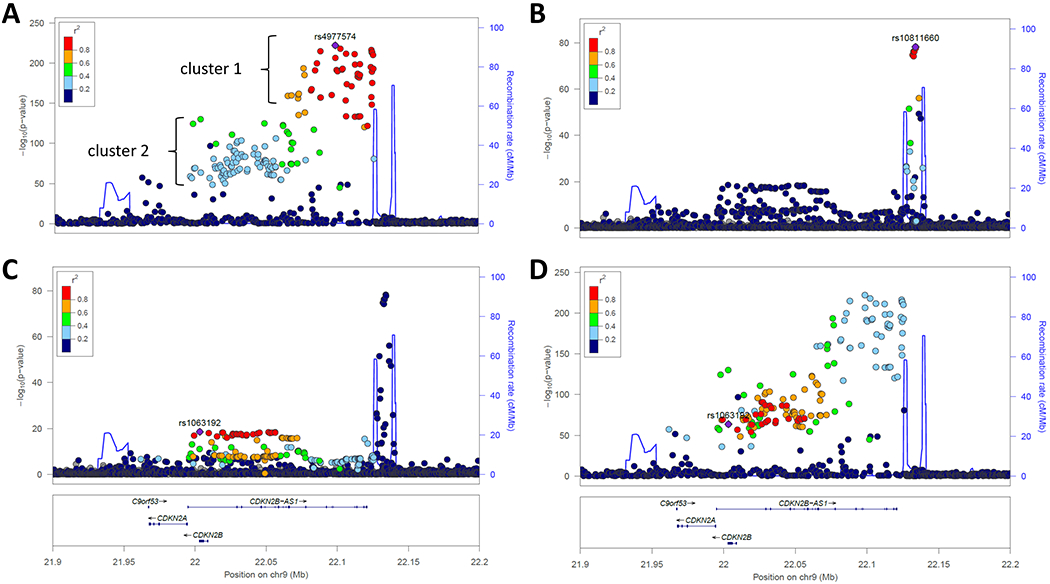
Figure 1.
Figure 1.
Regional association plot of the chromosome 9p21 locus for CHD and T2D. In these plots, P values are plotted as -log10 values as a function of genomic position. Each dot represents one SNP, with the index variant represented as a purple diamond. Color of other SNPs indicates their LD with the index SNP, per the scale on the top left. Recombination rates are represented by the blue line and genes in the region are shown at bottom. Plots were generated using publicly available summary statistics for CHD and T2D. A. Association with CHD, where the index SNP rs4977574 is the top known signal. Note that the CHD association lies proximal to a recombination hotspot; B. Association with T2D, index SNP rs10811660 is the top signal, in a region delimited by two recombination hotspots; C. Association with T2D at a second locus in the region, indexed by rs1063192, and independent of the first T2D signal; D. Association with CHD, indexed to the T2D SNP rs1063192. The cluster of SNPs constituting the second T2D signal is in LD with the CHD signal.
Figure 2.
Figure 2.
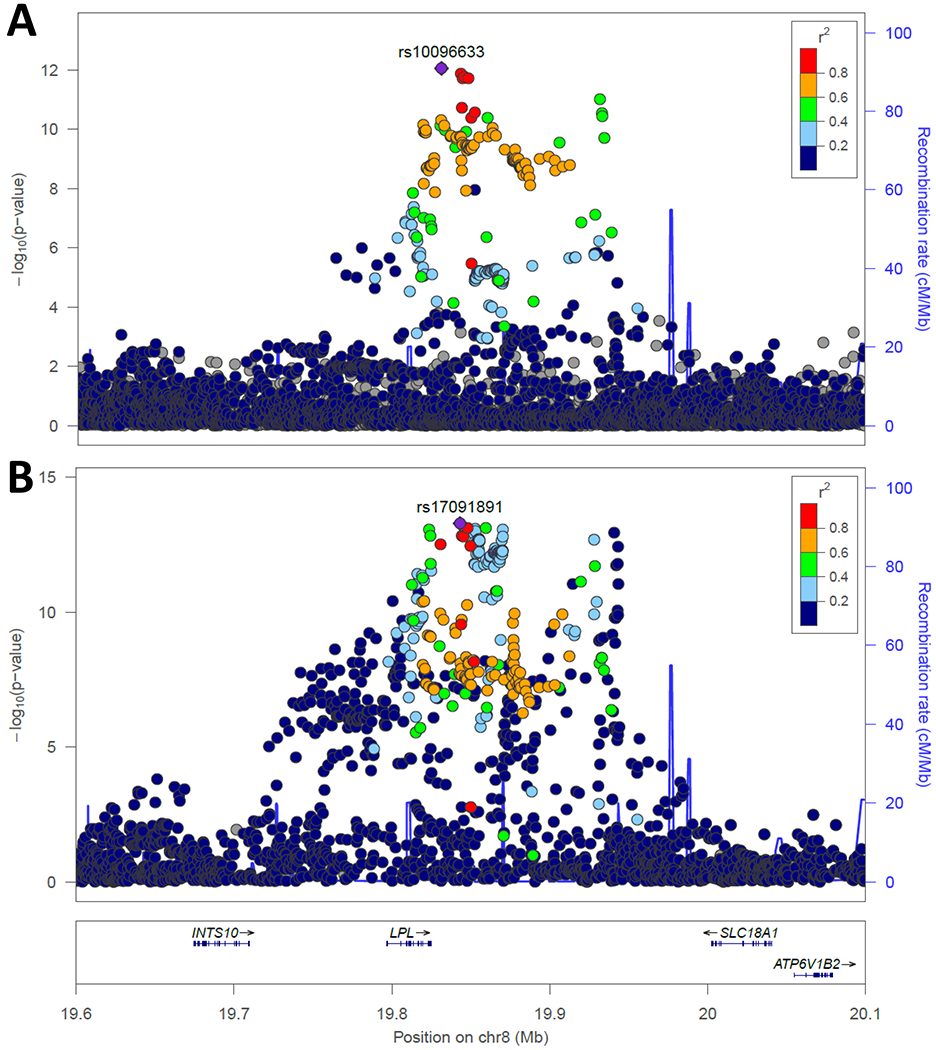
Regional association plot of the LPL locus for T2D and CHD. In these plots, P values are plotted as -log10 values as a function of genomic position. Each dot represents one SNP, with the index variant represented as a purple diamond. Color of other SNPs indicates their LD with the index SNP, per the scale on the top right. Recombination rates are represented by the blue line and genes in the region are shown at bottom. Plots were generated using publicly available summary statistics for CHD and T2D. A. Association with T2D, indexed to rs10096633. B. Association with CHD indexed to rs17091891. The two index SNPs are highly linked (r2=0.97 in Europeans).
Figure 3.
Figure 3.
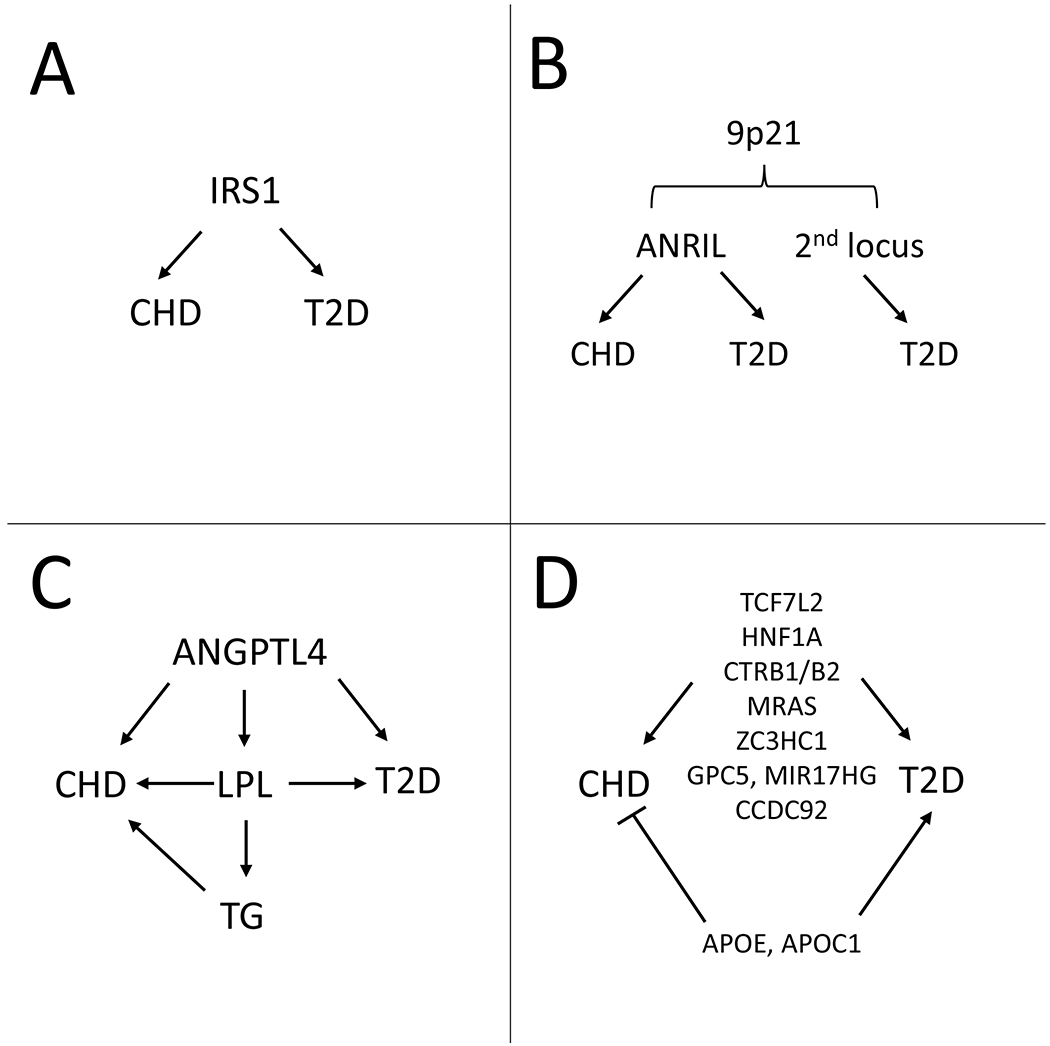
Different types of shared loci for CHD and T2D. A. IRS1 locus where the same variants are associated with CHD and T2D. B. More complex structure of chromosome 9p21 locus, which houses overlapping signals for CHD and T2D as well as an independent signal for T2D (see also Figure 1). C. Loci involved in triglyceride metabolism. D. Multi-locus colocalization approach that revealed seven signals with consistent direction of effect and one locus with opposite effects on CHD and T2D.
Figure 4.
Figure 4.
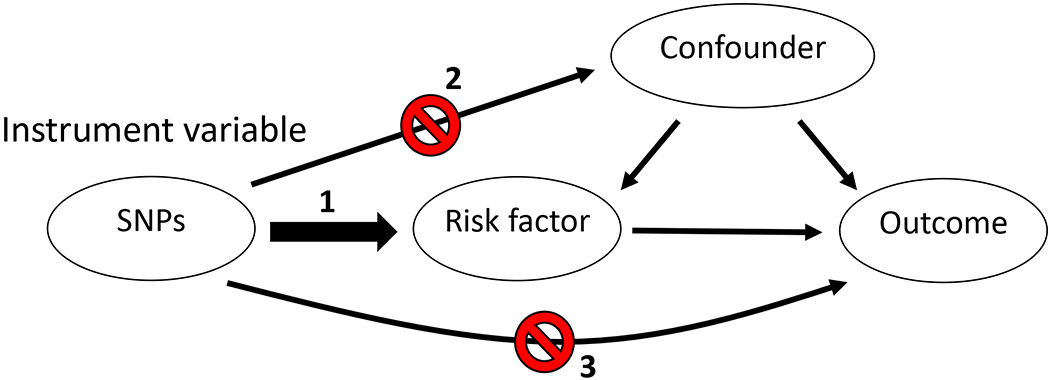
Illustrations of the core assumptions of Mendelian randomization. 1. The instrument variables must be strongly associated with the risk factor of interest, 2. Variants must not be associated with confounders of the risk factor and the outcome. 3. Variants are associated with disease through that risk factor and not through other mediators.
Figure 5.
Figure 5.
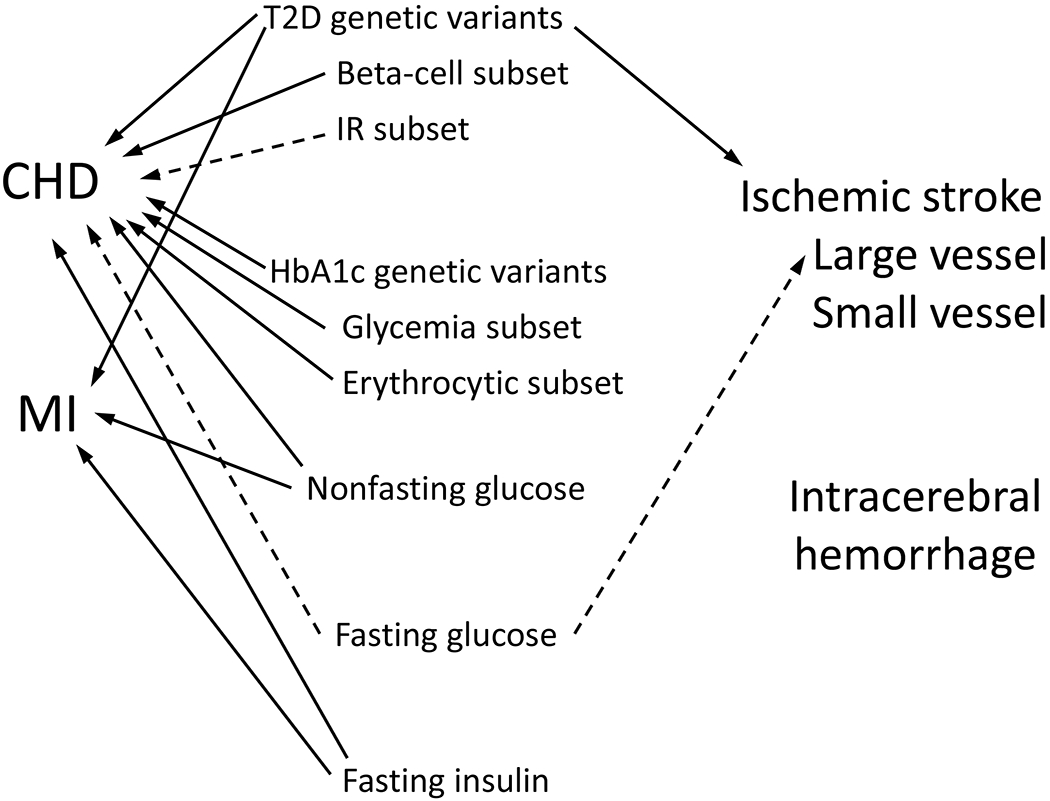
Summary of Mendelian randomization literature examining T2D and related traits as risk factors for CVD. Solid lines represent compelling evidence for causality. Dotted lines represent mixed results.

References

    1. Staimez LR, Deepa M, Ali MK, Mohan V, Hanson RL, Narayan KMV. Tale of two Indians: Heterogeneity in type 2 diabetes pathophysiology. Diabetes Metab Res Rev. 2019:e3192. - PMC - PubMed
    1. Zimmet P, Alberti KG, Shaw J. Global and societal implications of the diabetes epidemic. Nature. 2001;414:782–787 - PubMed
    1. Magliano DJ, Islam RM, Barr ELM, Gregg EW, Pavkov ME, Harding JL, Tabesh M, Koye DN, Shaw JE. Trends in incidence of total or type 2 diabetes: systematic review. Bmj. 2019;366:l5003. - PMC - PubMed
    1. Narayan KM, Boyle JP, Thompson TJ, Sorensen SW, Williamson DF. Lifetime risk for diabetes mellitus in the United States. Jama. 2003;290:1884–1890 - PubMed
    1. Perry JR, Frayling TM. New gene variants alter type 2 diabetes risk predominantly through reduced beta-cell function. Curr Opin Clin Nutr Metab Care. 2008;11:371–377 - PubMed

Publication types

MeSH terms