. 2020 May 21;15(5):e0233180.
doi: 10.1371/journal.pone.0233180. eCollection 2020.

THP-1 macrophage cholesterol efflux is impaired by palmitoleate through Akt activation

Affiliations

THP-1 macrophage cholesterol efflux is impaired by palmitoleate through Akt activation

Jenika D Marshall et al. PLoS One. .

Abstract

Lipoprotein lipase (LPL) is upregulated in atherosclerotic lesions and it may promote the progression of atherosclerosis, but the mechanisms behind this process are not completely understood. We previously showed that the phosphorylation of Akt within THP-1 macrophages is increased in response to the lipid hydrolysis products generated by LPL from total lipoproteins. Notably, the free fatty acid (FFA) component was responsible for this effect. In the present study, we aimed to reveal more detail as to how the FFA component may affect Akt signalling. We show that the phosphorylation of Akt within THP-1 macrophages increases with total FFA concentration and that phosphorylation is elevated up to 18 hours. We further show that specifically the palmitoleate component of the total FFA affects Akt phosphorylation. This is tied with changes to the levels of select molecular species of phosphoinositides. We further show that the total FFA component, and specifically palmitoleate, reduces apolipoprotein A-I-mediated cholesterol efflux, and that the reduction can be reversed in the presence of the Akt inhibitor MK-2206. Overall, our data support a negative role for the FFA component of lipoprotein hydrolysis products generated by LPL, by impairing macrophage cholesterol efflux via Akt activation.


Conflict of interest statement

The authors have declared that no competing interests exist.

Figures
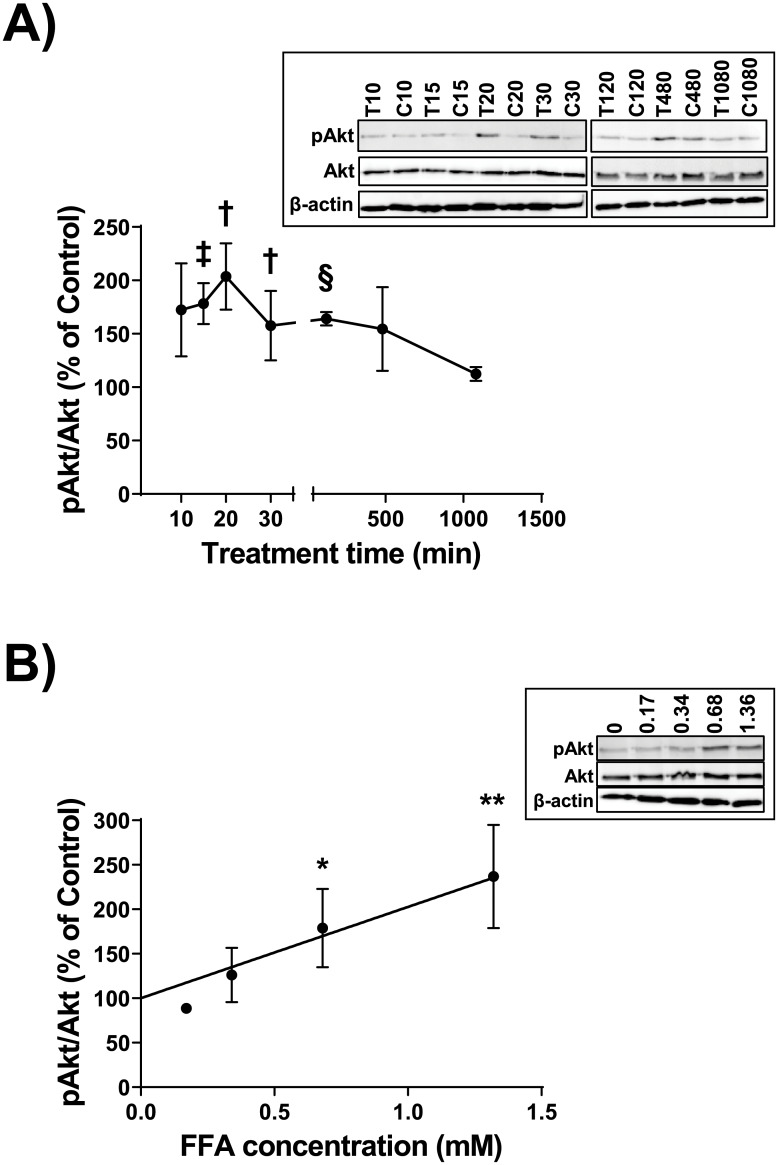
Fig 1
Fig 1. Time course and dose response of Akt phosphorylation.
A. THP-1 macrophages were incubated for 0, 10, 15, 20, 30, 120, 420, or 1080 minutes with either a vehicle control (Control or C), or a 0.68 mM mixture of purified FFA (T) that matched the ratios observed post-hydrolysis of total human lipoprotein lipids by LPL. Cell lysates were collected and proteins were subjected to immunoblot analyses. Densitometry of Akt and pAkt were assessed; data are expressed as the ratio of pAkt to total Akt, as a percent of Control. Data are means `SE from three independent experiments, and statistical analysis was performed using multiple t-testing (uncorrected: †, p = 0.03; ‡, p = 0.008; §, p = 0.0003). Following a Bonferroni-Dunn correction (with α = 0.05), only the 120 minute data retained significance (p = 0.004). Inset, one complete set of immunoblot results from the three independent experiments. The complete set of uncropped immunoblots can be found in S8 Fig. B. THP-1 macrophages were incubated for 2 hours with either a vehicle control (Control), or a mixture of purified FFA that matched the ratios observed post-hydrolysis of total human lipoprotein lipids by LPL; concentrations of 0 mM, 0.17 mM, 0.34 mM, 0.68 mM, and 1.38 mM were tested. Analyses of cell lysates were performed as in “A”. Data are from three independent experiments, and statistical analysis was performed using regression analysis (R2 = 0.49, p = 0.01) and a t-test (*, p = 0.02; **, p = 0.005). Inset, one complete set of immunoblot results from the three independent experiments. The complete set of uncropped immunoblots can be found in S9 Fig.
Fig 2
Fig 2. Analysis of FFA classes on Akt phosphorylation.
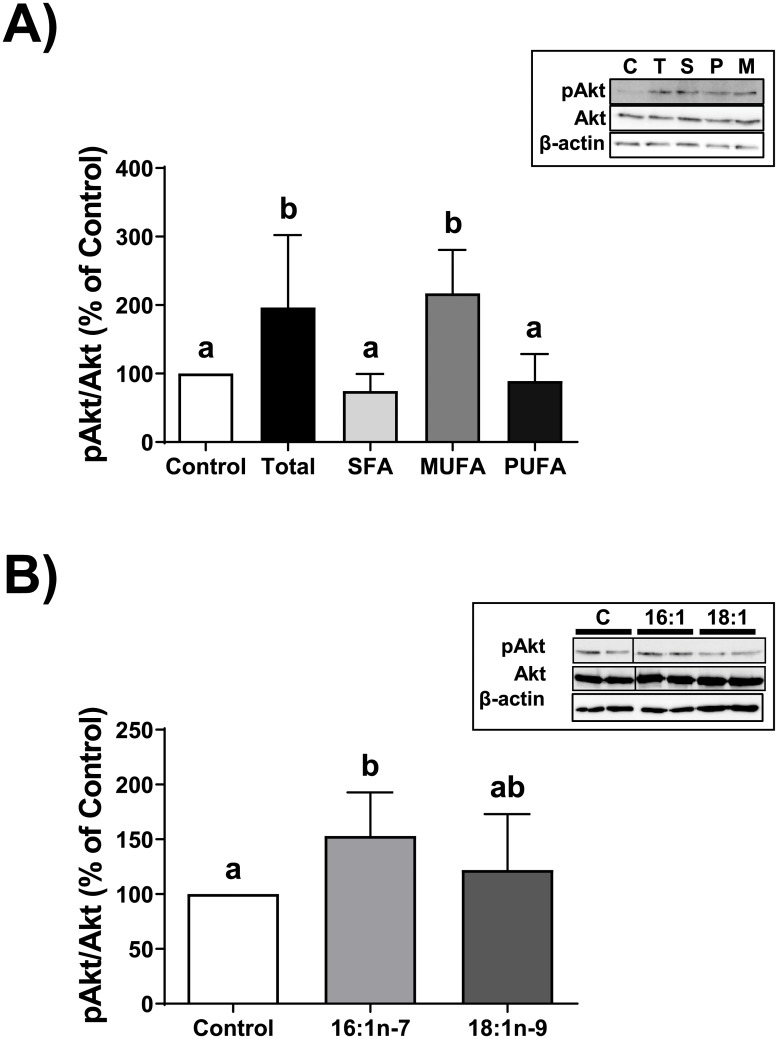
A. THP-1 macrophages were incubated for 2 hours with either a vehicle control (Control or C), a 0.68 mM mixture of purified FFA (Total or T) that matched the ratios observed post-hydrolysis of total human lipoprotein lipids by LPL, the SFA component of the total mixture (S), the MUFA component of the total mixture (M), or the PUFA component of the total mixture (P). Cell lysates were collected and proteins were subjected to immunoblot analyses. Densitometry of Akt and pAkt were assessed; data are expressed as the ratio of pAkt to total Akt, as a percent of Control. Data are from at least five independent experiments. Statistical analysis was performed using a one-way ANOVA with Tukey’s multiple comparisons testing. Inset, one complete set of immunoblot results from the five independent experiments. The complete set of uncropped immunoblots can be found in S10 Fig. B. THP-1 macrophages were incubated for 2 hours with either a vehicle control (Control or C), 0.02 mM palmitoleate (16:1n-7 or 16:1), or 0.24 mM oleate (18:1n-9 or 18:1). Cell lysates were collected and proteins were subjected to immunoblot analyses. Analyses of cell lysates and data were performed as in “A”. Data are from five independent experiments. Inset, one complete set of immunoblot results from the five independent experiments. The complete set of uncropped immunoblots can be found in S11 Fig.
Fig 3
Fig 3. Analyses of PIPx species in response to palmitoleate treatment.
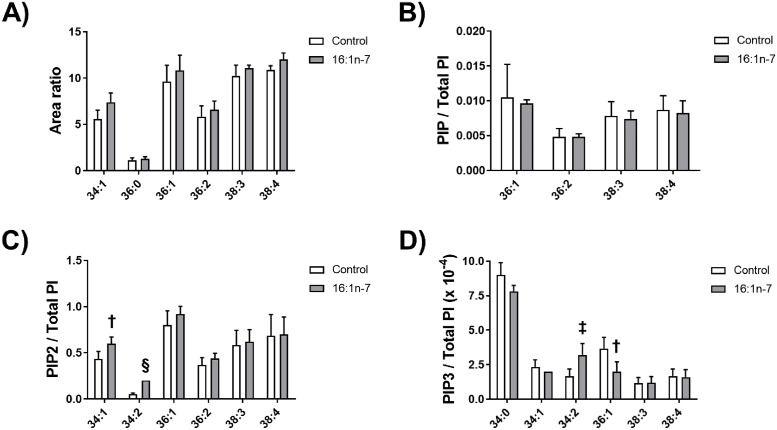
THP-1 macrophages were incubated for 18 hours with either a vehicle control (Control) or 0.02 mM palmitoleate (16:1n-7). Lipids were extracted from cell lysates; A, PI species; B, PIP species; C, PIP2 species; and D, PIP3 species were quantified. Data in “A” are expressed as a ratio of area under the curve of the examined species to the area under the curve of the standard PI; data in “B”, “C”, and “D” are expressed as a ratio of intensity per total PI. Control data are from six independent experiments and palmitoleate-treatment data are from five independent experiments. Statistical analysis was performed using a t-test (†, p = 0.006; ‡, p = 0.005; §, p<0.0001).
Fig 4
Fig 4. ApoA-I-mediated cholesterol efflux in response to fatty acids and Akt inhibition.
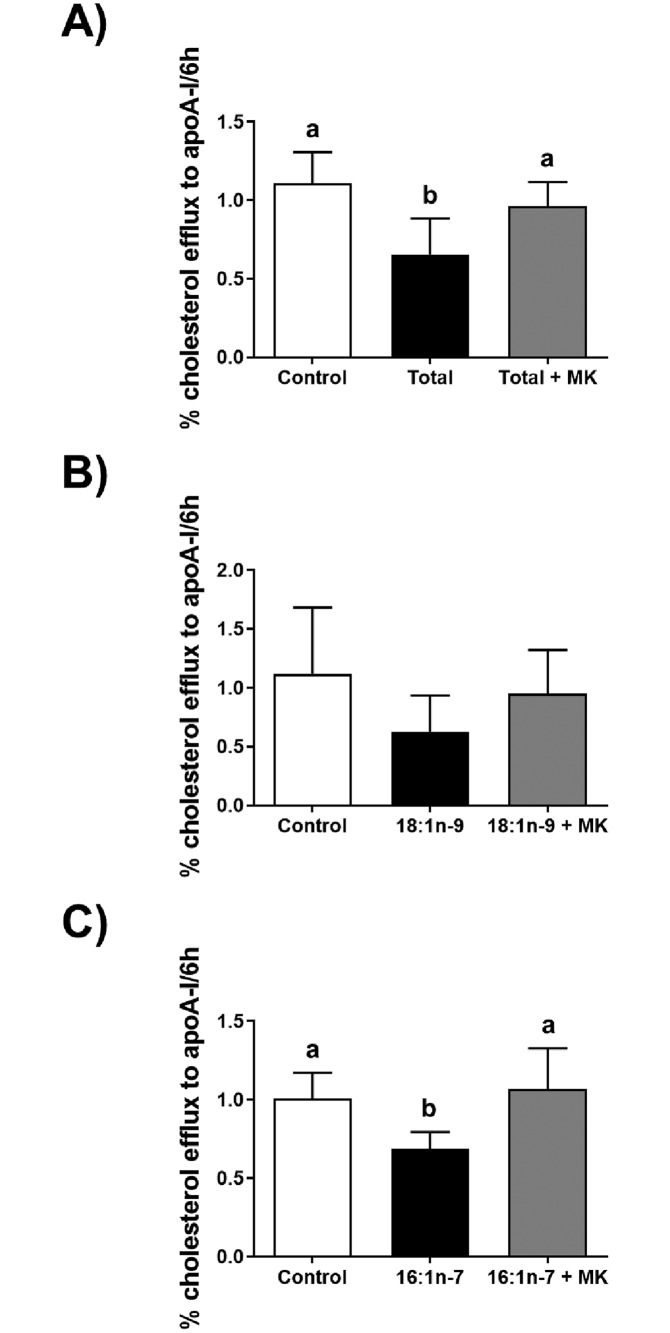
THP-1 macrophages labelled with [3H]cholesterol were incubated for 18 hours with either a vehicle control (Control); or A, a 0.68 mM mixture of purified FFA (Total) that matched the ratios observed post-hydrolysis of total human lipoprotein lipids by LPL; B, 0.24 mM oleate (18:1n-9); or C, 0.02 mM palmitoleate (16:1n-7). Incubations were in the absence or presence of 1 μM MK-2206 (+ MK). Cholesterol efflux in the absence or presence of 25 μg/ml apoA-I was examined after 6 hours. Cholesterol efflux was calculated as a percent of media [3H]cholesterol per total cell and media [3H]cholesterol; background efflux (in the absence of apoA-I) was subtracted from efflux data for apoA-I to obtain apoA-I specific efflux. Data in “A” are from eight independent experiments, and data in “B” and “C” are from five independent experiments. Statistical analysis was performed using a one-way ANOVA with Tukey’s multiple comparisons testing.

References

    1. Nicoll A & Lewis B. Evaluation of the roles of lipoprotein lipase and hepatic lipase in lipoprotein metabolism: in vivo and in vitro studies in man. Eur J Clin Invest. 1980;10(6):487–495. 10.1111/j.1365-2362.1980.tb02090.x - DOI - PubMed
    1. McCoy MG, Sun GS, Marchadier D, Maugeais C, Glick JM, & Rader DJ. Characterization of the lipolytic activity of endothelial lipase. J Lipid Res. 2002;43(6):921–929. - PubMed
    1. Savonen R, Hiden M, Zechner R, Levak-Frank S, Olivecrona G, et al. The tissue distribution of lipoprotein lipase determines where chylomicrons bind. J Lipid Res. 2015;56(3):588–598. 10.1194/jlr.M056028 - DOI - PMC - PubMed
    1. Zechner R. The tissue-specific expression of lipoprotein lipase: implications for energy and lipoprotein metabolism. Curr Opin Lipidol. 1997;8(2):77–88. 10.1097/00041433-199704000-00005 - DOI - PubMed
    1. Kristensen KK, Midtgaard SR, Mysling S, Kovrov O, Hansen LB, Skar-Gislinge N, et al. A disordered acidic domain in GPIHBP1 harboring a sulfated tyrosine regulates lipoprotein lipase. Proc Natl Acad Sci U S A. 2018;115(26):E6020–E6029. 10.1073/pnas.1806774115 - DOI - PMC - PubMed

Publication types

MeSH terms