Randomized Controlled Trial
. 2020 May 21;15(5):e0232739.
doi: 10.1371/journal.pone.0232739. eCollection 2020.

Fecal microbiota transplantation in systemic sclerosis: A double-blind, placebo-controlled randomized pilot trial

Affiliations
Randomized Controlled Trial

Fecal microbiota transplantation in systemic sclerosis: A double-blind, placebo-controlled randomized pilot trial

Håvard Fretheim et al. PLoS One. .

Abstract

Objectives: Systemic sclerosis (SSc) is an auto-immune, multi organ disease marked by severe gastrointestinal (GI) involvement and gut dysbiosis. Here, we aimed to determine the safety and efficacy of fecal microbiota transplantation (FMT) using commercially-available anaerobic cultivated human intestinal microbiota (ACHIM) in SSc.

Methods: Ten patients with SSc were randomized to ACHIM (n = 5) or placebo (n = 5) in a double-blind, placebo-controlled 16-week pilot. All patients had mild to severe upper and lower GI symptoms including diarrhea, distention/bloating and/or fecal incontinence at baseline. Gastroduodenoscopy transfer of ACHIM or placebo was performed at weeks 0 and 2. Primary endpoints were safety and clinical efficacy on GI symptoms assessed at weeks 4 and 16. Secondary endpoints included changes in relative abundance of total, immunoglobulin (Ig) A- and IgM-coated fecal bacteria measured by 16s rRNA sequencing.

Results: ACHIM side effects were mild and transient. Two placebo controls experienced procedure-related serious adverse events; one developed laryngospasms at week 0 gastroduodenoscopy necessitating study exclusion whilst one encountered duodenal perforation during gastroduodenoscopy at the last study visit (week 16). Decreased bloating, diarrhea and/or fecal incontinence was observed in four of five patients in the FMT group (week 4 or/and 16) and in two of four in the placebo group (week 4 or 16). Relative abundance, richness and diversity of total and IgA-coated and IgM-coated bacteria fluctuated more after FMT, than after placebo.

Conclusions: FMT of commercially-available ACHIM is associated with gastroduodenoscopy complications but reduces lower GI symptoms by possibly altering the gut microbiota in patients with SSc.


Conflict of interest statement

I have read the journal's policy and the authors of this manuscript have the following competing interests: HF: received travel bursaries from Actelion and GSK, and remuneration from Bayer. BKC: none. HD: received remuneration from Actelion, and GSK. EB: none. ØM: in family with TM. CB: none. KH: none. JV: none. AHT: received remuneration from Actelion, and GSK. TG: none, TM: applicant of a patent regarding ACHIM, MT: none, HZ: none, MBL: none, JRH: received research funding and/or consulting fees from Biogen and Orkla Health. KEAL: none for this work, ØM: none, AMHV: received research funding and/or consulting fees or other remuneration from Actelion, Bayer, Boehringer Ingelheim and GSK. This does not alter our adherence to PLOS ONE policies on sharing data and materials.

Figures
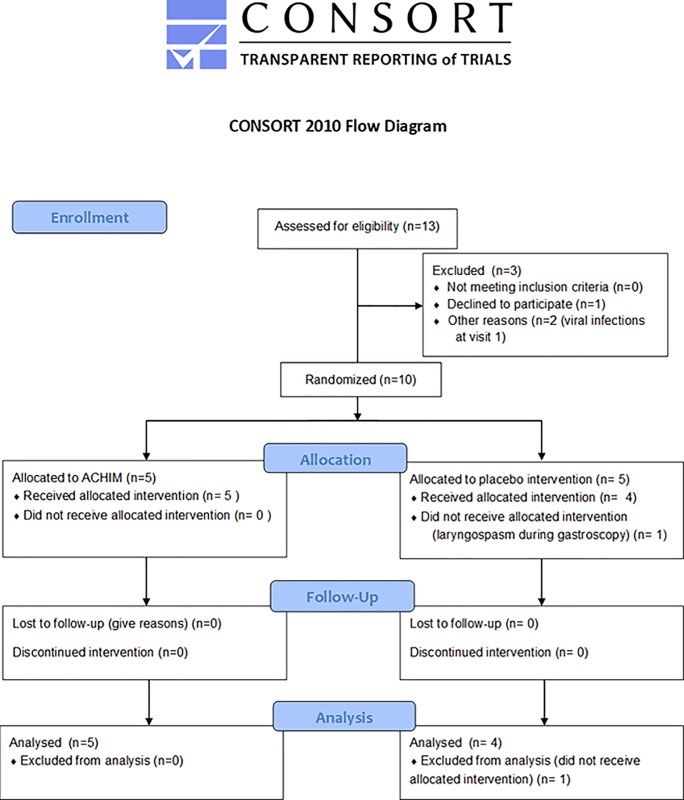
Fig 1
Fig 1. CONSORT flow chart.
Fig 2
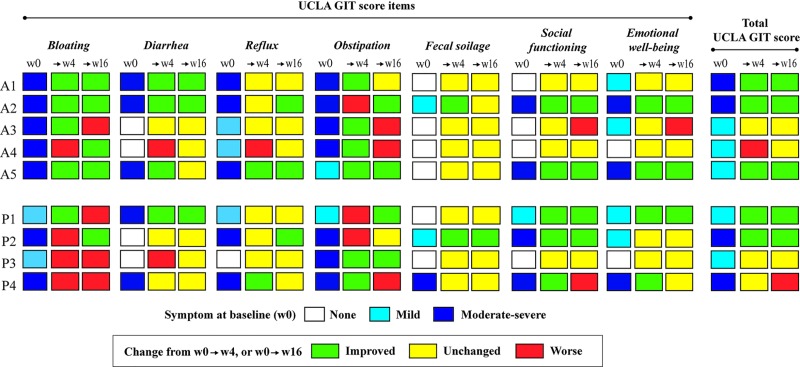
Fig 2. Clinical efficacy of fecal microbiota transplantation (FMT) on gastrointestinal (GI) symptoms.
Efficacy of FMT measured by the total UCLA GIT score and all seven items of the UCLA GIT score (bloating, diarrhea, reflux, obstipation, fecal soilage, social functioning and emotional well being). Patients receiving FMT (active treatment) marked as A and placebo marked as P. Symptoms at baseline (week 0; w0) are segregated into dark blue (moderate-severe), light blue (mild) and white (no) GI symptoms. Changes to week 4 and week 16 are marked in green (improved), yellow (stable) or red (worsening).
Fig 3
Fig 3. Changes in patient reported fecal incontinence.
Patient reported fecal incontinence was registered at week 0, 4, 8, 12 and 16 as an exploratory endpoint. Three patients in the FMT group (orange) had fecal incontinence at week 0, with restoration of incontinence at week 4. Two patients in the placebo group (blue) had fecal incontinence at week 0, with restoration of incontinence within week 4 in one patient.
Fig 4
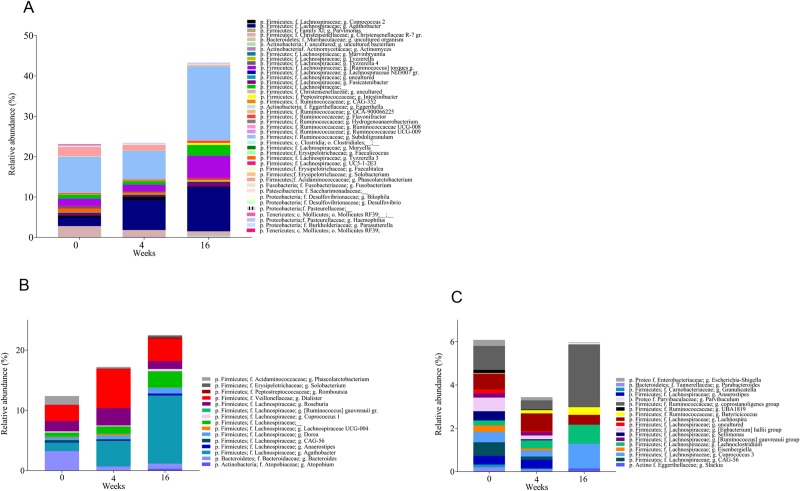
Fig 4. Relative abundance of total, IgA and IgM coated fecal bacteria in the FMT group.
Genera that showed increased relative abundance after FMT were predominantly within the Firmicutes phylum, including genera within the Ruminococcaceae and Lachnospiraceae families. At baseline, relative abundance of IgA and IgM coated fecal bacteria were similar in the FMT and placebo groups. IgA and IgM coating pattern at genera level changed from baseline to weeks 4 and 16 in the FMT group, while the placebo group showed stable relative abundances of these genera. A: Relative abundance of unsorted bacteria. Only bacteria with change (p<0.1) in relative abundance of unsorted bacteria from week 0–4 or week 0–16 are shown. B: Relative abundance of IgA coated bacteria. Only bacteria with changes (p<0.1) in relative abundance of IgA coating from week 0–4 or week 0–16 are shown. C: Relative abundance of IgM coated bacteria. Only bacteria with change (p<0.1) in relative abundance of IgM coating from week 0–4 or week 0–16 are shown.

References

    1. Denton CP, Khanna D. Systemic sclerosis. The Lancet. 2017;390(10103):1685–99. 10.1016/S0140-6736(17)30933-9 - DOI - PubMed
    1. Thoua NM, Bunce C, Brough G, Forbes A, Emmanuel AV, Denton CP. Assessment of gastrointestinal symptoms in patients with systemic sclerosis in a UK tertiary referral centre. Rheumatology. 2010;49(9):1770–5. 10.1093/rheumatology/keq147 - DOI - PubMed
    1. Emmanuel A. Current management of the gastrointestinal complications of systemic sclerosis. Nature Reviews Gastroenterology & Hepatology. 2016;13:461 10.1038/nrgastro.2016.99 - DOI - PubMed
    1. Ebert EC. Esophageal Disease in Scleroderma. 2006;40(9):769–75. 10.1097/01.mcg.0000225549.19127.90 00004836-200610000-00002. - DOI - PubMed
    1. Thoua NM, Abdel-Halim M, Forbes A, Denton CP, Emmanuel AV. Fecal Incontinence in Systemic Sclerosis Is Secondary to Neuropathy. The American Journal Of Gastroenterology. 2011;107:597 10.1038/ajg.2011.399 - DOI - PubMed

Publication types