. 2020 May 21;16(5):e1008434.
doi: 10.1371/journal.ppat.1008434. eCollection 2020 May.

A viral journey to the brain: Current considerations and future developments

Affiliations

A viral journey to the brain: Current considerations and future developments

Nilda Vanesa Ayala-Nunez et al. PLoS Pathog. .
No abstract available


Conflict of interest statement

The authors have declared that no competing interests exist.

Figures
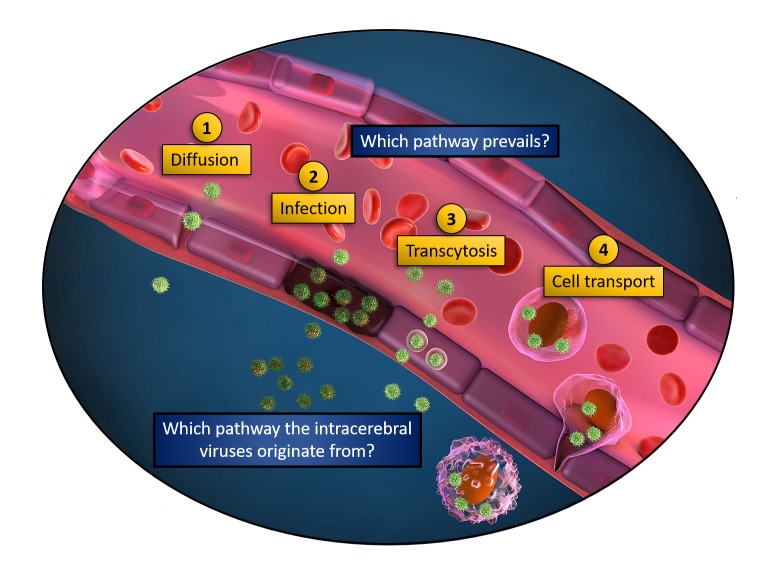
Fig 1
Fig 1. Ways viruses can use to cross the BBB.
Illustration of a blood vessel and the four nonexclusive ways viruses may employ to reach adjacent tissues: 1. Diffusion (passive-aggressive way): Viruses freely diffuse when endothelium integrity is altered. 2. Infection (energetic way): The endothelium is infected and viruses released on the other side. 3. Transcytosis (commuting way): The circulating virions are endocytosed by endothelial cells and exocytosed on the other side, in the absence of productive infection. 4. Cell transport (Trojan horse way): Leukocytes are carrying the circulating viruses through the endothelial cell wall. BBB, blood–-brain barrier.

References

    1. Mustafa YM, Meuren LM, Coelho SVA, de Arruda LB. Pathways Exploited by Flaviviruses to Counteract the Blood-Brain Barrier and Invade the Central Nervous System. Front Microbiol. 2019;10:525 Epub 2019/04/16. 10.3389/fmicb.2019.00525 - DOI - PMC - PubMed
    1. Santiago-Tirado FH, Doering TL. False friends: Phagocytes as Trojan horses in microbial brain infections. PLoS Pathog. 2017;13(12):e1006680 Epub 2017/12/15. 10.1371/journal.ppat.1006680 - DOI - PMC - PubMed
    1. Ludlow M, Kortekaas J, Herden C, Hoffmann B, Tappe D, Trebst C, et al. Neurotropic virus infections as the cause of immediate and delayed neuropathology. Acta Neuropathol. 2016;131(2):159–84. Epub 2015/12/15. 10.1007/s00401-015-1511-3 - DOI - PMC - PubMed
    1. Srikiatkhachorn A, Kelley JF. Endothelial cells in dengue hemorrhagic fever. Antiviral research. 2014;109:160–70. Epub 2014/07/16. 10.1016/j.antiviral.2014.07.005 - DOI - PMC - PubMed
    1. Ayala-Nunez NV, Follain G, Delalande F, Hirschler A, Partiot E, Hale GL, et al. Zika virus enhances monocyte adhesion and transmigration favoring viral dissemination to neural cells. Nature communications. 2019;10(1):4430 Epub 2019/09/29. 10.1038/s41467-019-12408-x - DOI - PMC - PubMed

Publication types

MeSH terms
