Review
. 2020 Oct;108(4):775-790.
doi: 10.1002/cpt.1909. Epub 2020 Jun 14.

Prioritization of Anti-SARS-Cov-2 Drug Repurposing Opportunities Based on Plasma and Target Site Concentrations Derived from their Established Human Pharmacokinetics

Affiliations
Review

Prioritization of Anti-SARS-Cov-2 Drug Repurposing Opportunities Based on Plasma and Target Site Concentrations Derived from their Established Human Pharmacokinetics

Usman Arshad et al. Clin Pharmacol Ther. 2020 Oct.

Erratum in

Abstract

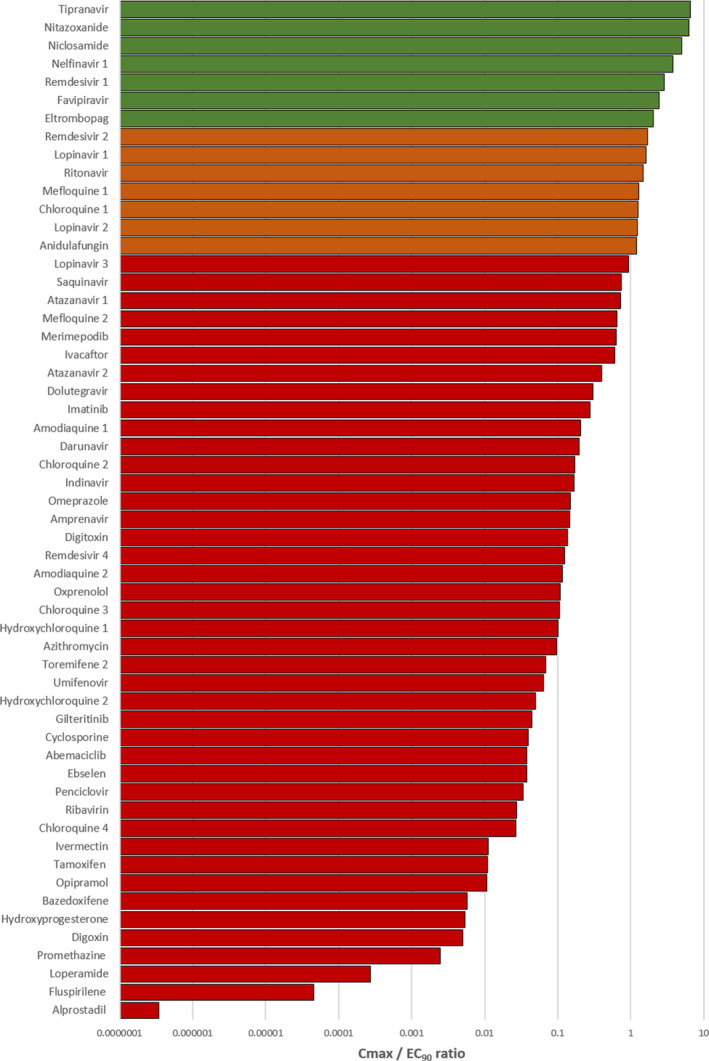
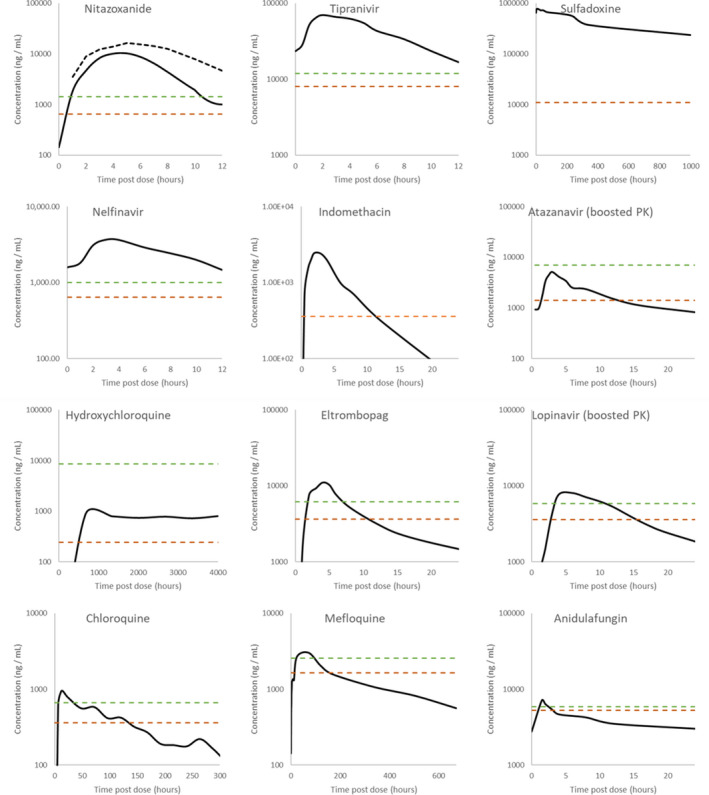
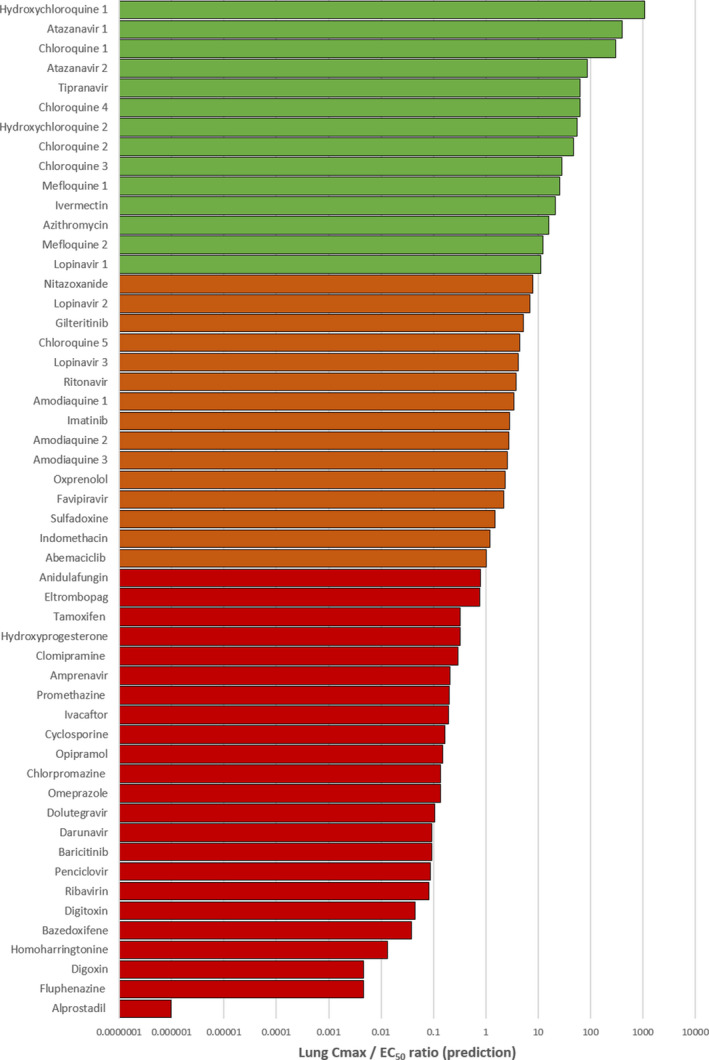
There is a rapidly expanding literature on the in vitro antiviral activity of drugs that may be repurposed for therapy or chemoprophylaxis against severe acute respiratory syndrome-coronavirus 2 (SARS-CoV-2). However, this has not been accompanied by a comprehensive evaluation of the target plasma and lung concentrations of these drugs following approved dosing in humans. Accordingly, concentration 90% (EC90 ) values recalculated from in vitro anti-SARS-CoV-2 activity data was expressed as a ratio to the achievable maximum plasma concentration (Cmax ) at an approved dose in humans (Cmax /EC90 ratio). Only 14 of the 56 analyzed drugs achieved a Cmax /EC90 ratio above 1. A more in-depth assessment demonstrated that only nitazoxanide, nelfinavir, tipranavir (ritonavir-boosted), and sulfadoxine achieved plasma concentrations above their reported anti-SARS-CoV-2 activity across their entire approved dosing interval. An unbound lung to plasma tissue partition coefficient (Kp Ulung ) was also simulated to derive a lung Cmax /half-maximal effective concentration (EC50 ) as a better indicator of potential human efficacy. Hydroxychloroquine, chloroquine, mefloquine, atazanavir (ritonavir-boosted), tipranavir (ritonavir-boosted), ivermectin, azithromycin, and lopinavir (ritonavir-boosted) were all predicted to achieve lung concentrations over 10-fold higher than their reported EC50 . Nitazoxanide and sulfadoxine also exceeded their reported EC50 by 7.8-fold and 1.5-fold in lung, respectively. This analysis may be used to select potential candidates for further clinical testing, while deprioritizing compounds unlikely to attain target concentrations for antiviral activity. Future studies should focus on EC90 values and discuss findings in the context of achievable exposures in humans, especially within target compartments, such as the lungs, in order to maximize the potential for success of proposed human clinical trials.


Conflict of interest statement

D.J.B. has received honoraria or advisory board payments from AbbVie, Gilead, ViiV, Merck, Janssen, and educational grants from AbbVie, Gilead, ViiV, Merck, Janssen, and Novartis. A.O. and S.P.R. are Directors of Tandem Nano Ltd. A.O. has received research funding from ViiV, Merck, Janssen, and consultancy from Gilead, ViiV and Merck not related to the current paper. P.O.N. is currently engaged in a collaboration with Romark LLC but this interaction did not influence the prioritization or conclusions in the current paper. All other authors declared no competing interests for this work.

Figures
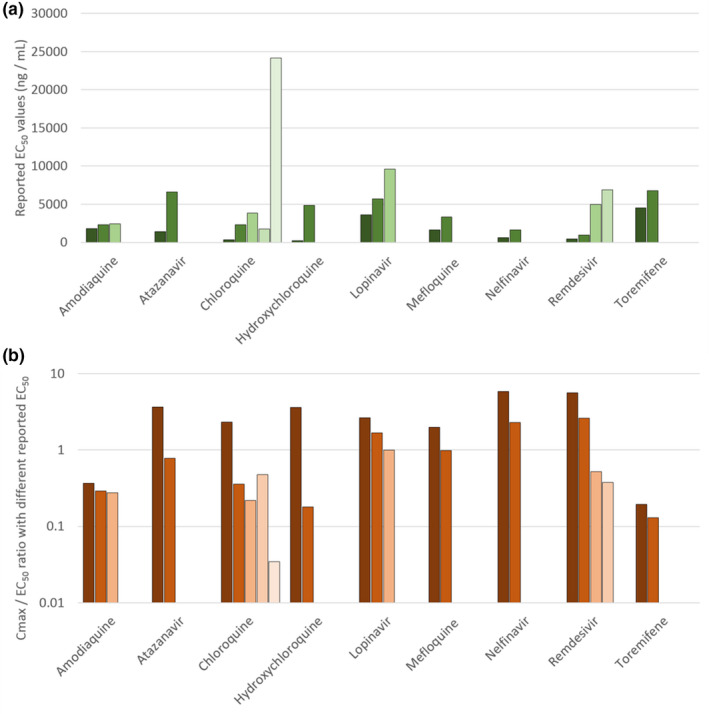
Figure 1
Figure 1
Assessment of the variation in reported half‐maximal effective concentration (EC50) values for severe acute respiratory syndrome‐coronavirus 2 across the drugs for which more than one value was available in the literature (a). The consequences of this variability in reported EC50 in terms of the peak plasma concentration (Cmax)/EC50 ratio is also provided (b). Amodiaquine and toremifene were estimated to exhibit subtherapeutic pharmacokinetics irrespective of which EC50 value was used. Similarly, nelfinavir was estimated to have Cmax value higher than its EC50 irrespective of which EC50 was used in the analysis. For the other drugs, interpretation was highly dependent upon which reported EC50 was utilised and this underscores the caution that should be taken in interpreting the available data.
Figure 2
Figure 2
A bar chart displaying peak plasma concentration (Cmax)/effective concentration 90% (EC90) ratio for compounds studied for in vitro antiviral activity against severe acute respiratory syndrome‐coronavirus 2 for which data were available to recalculate an EC90. Drugs with a ratio below 1 were deemed not to provide plasma concentrations at their approved doses to exert sufficient systemic antiviral activity. Those drugs with a ratio above 1 (shown in orange) were deemed to have potential to provide plasma concentrations sufficient to exert at least some antiviral activity for at least some of their dosing interval at their approved dose. Drugs shown in green were predicted to exceed plasma concentrations over their EC90 by more than twofold.
Figure 3
Figure 3
Digitized pharmacokinetic (PK) interrogation of all drugs calculated to have a peak plasma concentration (Cmax)/half‐maximal effective concentration (EC50) ratio above 1. The lowest reported severe acute respiratory syndrome‐coronavirus 2 EC50 (dashed orange lines) and associated recalculated effective concentration 90% (EC90; dashed green lines) are also highlighted. References for the utilized data are nitazoxanide 500 mg b.i.d. and 1,000 mg b.i.d., tipranavir 500 mg b.i.d. with 200 mg ritonavir, sulfadoxine 1,500 mg with 75 mg pyrimethamine, nelfinavir 1,250 mg b.i.d., indomethacin 50 mg t.i.d., atazanavir 300 mg q.d. with 100 mg ritonavir, hydroxychloroquine 2,000 mg hydroxychloroquine sulfate/1,550 mg base administered over 3 days, eltrombopag 75 mg single dose, lopinavir 400 mg with 100 mg ritonavir, chloroquine 1,500 mg administered over 3 days, mefloquine 1,200 mg over 3 days, and anidulafungin 100 mg q.d. Robust PK data were unavailable for niclosamide 500 mg, ritonavir 600 mg, and merimepodib 300 mg in order to conduct this digitized interrogation of these molecules.
Figure 4
Figure 4
A bar chart displaying the simulated lung peak plasma concentration (Cmax)/half‐maximal effective concentration (EC50). Drugs with a ratio below 1 were deemed not to provide lung concentrations at their approved doses to exert sufficient pulmonary antiviral activity for treatment or prevention strategies. Those drugs with a ratio above 1 (shown in orange) were estimated to provide lung concentrations sufficient to exert at least some antiviral activity at their approved dose. Drugs shown in green were predicted to exceed lung concentrations over their EC50 by > 10‐fold.
Figure 5
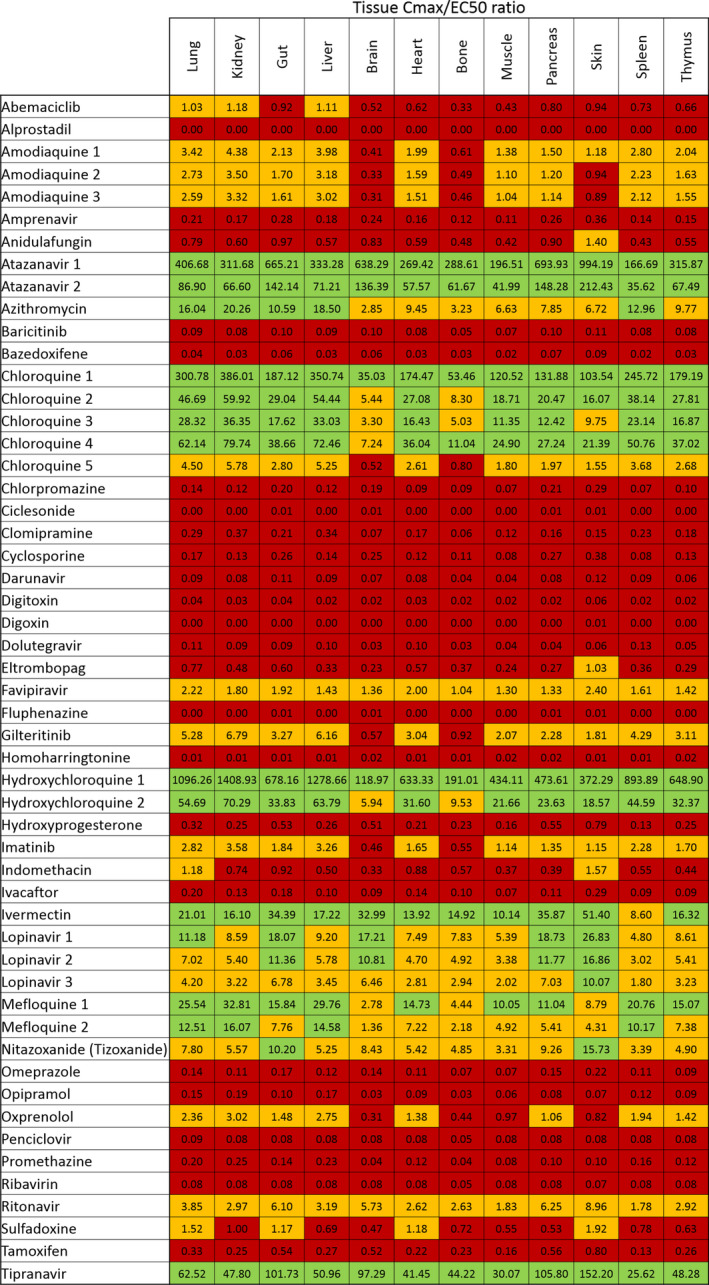
Figure 5
A heatmap displaying the simulated tissue peak plasma concentration (Cmax)/half‐maximal effective concentration (EC50) values for all drugs with available data. Those drugs with a ratio above 1 (shown in orange) were estimated to provide tissue concentrations sufficient to exert at least some antiviral activity at their approved dose. Drugs shown in green were predicted to exceed tissue concentrations over their EC50 by > 10‐fold.

References

    1. Gu, J. , Han, B. & Wang, J. COVID‐19: Gastrointestinal manifestations and potential fecal‐oral transmission. Gastroenterology 158, 1518–1519 (2020). - PMC - PubMed
    1. World Health Organisation . COVID‐19 Trials ‐ International Clinical Trials Registry Platform (ICTRP) <https://www.who.int/ictrp/search/en/> (2020).
    1. Qin, C. et al. Dysregulation of immune response in patients with COVID‐19 in Wuhan, China. Clin. Infect. Dis. 10.1093/cid/ciaa248. - DOI - PMC - PubMed
    1. Li, W. et al. Angiotensin‐converting enzyme 2 is a functional receptor for the SARS coronavirus. Nature 426, 450–454 (2003). - PMC - PubMed
    1. Zhao, Y. , Zhao, Z. , Wang, Y. , Zhou, Y. , Ma, Y. & Zuo, W. Single‐cell RNA expression profiling of ACE2, the receptor of SARS‐CoV‐2. J bioRxiv. 10.1101/2020.01.26.919985. - DOI - PMC - PubMed

Publication types

Substances