Review
. 2020 Oct 1;1866(10):165841.
doi: 10.1016/j.bbadis.2020.165841. Epub 2020 May 19.

Reprogramming of serine, glycine and one-carbon metabolism in cancer

Affiliations
Review

Reprogramming of serine, glycine and one-carbon metabolism in cancer

Albert M Li et al. Biochim Biophys Acta Mol Basis Dis. .

Abstract

Metabolic pathways leading to the synthesis, uptake, and usage of the nonessential amino acid serine are frequently amplified in cancer. Serine encounters diverse fates in cancer cells, including being charged onto tRNAs for protein synthesis, providing head groups for sphingolipid and phospholipid synthesis, and serving as a precursor for cellular glycine and one-carbon units, which are necessary for nucleotide synthesis and methionine cycle reloading. This review will focus on the participation of serine and glycine in the mitochondrial one-carbon (SGOC) pathway during cancer progression, with an emphasis on the genetic and epigenetic determinants that drive SGOC gene expression. We will discuss recently elucidated roles for SGOC metabolism in nucleotide synthesis, redox balance, mitochondrial function, and epigenetic modifications. Finally, therapeutic considerations for targeting SGOC metabolism in the clinic will be discussed.

Keywords: Cancer; Glycine; Metabolism; Mitochondria; One-carbon; Serine.


Conflict of interest statement

Declaration of competing interest The authors declare that they have no known competing financial interests or personal relationships that could have appeared to influence the work reported in this paper.

Figures
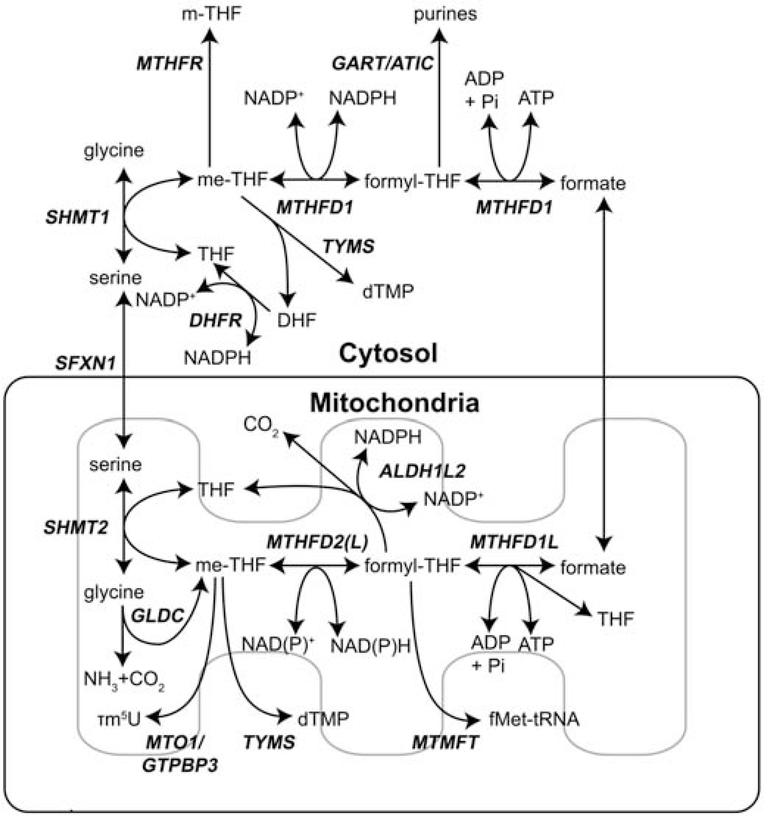
Figure 1.
Figure 1.. Cytosolic and mitochondrial folate-mediated serine, glycine, and one-carbon cycle.
Serine, and to a lesser extent glycine, provides 1C precursors for biosynthesis in the cytosol and mitochondria. Flux through either branch also maintains redox homeostasis through NAD(P)H consumption or generation. Important enzymes are highlighted in bold and italicized.
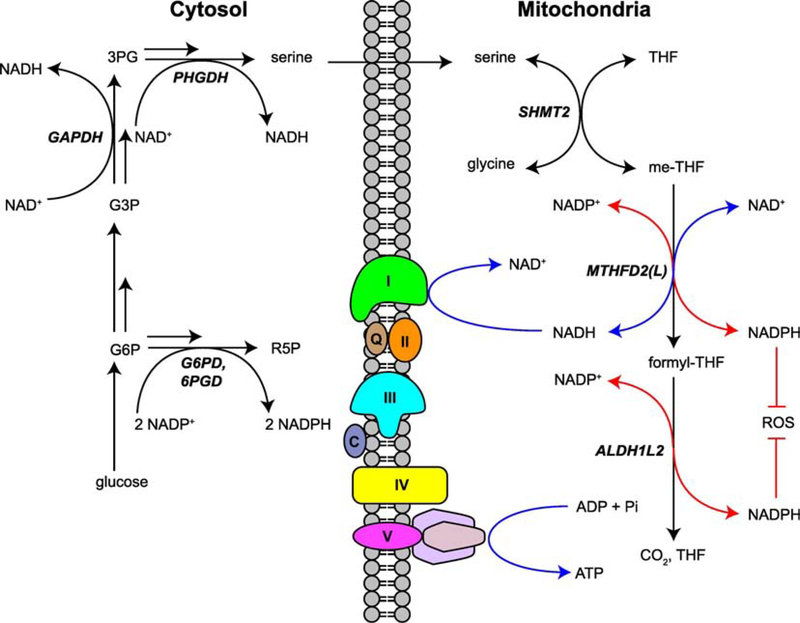
Figure 2.
Figure 2.. Mitochondrial serine catabolism contributes to shifting NADH and NADPH levels.
Serine catabolism through the mitochondrial folate cycle contributes substantial amounts of NADPH and NADH, particularly under stress conditions such as respiration deficiency. NADH production may be intimately tied to energy production through coupling of MTHFD2(L)-derived NADH to the electron transport chain, which produces ATP. Electron transport chain complexes I, II, III, IV, V are denoted by their respective Roman numerals, and the mobile electron carriers ubiquinone and cytochrome C by Q and C, respectively. Only the inner membrane is shown. NADPH produced by either MTHFD2(L) or ALDH1L2 may be crucial to controlling ROS accumulation. An analogy to cytoplasmic pathways that produce NADH and NADPH from glucose (either through glycolysis or shunt pathways) is provided.
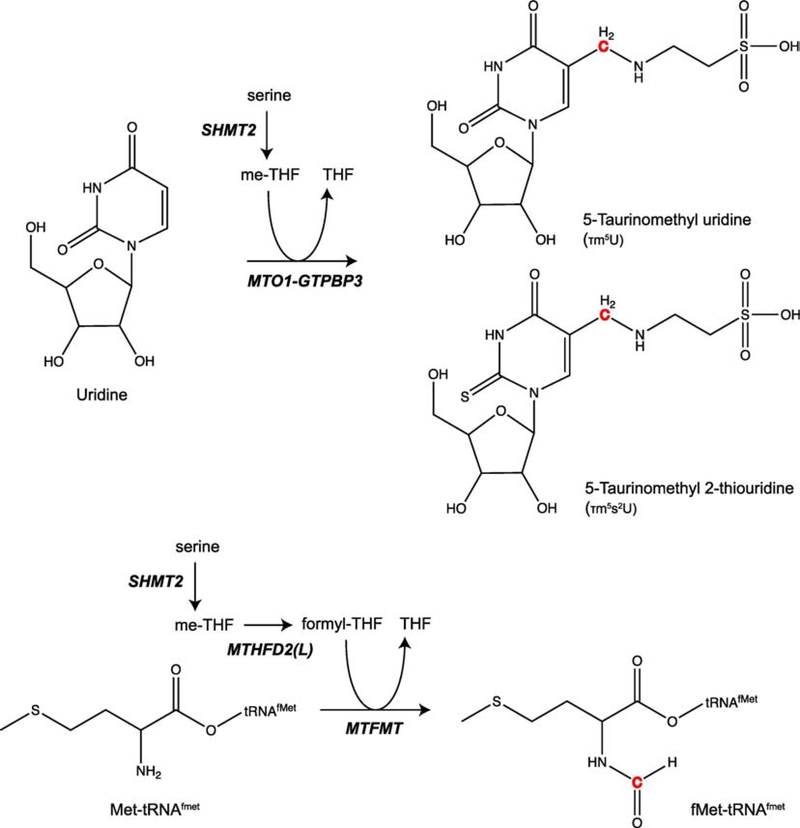
Figure 3.
Figure 3.. Mechanism of tRNA modification from products of either SHMT2 or MTHFD2(L) activity.
5,10-methylene-THF (me-THF) produced by SHMT2 is used as a substrate by the enzyme complex of MTO1 and GTPBP3 to generate the 5-taurinomethyl modification on uridine, producing either 5-taurinomethyl uridine or its derivative 5-taurionmethyl 2-thiouridine. 10-formyl-THF (formyl-THF) produced by MTHFD2(L), downstream of SHMT2 production of me-THF, is used as a substrate by MTMFT to formylate methionine on formyl-methionine tRNAs (tRNAMet), the tRNAs used to initiate mitochondrial protein translation. The 1C unit contribution to each respective modification from either me-THF or formyl-THF is highlighted in red.
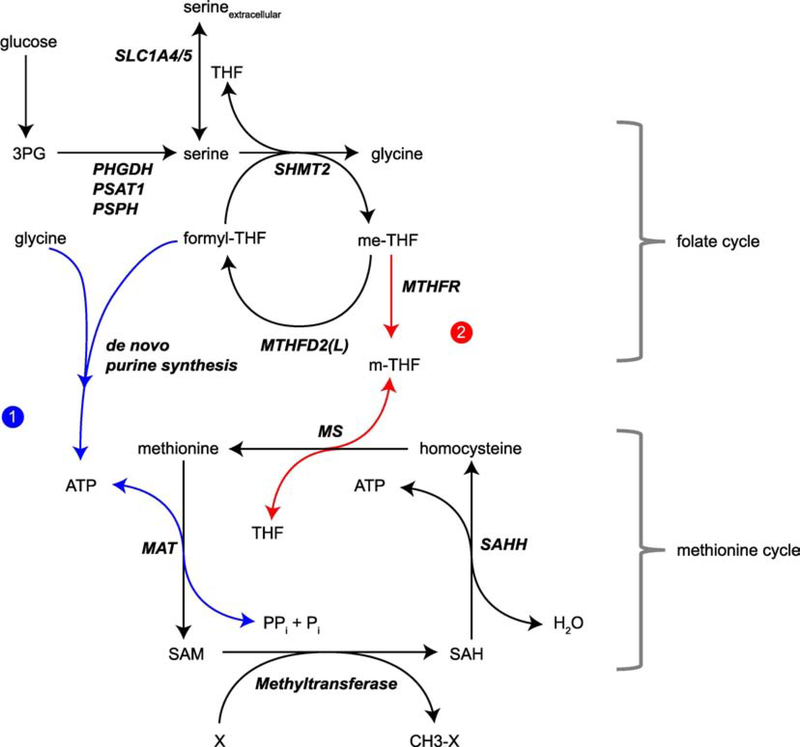
Figure 4.
Figure 4.. The folate cycle is coupled to the methionine cycle through distinct mechanisms.
The products of serine, either transported into the cell or synthesized from glucose de novo, contributes to SAM generation in two ways. Under normal culture conditions with sufficient methionine, the serine catabolism products glycine and formyl-THF support SAM synthesis through ATP (pathway 1, in blue). In the absence of methionine, serine becomes the crucial 1C donor for the re-methylation of methionine from homocysteine (pathway 2, in red).

References

    1. Agarwal S, Behring M, Hale K, Al Diffalha S, Wang K, Manne U, and Varambally S (2019). MTHFD1L, A Folate Cycle Enzyme, Is Involved in Progression of Colorectal Cancer. Transl Oncol 12, 1461–1467. - PMC - PubMed
    1. Alvarez SW, Sviderskiy VO, Terzi EM, Papagiannakopoulos T, Moreira AL, Adams S, Sabatini DM, Birsoy K, and Possemato R (2017). NFS1 undergoes positive selection in lung tumours and protects cells from ferroptosis. Nature 551, 639–643. - PMC - PubMed
    1. Anastasiou D, Poulogiannis G, Asara JM, Boxer MB, Jiang JK, Shen M, Bellinger G, Sasaki AT, Locasale JW, Auld DS, et al. (2011). Inhibition of pyruvate kinase M2 by reactive oxygen species contributes to cellular antioxidant responses. Science 334, 1278–1283. - PMC - PubMed
    1. Anderson DD, Quintero CM, and Stover PJ (2011). Identification of a de novo thymidylate biosynthesis pathway in mammalian mitochondria. Proc Natl Acad Sci U S A 108, 15163–15168. - PMC - PubMed
    1. Anderson DD, Woeller CF, Chiang EP, Shane B, and Stover PJ (2012). Serine hydroxymethyltransferase anchors de novo thymidylate synthesis pathway to nuclear lamina for DNA synthesis. J Biol Chem 287, 7051–7062. - PMC - PubMed

Publication types