


Reflux symptoms and oesophageal acidification in treated achalasia patients are often not reflux related
- PMID: 32439713
- PMCID: PMC7788183
- DOI: 10.1136/gutjnl-2020-320772
Reflux symptoms and oesophageal acidification in treated achalasia patients are often not reflux related
Abstract
Objective: After treatment, achalasia patients often develop reflux symptoms. Aim of this case-control study was to investigate mechanisms underlying reflux symptoms in treated achalasia patients by analysing oesophageal function, acidification patterns and symptom perception.
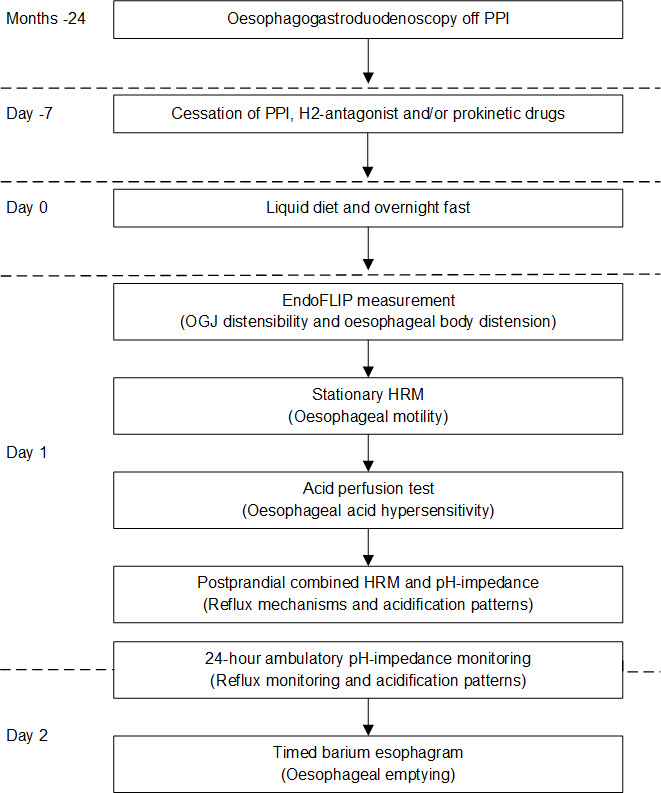
Design: Forty treated achalasia patients (mean age 52.9 years; 27 (68%) men) were included, 20 patients with reflux symptoms (RS+; Gastro-Oesophageal Reflux Disease Questionnaire (GORDQ) ≥8) and 20 without reflux symptoms (RS-: GORDQ <8). Patients underwent measurements of oesophagogastric junction distensibility, high-resolution manometry, timed barium oesophagogram, 24 hours pH-impedance monitoring off acid-suppression and oesophageal perception for acid perfusion and distension. Presence of oesophagitis was assessed endoscopically.
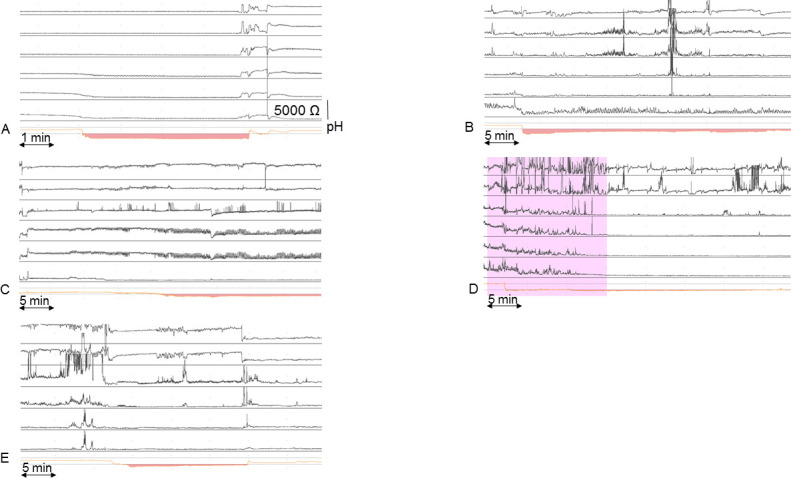
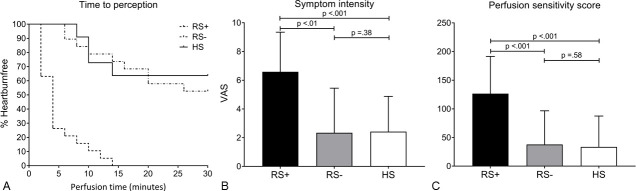
Results: Total acid exposure time during 24 hours pH-impedance was not significantly different between patients with (RS+) and without (RS-) reflux symptoms. In RS+ patients, acid fermentation was higher than in RS- patients (RS+: mean 6.6% (95% CI 2.96% to 10.2%) vs RS-: 1.8% (95% CI -0.45% to 4.1%, p=0.03) as well as acid reflux with delayed clearance (RS+: 6% (95% CI 0.94% to 11%) vs RS-: 3.4% (95% CI -0.34% to 7.18%), p=0.051). Reflux symptoms were not related to acid in both groups, reflected by a low Symptom Index. RS+ patients were highly hypersensitive to acid, with a much shorter time to heartburn perception (RS+: 4 (2-6) vs RS-:30 (14-30) min, p<0.001) and a much higher symptom intensity (RS+: 7 (4.8-9) vs RS-: 0.5 (0-4.5) Visual Analogue Scale, p<0.001) during acid perfusion. They also had a lower threshold for mechanical stimulation.
Conclusion: Reflux symptoms in treated achalasia are rarely caused by gastro-oesophageal reflux and most instances of oesophageal acidification are not reflux related. Instead, achalasia patients with post-treatment reflux symptoms demonstrate oesophageal hypersensitivity to chemical and mechanical stimuli, which may determine symptom generation.
Keywords: achalasia; gastroesophageal reflux disease; oesophageal motility disorder; oesophageal ph monitoring; visceral hypersensitivity.
© Author(s) (or their employer(s)) 2021. Re-use permitted under CC BY. Published by BMJ.
Conflict of interest statement
Competing interests: FAP: None. JMO: Received speaker and/or consulting fees from Laborie. AJS: None. AJB: Received research funding from Nutricia, Norgine and Bayer and received speaker and/or consulting fees from Laborie, EsoCap, Diversatek, Medtronic, Falk Pharma, Calypso Biotech, Thelial, Robarts, Reckett Benkiser, Regeneron, Celgene, Bayer, Norgine, AstraZeneca, Almirall, Arena and Allergan.
Figures
References
Publication types
MeSH terms
LinkOut - more resources
Full Text Sources
Medical
