. 2020 Jul 10;295(28):9583-9595.
doi: 10.1074/jbc.RA119.011844. Epub 2020 May 21.

Role of the trigger loop in translesion RNA synthesis by bacterial RNA polymerase

Affiliations

Role of the trigger loop in translesion RNA synthesis by bacterial RNA polymerase

Aleksei Agapov et al. J Biol Chem. .

Abstract

DNA lesions can severely compromise transcription and block RNA synthesis by RNA polymerase (RNAP), leading to subsequent recruitment of DNA repair factors to the stalled transcription complex. Recent structural studies have uncovered molecular interactions of several DNA lesions within the transcription elongation complex. However, little is known about the role of key elements of the RNAP active site in translesion transcription. Here, using recombinantly expressed proteins, in vitro transcription, kinetic analyses, and in vivo cell viability assays, we report that point amino acid substitutions in the trigger loop, a flexible element of the active site involved in nucleotide addition, can stimulate translesion RNA synthesis by Escherichia coli RNAP without altering the fidelity of nucleotide incorporation. We show that these substitutions also decrease transcriptional pausing and strongly affect the nucleotide addition cycle of RNAP by increasing the rate of nucleotide addition but also decreasing the rate of translocation. The secondary channel factors DksA and GreA modulated translesion transcription by RNAP, depending on changes in the trigger loop structure. We observed that although the mutant RNAPs stimulate translesion synthesis, their expression is toxic in vivo, especially under stress conditions. We conclude that the efficiency of translesion transcription can be significantly modulated by mutations affecting the conformational dynamics of the active site of RNAP, with potential effects on cellular stress responses and survival.

Keywords: DNA damage; DNA repair; DksA; GreA; RNA; RNA polymerase; RNA polymerase (RNAP); nucleotide excision repair (NER); secondary channel factor; transcription; transcription-coupled repair; translesion transcription; trigger loop.


Conflict of interest statement

Conflict of interest—The authors declare that they have no conflicts of interest with the contents of this article.

Figures

Figure 1.
Figure 1.
Structure of the RNAP active site and conformational changes in the TL during nucleotide addition. A, structure of the TEC of T. thermophilus RNAP with partially folded TL and NTP bound in the preinsertion state (complex with streptolydigin, not shown here; Protein Data Bank code 2PPB) (75). B, structure of the TEC with fully folded TL and NTP bound in the catalytically competent conformation (Protein Data Bank code 2O5J) (75). Catalytic Mg2+ ions are shown as pink spheres; the TL and bridge helix (BH) are blue and turquoise, respectively. The positions of the G1136M and I937T substitutions are indicated (correspond to Gln1254 and Thr1243 in the T. thermophilus RNAP structure). The position of the SI3 insertion in E. coli RNAP is shown with a gray sphere (located in a disordered TL region in the preinsertion complex structure).
Figure 2.
Figure 2.
Transcription of damaged and control DNA templates by the WT and mutant RNAP variants. The structures of nucleic-acid scaffolds used for the TEC assembly are shown in the top panels. Positions of damaged nucleotides and read-through RNA transcripts are indicated. A, CPD and control TT templates (see the second replica in Fig. S2). B, εA and control A templates. C, AP site and control T templates. Transcription was performed in the presence of ATP, GTP, and UTP (100 μm each) at either 37 °C (CPD and εA) or 25 °C (AP site). The reaction times were 10 s, 30 s, 1 min, 2 min, 4 min, 10 min, and 30 min for the AP site and 30 s, 1 min, 2 min, 4 min, 10 min, 30 min, and 60 min for CPD and εA.
Figure 3.
Figure 3.
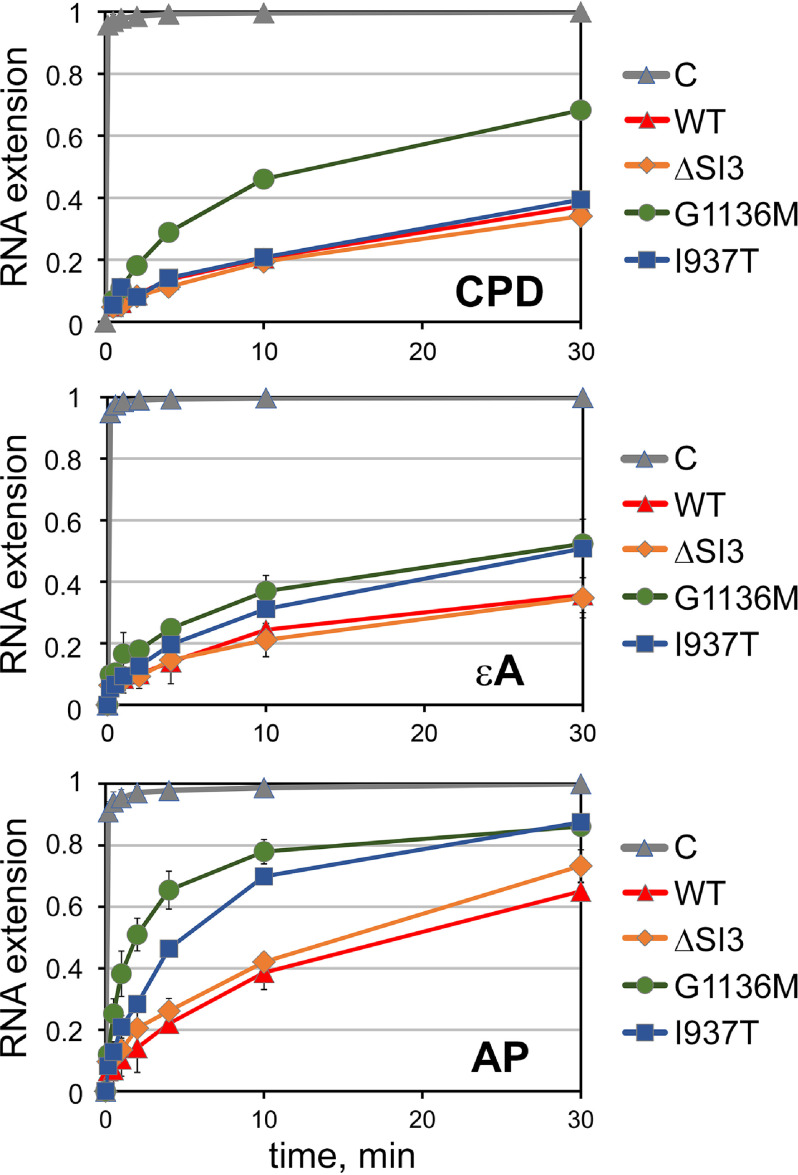
Kinetics of RNA extension by the WT and mutant RNAP variants opposite various DNA lesions. The efficiency of RNA extension at each time point is calculated as the ratio of all extended RNA products to the sum of all RNAs, including the starting 12-nt RNA oligonucleotide. The gray curves show the kinetics of RNA extension on control undamaged templates by WT RNAP. For both control and damaged templates, the data were normalized to the maximum RNA extension observed for corresponding undamaged templates at the 30-min time point. Means and standard deviations from two or three independent experiments are shown. For the CPD template, the calculation is shown only for the experiment from Fig. 2 (see Fig. S2 for the second replica). All kinetic plots are presented separately in Fig. S1.
Figure 4.
Figure 4.
Fidelity of nucleotide incorporation by WT and mutant RNAPs on damaged DNA templates. A, CPD template. B, εA template. C, AP template. For each template, the TECs were incubated with either all four (N) or each single NTP (A, G, U, and C; 100 μm) at 37 °C (CPD and εA) or 25 °C (AP site) for 3 min. The positions of the lesions in each template are indicated with arrowheads. The overall efficiency of RNA extension, calculated as the ratio of extended RNA products to the sum of all RNAs in the reaction normalized by RNA extension in the presence of all four NTPs, is shown below each lane (means from three independent experiments).
Figure 5.
Figure 5.
Analysis of hairpin-dependent pausing by the WT, ΔSI3, and G1136M(ΔSI3) RNAPs. A, structure of the nucleic-acid scaffold used for analysis of his pausing. The positions of the starting 17-nt transcript, the paused 19-nt transcript, and the read-through 21-nt transcript are indicated. B, kinetics of RNA extension in TECs reconstituted at the his pause site. C, Quantification of the pausing kinetics. The pause t1/2 times for each RNAP are shown on the right (means from two or three independent experiments).
Figure 6.
Figure 6.
Analysis of the catalytic properties of the ΔSI3 and G1136M(ΔSI3) RNAPs. A, the nucleic-acid scaffold employed in the nucleotide addition/translocation assay. The guanine analog 6MI was initially positioned in the RNA:DNA hybrid eight nucleotides upstream of the RNA 3′-end. The 6-MI fluorescence was quenched by the neighboring base pairs in the initial TEC (state 1) and the pretranslocated TEC that formed following the nucleotide incorporation (state 2) but increases when the 6-MI relocates to the edge of the RNA:DNA hybrid upon translocation (state 3). The bridge helix (BH) and the lid loop (LL) are two structural elements of the β′ subunit that flank the RNA:DNA hybrid in the multisubunit RNAPs. B, the pretranslocated state was generated by rapid GMP addition, and the apparent translocation rate (the rate of relaxation to the equilibrium) was determined from the delay between the GMP addition (discrete time points) and the translocation curve (continuous time trace) using the irreversible two step model (schematics below the graph and also D). C, the completeness of translocation was assessed by extending the TEC with 2′-dGTP or 3′-dGTP in the presence of 0.5 mm CTP. The individual forward and backward translocation rates were then determined from the relaxation rate using the relationships presented below the graph. D, the kinetic parameters of the nucleotide addition cycle determined from the data in B and C.
Figure 7.
Figure 7.
Determination of the apparent Km values for NTP substrates on the CPD (A) and AP site (B) templates. The reactions were performed in reconstituted TECs formed with control or damaged templates with ΔSI3 or mutant G1137M(ΔSI3) and I937T(ΔSI3) RNAPs at increasing NTP concentrations. The efficiency of RNA extension was calculated and normalized to the maximum efficiency observed at the highest NTP concentration, and the data were fitted to a hyperbolic equation (means and standard deviations from three independent experiments).
Figure 8.
Figure 8.
Effects of DksA and ppGpp on RNA synthesis on the CPD template. A, analysis of the RNA extension products. The reactions were performed with either ΔSI3 or G1136M(ΔSI3) RNAPs for 10 s 1 min, 5 min, or 30 min at 37 °C; DksA and ppGpp were added to 2 and 200 μm, respectively. Positions of damaged nucleotides are indicated with arrowheads. B, quantification of the RNA extension efficiencies. For each time point, the relative amounts of starting RNA, RNA transcripts corresponding to the sites of lesion, and read-through RNAs are shown. The data are the means and standard deviations from three independent experiments.
Figure 9.
Figure 9.
Effects of the mutant rpoC alleles on cell viability in the MG1655 strain. Expression of the β′ subunit variants, ΔSI3 and G1136M(ΔSI3), was induced from a pBAD-based vector by arabinose, and the cells were grown under identical conditions and plated with serial dilutions, either without or with UV irradiation.

References

    1. Spivak G. (2016) Transcription-coupled repair: an update. Arch. Toxicol. 90, 2583–2594 10.1007/s00204-016-1820-x - DOI - PMC - PubMed
    1. Strick T. R., and Portman J. R. (2019) Transcription-coupled repair: from cells to single molecules and back again. J. Mol. Biol. 431, 4093–4102 10.1016/j.jmb.2019.05.040 - DOI - PubMed
    1. Pani B., and Nudler E. (2017) Mechanistic insights into transcription coupled DNA repair. DNA Repair 56, 42–50 10.1016/j.dnarep.2017.06.006 - DOI - PMC - PubMed
    1. Donahue B. A., Yin S., Taylor J. S., Reines D., and Hanawalt P. C. (1994) Transcript cleavage by RNA polymerase II arrested by a cyclobutane pyrimidine dimer in the DNA template. Proc. Natl. Acad. Sci. U.S.A. 91, 8502–8506 10.1073/pnas.91.18.8502 - DOI - PMC - PubMed
    1. Brueckner F., Hennecke U., Carell T., and Cramer P. (2007) CPD damage recognition by transcribing RNA polymerase II. Science 315, 859–862 10.1126/science.1135400 - DOI - PubMed

Publication types

MeSH terms

LinkOut - more resources