. 2020 May 21;10(1):8483.
doi: 10.1038/s41598-020-65436-9.

The impact of Hurricane Michael on longleaf pine habitats in Florida

Affiliations

The impact of Hurricane Michael on longleaf pine habitats in Florida

Nicole E Zampieri et al. Sci Rep. .

Abstract

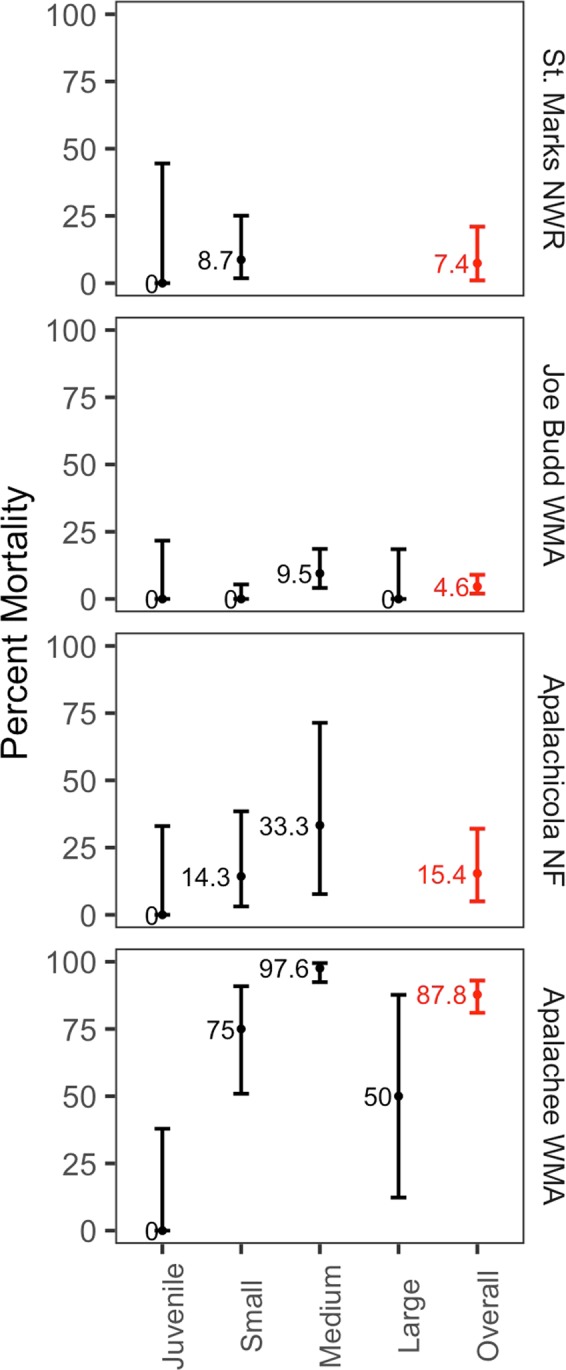
Global biodiversity hotspots (GBHs) are increasingly vulnerable to human stressors such as anthropogenic climate change, which will alter the ecology of these habitats, even where protected. The longleaf pine (Pinus palustris) ecosystem (LPE) of the North American Coastal Plain is a GBH where disturbances are integral for ecosystem maintenance. However, stronger storms due to climate change may be outside their historical norm. In this study, we estimate the extent of Florida LPE that was directly affected by Hurricane Michael in 2018, an unprecedented Category 5 storm. We then leveraged a unique data set in a Before-After study of four sites within this region. We used variable-area transects and generalized linear mixed-effects models to estimate tree densities and logistic regression to estimate mortality by size class. We found at least 28% of the global total remaining extent of LPE was affected in Florida alone. Mortality was highest in medium sized trees (30-45 cm dbh) and ranged from 4.6-15.4% at sites further from the storm center, but increased to 87.8% near the storm center. As the frequency and intensity of extreme events increases, management plans to mitigate climate change need to account for large-scale stochastic mortality events to preserve critical habitats.


Conflict of interest statement

The authors declare no competing interests.

Figures

Figure 1
Figure 1
Map of study sites and storm coverage. Hurricane Michael made landfall as a Category 5 hurricane on October 10th, 2018 near Mexico Beach, FL, USA. Maximum sustained winds at landfall were approximately 257 km/h and minimum barometric pressure was 919 mb. Hurricane-force winds extended outward from the center up to 75 km and tropical storm force winds extended outward up to 280 km,. The four study sites in the Florida Panhandle in the path of Hurricane Michael include: Apalachee WMA, Joe Budd WMA, Apalachicola NF, and St. Marks NWR. The “known” longleaf pine habitat is extracted from the LPEGDB. Map created in ArcMap 10.6.1.
Figure 2
Figure 2
Pre- and post-hurricane living and dead tree density frequency histogram. (a) Histograms of pre- and post- hurricane living tree densities from each cell in all plots show the most dramatic change in tree density at Apalachee WMA, whereas other sites show less change or no detectable change. Group means of living tree density are indicated by dashed lines. Each site is scaled on a different x-axis for clearer visualization. Sites are listed in order of decreasing distance to the storm center. (b) Histograms of dead tree densities from each cell in all plots at all sites post-hurricane. The mean overall dead tree densities are indicated by dashed lines.
Figure 3
Figure 3
Estimated longleaf pine mortality by size class. We estimated site level mortality (overall and by size class) using logistic regression. Estimated mean percent mortality value for each size class and overall is indicated on the plots. Overall percent mortality at each site is in red. 95% confidence intervals are presented in the error bars. Sites are listed in order of decreasing distance to the storm center. Trees that were partially uprooted, uprooted, snapped, or had canopy damage of >90% were used to estimate mortality. Size classes are as follows: juveniles (<15 cm dbh), small-mature (15–30 cm dbh), medium-mature (30–45 cm dbh), or large-mature (45 + cm dbh).
Figure 4
Figure 4
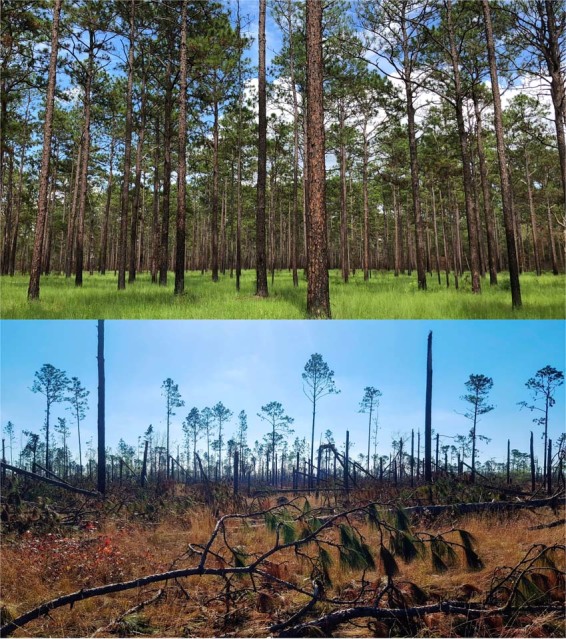
Apalachee WMA. Pre-hurricane, July 7th, 2018 (top, image: C. Anderson) and post-hurricane, December 1st, 2018 (bottom, image: N. Zampieri).

References

    1. Attiwill PM. The disturbance of forest ecosystems: the ecological basis for conservative management. For. Ecol. Manage. 1994;63:247–300.
    1. Folke C, et al. Regime Shifts, Resilience, and Biodiversity in Ecosystem Management. Annu. Rev. Ecol. Evol. Syst. 2004;35:557–581.
    1. Pickett, S. T. A. & White, P. S. The ecology of natural disturbance and patch dynamics. (Academic Press, INC.). 10.1016/b978-0-12-554520-4.50006-x, 1985
    1. Seidl R, et al. Forest disturbances under climate change. Nat. Clim. Chang. 2017;7:395–402. - PMC - PubMed
    1. Dale VH, et al. Climate Change and Forest Disturbances. Bioscience. 2001;51:723–734.

Publication types