


Thermodynamic Modeling of Calcium Sulfate Hydrates in a CaSO4-H2SO4-H2O System from 273.15 to 473.15 K up to 5 m Sulfuric Acid
- PMID: 32440025
- PMCID: PMC7233307
- DOI: 10.1021/acs.jced.9b00829
Thermodynamic Modeling of Calcium Sulfate Hydrates in a CaSO4-H2SO4-H2O System from 273.15 to 473.15 K up to 5 m Sulfuric Acid
Abstract
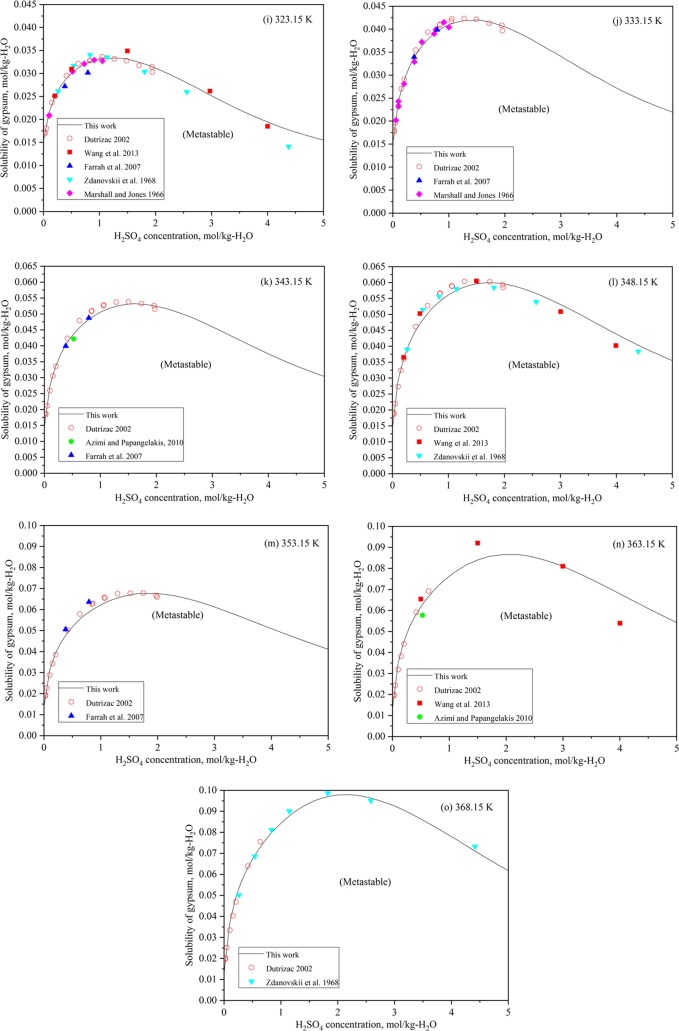
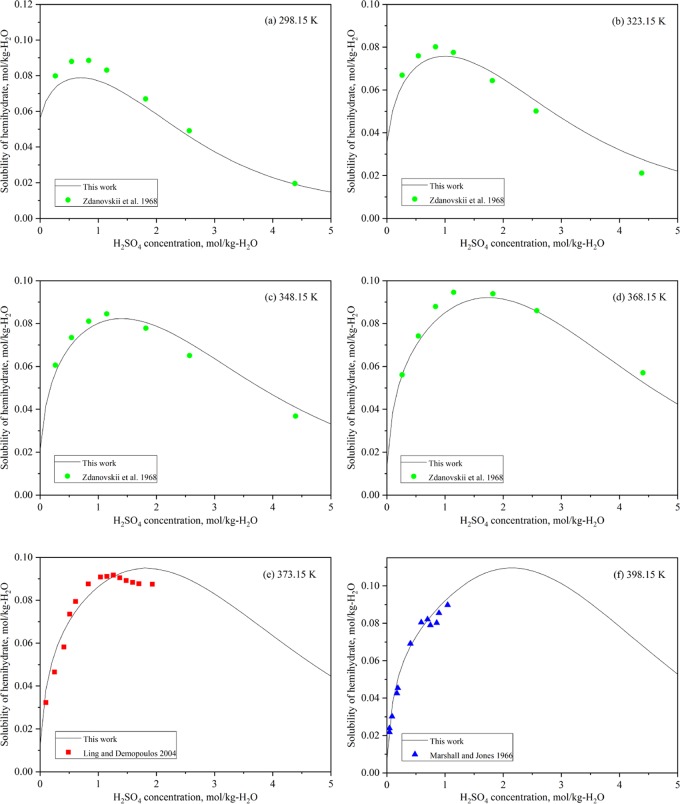
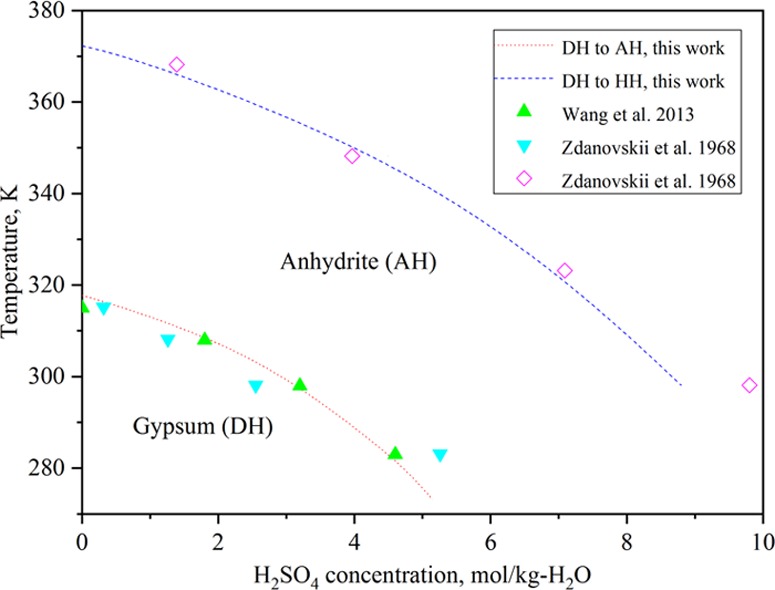
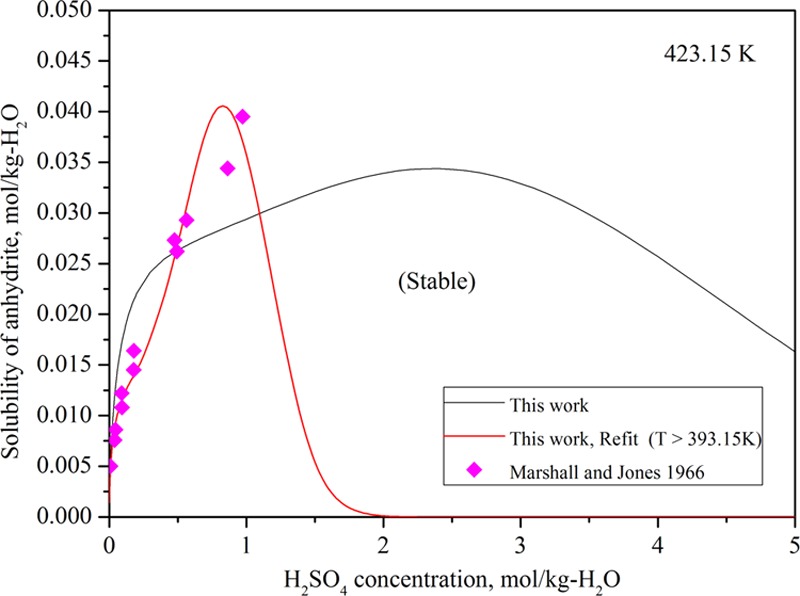
To prevent scaling and to recycle aqueous solutions in industrial processes, the thermodynamic properties of the CaSO4-H2SO4-H2O system are studied by thermodynamic modeling with the Pitzer model. The published solubility data of calcium sulfate hydrates in sulfuric acid solutions were collected and reviewed critically. Then, the CaSO4-H2SO4-H2O system was modeled using the Pitzer activity coefficient approach from critically selected experimental data to obtain optimized parameters. The model reproduces the solubility data with good accuracy up to 5 m sulfuric acid at temperatures of 283.15-368.15, 283.15-473.15, and 298.15-398.15 K for gypsum (CaSO4·2H2O), anhydrite (CaSO4), and hemihydrate (CaSO4·0.5H2O), respectively. However, at temperatures above 398.15 K and sulfuric acid concentration above 0.5 mol/kg, the solubility of anhydrite predicted by our model deviates significantly from the literature data. Our model predicts that the solubility of anhydrite would first increase but then decrease in more concentrated sulfuric acid solutions, which is in disagreement with the experimental data showing constantly increasing solubilities as a function of increasing sulfuric acid concentration. This discrepancy has been discussed. The transformations of gypsum to anhydrite and hemihydrate were predicted in sulfuric acid solutions. With increasing H2SO4 concentration, the transformation temperatures of gypsum to anhydrite and hemihydrate will decrease. Thus, gypsum is stable at low temperatures in solutions of low H2SO4 concentrations and transforms to anhydrite at high temperatures and in concentrated H2SO4 solutions, while hemihydrate is always a metastable phase. Furthermore, the predicted results were compared with previous experimental studies to verify the accuracy of the model.
Copyright © 2020 American Chemical Society.
Conflict of interest statement
The authors declare no competing financial interest.
Figures






References
-
- Azimi G.Evaluating the Potential of Scaling Due to Calcium Compounds in Hydrometallurgical Process. Ph.D. thesis, University of Toronto, 2010.
-
- Li X. B.; Shen L. T.; Qiu S. Z.; Peng Z. H.; Liu G. H.; Tian G. Q. Scheelite conversion in sulfuric acid together with tungsten extraction by ammonium carbonate solution. Hydrometallurgy 2017, 171, 106–115. 10.1016/j.hydromet.2017.05.005. - DOI
-
- Dutrizac J. E.; Kuiper A. The solubility of calcium sulphate in simulated copper sulphate electro-refining solutions. Hydrometallurgy 2008, 92, 54–68. 10.1016/j.hydromet.2008.01.004. - DOI
-
- Dutrizac J. E.; Kuiper A. The solubility of calcium sulphate in simulated nickel sulphate chloride processing solutions. Hydrometallurgy 2006, 82, 13–31. 10.1016/j.hydromet.2005.12.013. - DOI
-
- Dutrizac J. E. Calcium sulphate solubilities in simulated zinc processing solutions. Hydrometallurgy 2002, 65, 109–135. 10.1016/S0304-386X(02)00082-8. - DOI
LinkOut - more resources
Full Text Sources
Other Literature Sources