


Sarcopenia Is an Independent Risk Factor for NAFLD in COPD: A Nationwide Survey (KNHANES 2008-2011)
- PMID: 32440112
- PMCID: PMC7213902
- DOI: 10.2147/COPD.S249534
Sarcopenia Is an Independent Risk Factor for NAFLD in COPD: A Nationwide Survey (KNHANES 2008-2011)
Abstract
Background: Nonalcoholic fatty liver disease (NAFLD) is highly prevalent in patients with chronic obstructive pulmonary disease (COPD) and is independently associated with cardiometabolic comorbidities and systemic inflammation. Although several factors are associated with NAFLD, the influence of sarcopenia on NAFLD has not been fully determined in patients with COPD. We explored whether sarcopenia is associated with NAFLD in a COPD population.
Methods: Data from the Korean National Health and Nutrition Examination Surveys 2008-2011 were analyzed. The subjects were defined as having NAFLD when they had a hepatic steatosis index (HSI) score >36, which is a previously validated NAFLD prediction score. Sarcopenia_BMI (=total appendicular skeletal muscle mass [kg]/body mass index [kg/m2]), sarcopenia_BW (=total appendicular skeletal muscle mass [kg]/body weight [kg] × 100), and sarcopenia_height (= total appendicular skeletal muscle mass (kg)/height2 (m)) measured using dual-energy X-ray absorptiometry was used to diagnose sarcopenia.
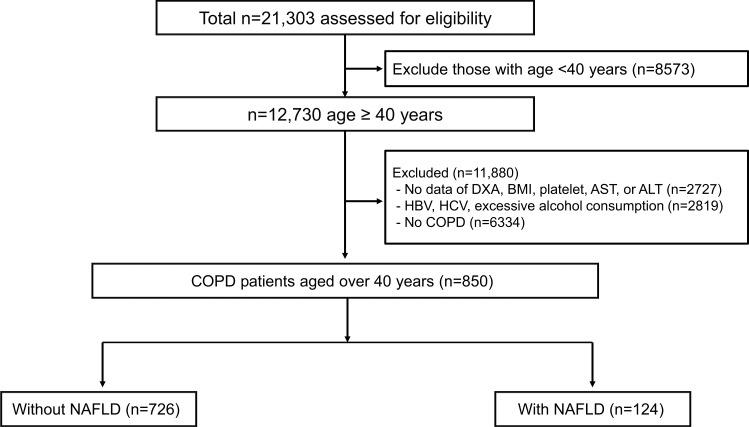
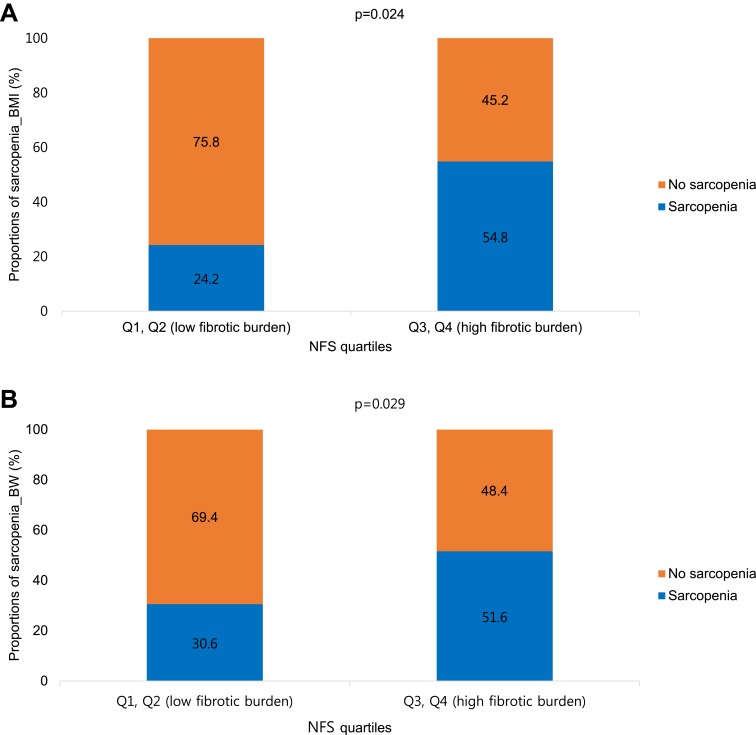
Results: NAFLD was identified in 124 (14.6%) of 850 COPD subjects using the HSI. Multivariable logistic analyses adjusted for age, sex, hypertension, diabetes mellitus (DM), forced vital capacity (FVC), and metabolic syndrome demonstrated that sarcopenia (sarcopenia_BMI, odds ratio [OR] = 1.95; 95% confidence interval [CI], 1.11-3.46, p = 0.022; sarcopenia_BW, OR = 2.25; 95% CI, 1.30-3.92, p = 0.004) was associated with NAFLD in patients with COPD. The proportion of sarcopenia_BMI was higher in patients with a high fibrotic burden from NAFLD (Q3, Q4) than in subjects with a low fibrotic burden from NALFD (Q1, Q2) (54.8% vs 24.2%, p = 0.024). The proportion of sarcopenia_BW was also higher in patients with a high fibrotic burden from NAFLD than in patients with a low fibrotic burden from NAFLD (51.6% vs 30.6%, p = 0.029).
Conclusion: Sarcopenia was associated with an increased risk for NAFLD in patients with COPD, independent of age, sex, lung function, and metabolic factors. Sarcopenic COPD was also associated with a high fibrotic burden in NAFLD patients. Pulmonologists should be aware of possible liver comorbidities in the sarcopenic COPD phenotype.
Keywords: COPD; NAFLD; sarcopenia.
© 2020 Hong et al.
Conflict of interest statement
The authors declare that they have no conflicts of interest.
Figures

References
-
- Chalasani N, Younossi Z, Lavine JE, et al. The diagnosis and management of non-alcoholic fatty liver disease: practice guideline by the American Association for the Study of Liver Diseases, American College of Gastroenterology, and the American Gastroenterological Association. Hepatology. 2012;55(6):2005–2023. doi:10.1002/hep.25762 - DOI - PubMed
MeSH terms
LinkOut - more resources
Full Text Sources
Medical
