


Quality of Life in Japanese Patients with Dysmenorrhea Treated with Ethinylestradiol 20 μg/Drospirenone 3 mg in a Real-World Setting: An Observational Study
- PMID: 32440228
- PMCID: PMC7210450
- DOI: 10.2147/IJWH.S238460
Quality of Life in Japanese Patients with Dysmenorrhea Treated with Ethinylestradiol 20 μg/Drospirenone 3 mg in a Real-World Setting: An Observational Study
Abstract
Background: Dysmenorrhea affects approximately 80% of women in Japan and has a negative impact on health-related quality of life (HRQoL). Low-dose estrogen/progestin combined oral contraceptives have been shown to reduce the severity of dysmenorrhea symptoms. This study characterized HRQoL in Japanese women with dysmenorrhea before and after ethinylestradiol/drospirenone (EE/DRSP) treatment.
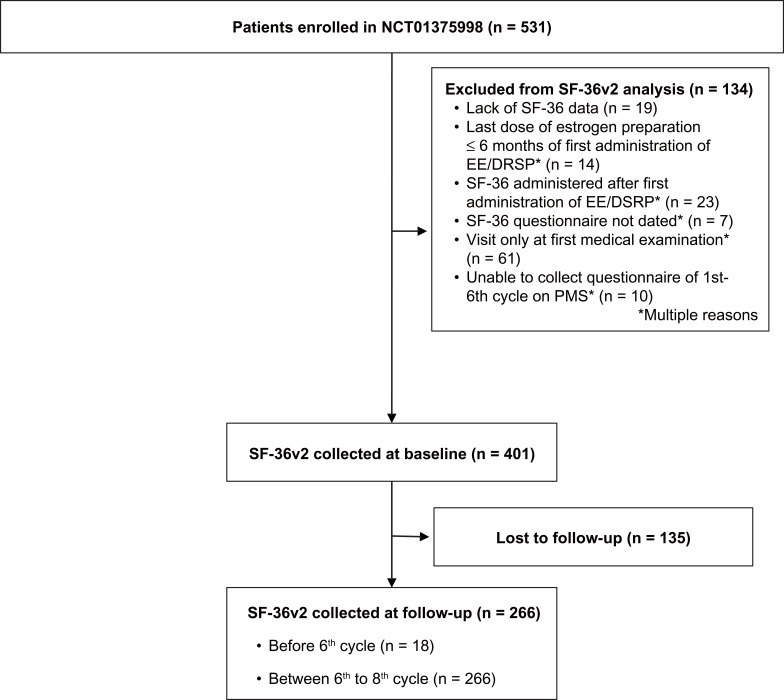
Methods: This prospective, observational study recruited 531 patients, of which 186 were evaluated after treatment with EE 20 μg/DRSP 3 mg for dysmenorrhea in a 24/4 cyclic regimen. The primary endpoints were mean baseline and post-treatment 36-Item Short-Form Health Survey version 2.0 (SF-36v2) scores for study patients compared with the general female population of Japan (calculated using norm-based scoring), and mean changes in study patient SF-36v2 scores between baseline and 6 to 8 treatment cycles.
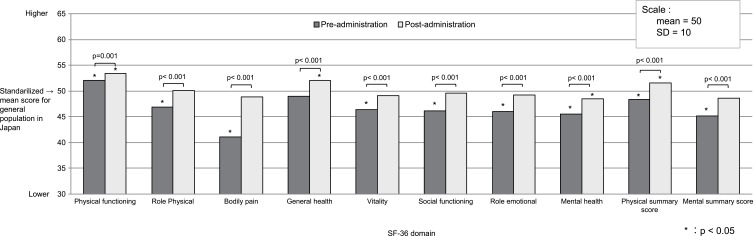
Results: Compared with Japanese norms, women with dysmenorrhea had lower pre-treatment SF-36v2 scores, except for the physical functioning domain. After 6-8 cycles of EE/DRSP treatment, all 8 SF-36v2 domain scores were significantly higher than baseline. The greatest improvements were observed in bodily pain and social functioning (mean change [standard deviation (SD)]: physical functioning: 1.4 [5.7], role physical: 3.2 [8.1], bodily pain: 7.8 [10.0], general health: 3.0 [7.0], vitality: 2.7 [8.1], social functioning: 3.5 [9.8], role emotional: 3.3 [9.2], and mental health: 3.0 [7.3]; p< 0.001 for all). Compared with the Japanese general population, study patients' post-treatment scores were significantly higher for the general health domain (p= 0.008) and physical summary scores (p= 0.033).
Conclusion: Dysmenorrhea has a profound impact on all aspects of functioning and well-being. This study, conducted in a real-world setting, found that physical, social, and mental HRQoL improved significantly after a cyclic regimen of EE/DRSP in Japanese patients with dysmenorrhea. This regimen may have the potential to provide an effective option to improve patient HRQoL.
Trial registration: Study sample was drawn from patients enrolled in a post-marketing surveillance study, registered June 20, 2011 (NCT01375998).
Keywords: Japan; SF-36; dysmenorrhea; ethinylestradiol/drospirenone; patient-reported outcomes; quality of life.
© 2020 Momoeda et al.
Conflict of interest statement
Mikio Momoeda was a paid medical advisor to Bayer Yakuhin, Ltd. for the duration of the study. Sayako Akiyama was an employee of Bayer Yakuhin, Ltd. at that time of the study. Kota Tanaka is an employee of EPS, which received funding from Bayer for the statistical analysis and reporting of study data. Yoshimi Suzukamo was a paid advisor on patient-reported outcome research to Bayer Yakuhin, Ltd. for the duration of the study. The authors report no other conflicts of interest in this work.
Figures
References
-
- Momoeda M, Kondo M, Elliesen J, Yasuda M, Yamamoto S, Harada T. Efficacy and safety of a flexible extended regimen of ethinylestradiol/drospirenone for the treatment of dysmenorrhea: a multicenter, randomized, open-label, active-controlled study. Int J Women's Health. 2017;9:295–305. doi: 10.2147/IJWH.S134576 - DOI - PMC - PubMed
Publication types
Associated data
LinkOut - more resources
Full Text Sources
Medical
