


Extubation and the Risks of Coughing and Laryngospasm in the Era of Coronavirus Disease-19 (COVID-19)
- PMID: 32440387
- PMCID: PMC7237060
- DOI: 10.7759/cureus.8196
Extubation and the Risks of Coughing and Laryngospasm in the Era of Coronavirus Disease-19 (COVID-19)
Abstract
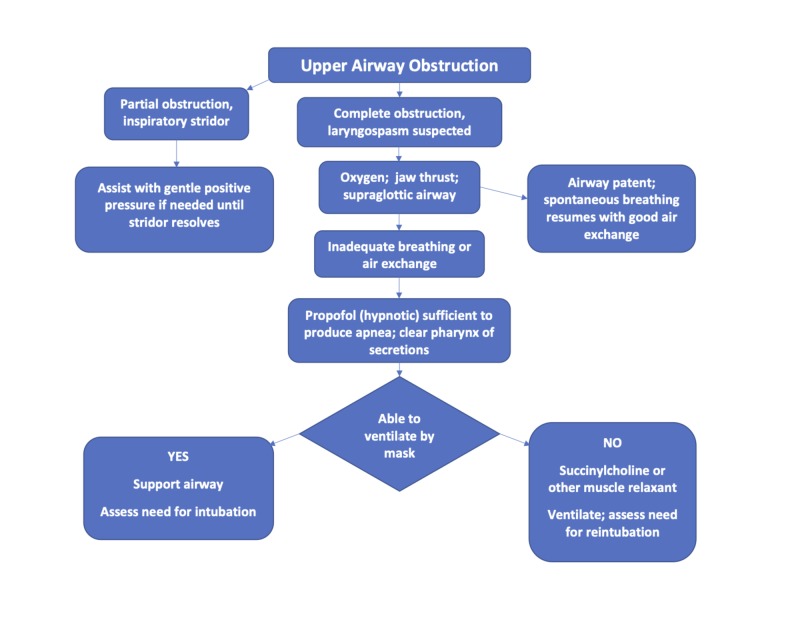
The coronavirus disease-19 (COVID-19) pandemic has prompted new interest among anesthesiologists and intensivists in controlling coughing and expectoration of potentially infectious aerosolized secretions during intubation and extubation. However, the fear of provoking laryngospasm may cause avoidance of deep or sedated extubation techniques which could reduce coughing and infection risk. This fear may be alleviated with clear understanding of the mechanisms and effective management of post-extubation airway obstruction including laryngospasm. We review the dynamic function of the larynx from the vantage point of head-and-neck surgery, highlighting two key concepts: 1. The larynx is a complex organ that may occlude reflexively at levels other than the true vocal folds; 2. The widely held belief that positive-pressure ventilation by mask can "break" laryngospasm is not supported by the otorhinolaryngology literature. We review the differential diagnosis of acute airway obstruction after extubation, discuss techniques for achieving smooth extubation with avoidance of coughing and expectoration of secretions, and recommend, on the basis of this review, a clinical pathway for optimal management of upper airway obstruction including laryngospasm to avoid adverse outcomes.
Keywords: aerosol-generating procedures; covid-19; deep extubation; extubation; functional anatomy of the larynx; laryngospasm; novel coronavirus; partial airway obstruction; stridor; upper airway obstruction.
Copyright © 2020, Sibert et al.
Conflict of interest statement
The authors have declared that no competing interests exist.
Figures


References
-
- Coronavirus disease 2019 (COVID-19): critical care and airway management issues. [Apr;2020 ];Anesi G. http://April 11, 2020 Up to Date Last updated April 10, 2020. 2020
-
- Pediatric perioperative cardiac arrest, death in the off hours: a report from Wake Up Safe, the Pediatric Quality Improvement Initiative. Christensen RE, Lee AC, Gowen MS, Rettiganti MR, Deshpande JK, Morray JP. Anesth Analg. 2018;127:472–477. - PubMed
-
- Negus V. New York, NY: Grune & Stratton; 1949. The Comparative Anatomy and Physiology of the Larynx.
-
- Cross-innervation of the thyroarytenoid muscle by a branch from the external division of the superior laryngeal nerve. Nasri S, Beizai P, Ye M, Sercarz JA, Kim YM, Berke GS. Ann Otol Rhinol Laryngol. 1997;106:594–598. - PubMed
-
- The pharyngeal plexus-mediated glottic closure response and associated neural connections of the plexus. Paskhover B, Wadie M, Sasaki CT. JAMA Otolaryngol Head Neck Surg. 2014;140:1056–1060. - PubMed