. 2020 Sep:213:107579.
doi: 10.1016/j.pharmthera.2020.107579. Epub 2020 May 19.

The proteasome as a druggable target with multiple therapeutic potentialities: Cutting and non-cutting edges

Affiliations

The proteasome as a druggable target with multiple therapeutic potentialities: Cutting and non-cutting edges

G R Tundo et al. Pharmacol Ther. 2020 Sep.

Abstract

Ubiquitin Proteasome System (UPS) is an adaptable and finely tuned system that sustains proteostasis network under a large variety of physiopathological conditions. Its dysregulation is often associated with the onset and progression of human diseases; hence, UPS modulation has emerged as a promising new avenue for the development of treatments of several relevant pathologies, such as cancer and neurodegeneration. The clinical interest in proteasome inhibition has considerably increased after the FDA approval in 2003 of bortezomib for relapsed/refractory multiple myeloma, which is now used in the front-line setting. Thereafter, two other proteasome inhibitors (carfilzomib and ixazomib), designed to overcome resistance to bortezomib, have been approved for treatment-experienced patients, and a variety of novel inhibitors are currently under preclinical and clinical investigation not only for haematological malignancies but also for solid tumours. However, since UPS collapse leads to toxic misfolded proteins accumulation, proteasome is attracting even more interest as a target for the care of neurodegenerative diseases, which are sustained by UPS impairment. Thus, conceptually, proteasome activation represents an innovative and largely unexplored target for drug development. According to a multidisciplinary approach, spanning from chemistry, biochemistry, molecular biology to pharmacology, this review will summarize the most recent available literature regarding different aspects of proteasome biology, focusing on structure, function and regulation of proteasome in physiological and pathological processes, mostly cancer and neurodegenerative diseases, connecting biochemical features and clinical studies of proteasome targeting drugs.

Keywords: Cancer; Neurodegeneration; Proteasome; Proteasome inhibitors; SARS-Cov-2.


Conflict of interest statement

Declaration of Competing Interest The authors declare that there are no conflicts of interest.

Figures
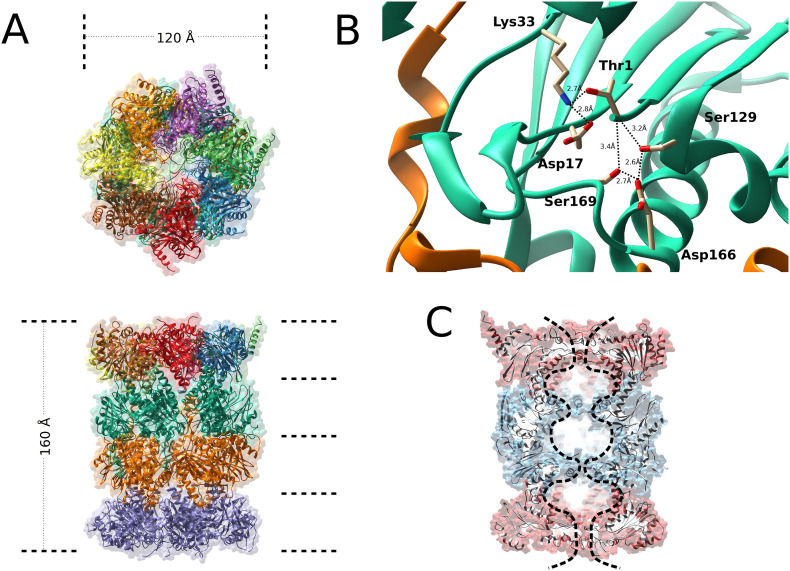
Fig. 1
Fig. 1
Structure of 20S. A. Structure of the 20S proteasome particle as viewed from the top (top panel) or the side (bottom panel). The protein backbone of the subunits is presented as ribbon. B. Active site of the threonine peptidase subunit (β5) of the proteasome. The protein backbone of the β5 subunit is represented as turquoise ribbon, catalytic residue (Thr1) and other residues that help to maintain the structural stability of the catalytic site (Lys33, Asp17, Ser129, Asp166 and Ser169) are represented as sticks. Polar interactions are indicated as black dashed lines together with the corresponding distances. C. Vertical cross-section of the 20S particle, the α-subunit rings are represented as red ribbons, the β-subunit rings as blue ribbons, the outline of the internal cavity and the internal “chambers” are highlighted with a black dashed line.
Fig. 2
Fig. 2
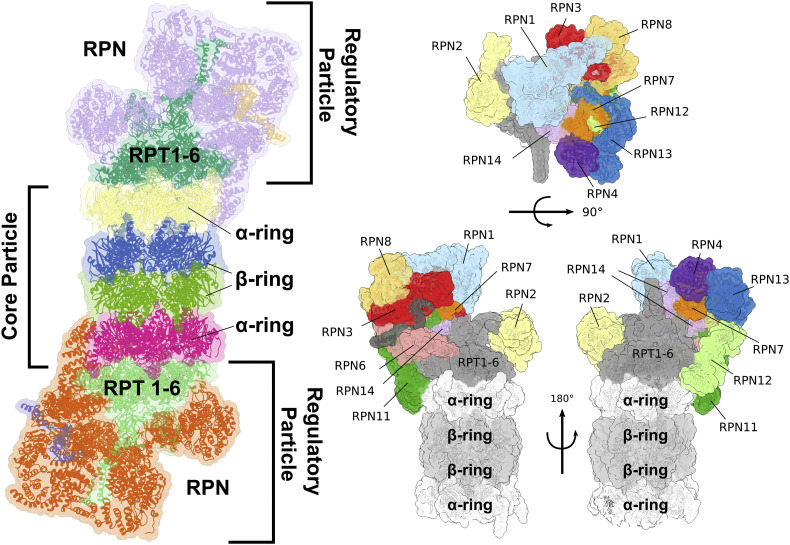
Overall organization of the proteasome 26S particle. Left: the “Core Particle” (20S proteasome) is represented as protein ribbons, in yellow and magenta the two α-subunit rings, in blue and green the two β-subunit rings. The two regulatory particles (19S proteasome), attached on both ends of the 20S particle, are represented as protein ribbons. The group of regulatory AAA-ATPases (Rpt1–6) are coloured in dark and pale green, the non-ATPase regulators (Rpn) are coloured in violet and orange. Right: close-up of the 26S regulatory particle with the various non-ATPase subunits highlighted and labelled. The particle is shown from various point of view: on the top panel it is shown from the top; on the lower panel two opposite side views are shown.
Fig. 3
Fig. 3
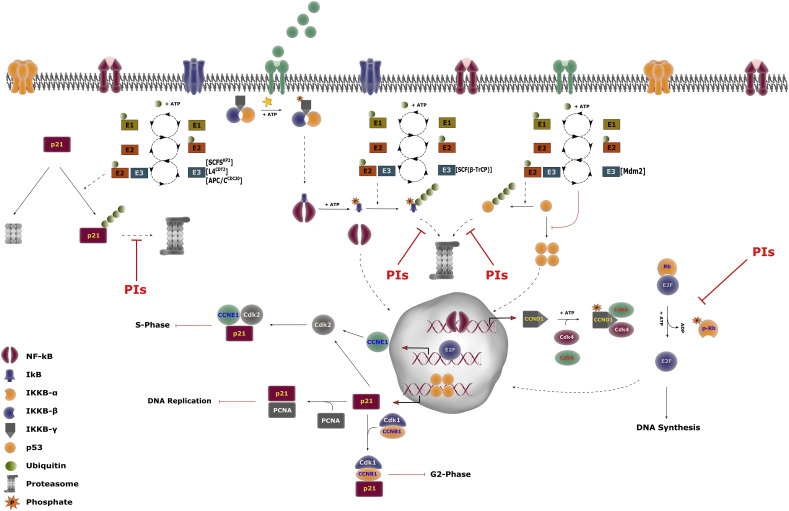
Regulation of NF-kB/E2F/Rb and p53/p21 pathways by proteasome. NF-kB/E2F/Rb pathway: under unstimulated conditions, NF-kB is kept inactive in the cytosol by IkB inhibitor. Different stimuli (e.g., cytokines, stressors, Pathogen Associated Molecular Patterns), generically indicated as green spheres on membrane receptors, phosphorylate and activate IKKBγ subunit which thereafter phosphorylate IkB through the kinase activity held by the α and β subunits. Phosphorylated IkB is ubiquitinated and degraded by the 26S proteasome. Free NF-kB dimers translocate into the nucleus, where transcription of target genes occurs. Cyclin D1 (CCDN1) expression allows the cyclin D1-Cdk4/6 complex to form. This complex phosphorylates Rb protein, inducing its detachment from EF2 transcription factor. Free EF2 enters the nucleus and transcribes cyclin E (not shown), cyclin A and genes involved in DNA synthesis: this triggers the progression toward the S-phase. p53/p21 pathway: under physiological conditions, p53 degradation is predominantly orchestrated by the E3-ligase MDM2, which promotes its poly-ubiquitination, and, thus, its degradation by the 26S proteasome. A number of stimuli activate the p53 pathway, inducing its tetramerization and translocation into the nucleus. Herein, p53 triggers the transcription of pro-apoptotic factors (i.e., Noxa and Bax, not shown) and CdkI p21. When expressed, p21 binds to: (i) Cdk2/cyclin E (CCNE1) complex, blocking the entry of the cell into the S phase; (ii) cyclin B (CCNB1)/Cdk1 complex, leading to a growth arrest in the G2 phase; (iii) PCNA, inhibiting DNA replication. p21 levels are also modulated through the ubiquitin-dependent degradation by the 26S, and further by a ubiquitin -independent pathway by the 20S. Figure legend is restricted to NF-kB and p53, whose mechanisms of transcription induction is not sketched. PIs stands for Proteasome Inhibitors and the red arrows indicate the steps of NF-kB, p53 and p21 turn-over which are blocked by this class of drugs.
Fig. 4
Fig. 4
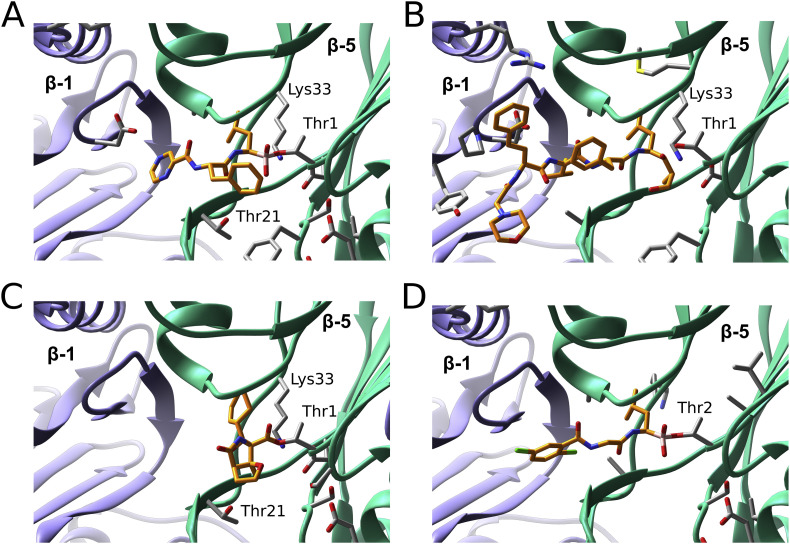
Proteasome binding structures of PIs. The structures of proteasome binding to carfilzomib (panel A), bortezomib (panel B), salinosporamide (marizomib) (panel C) and ixazomib (panel D); are reported. The β-5 subunit is represented as turquoise ribbon, the β-1 subunit is represented as purple ribbon, the inhibitors are represented as orange sticks and the protein residues interacting with the inhibitors as grey sticks.

References

    1. Abbas T., Dutta A. p21 in cancer: intricate networks and multiple activities. Nature Reviews. Cancer. 2009;9(6):400–414. doi: 10.1038/nrc2657. - DOI - PMC - PubMed
    1. Adams J. The proteasome: structure, function, and role in the cell. Cancer Treatment Reviews. 2003;29(Suppl. 1):3–9. doi: 10.1016/s0305-7372(03)00081-1. - DOI - PubMed
    1. Adams J. The development of proteasome inhibitors as anticancer drugs. Cancer Cell. 2004;5(5):417–421. doi: 10.1016/s1535-6108(04)00120-5. - DOI - PubMed
    1. Adams J. The proteasome: a suitable antineoplastic target. Nature Reviews. Cancer. 2004;4(5):349–360. doi: 10.1038/nrc1361. - DOI - PubMed
    1. Adams J., Behnke M., Chen S., Cruickshank A.A., Dick L.R., Grenier L.…Stein R.L. Potent and selective inhibitors of the proteasome: Dipeptidyl boronic acids. Bioorganic & Medicinal Chemistry Letters. 1998;8(4):333–338. doi: 10.1016/s0960-894x(98)00029-8. - DOI - PubMed

Publication types

MeSH terms