Review
. 2020 May 18;12(5):1150.
doi: 10.3390/polym12051150.

Agarose-Based Biomaterials: Opportunities and Challenges in Cartilage Tissue Engineering

Affiliations
Review

Agarose-Based Biomaterials: Opportunities and Challenges in Cartilage Tissue Engineering

Mohammad Amin Salati et al. Polymers (Basel). .

Abstract

The lack of adequate blood/lymphatic vessels as well as low-potential articular cartilage regeneration underlines the necessity to search for alternative biomaterials. Owing to their unique features, such as reversible thermogelling behavior and tissue-like mechanical behavior, agarose-based biomaterials have played a key role in cartilage tissue repair. Accordingly, the need for fabricating novel highly efficient injectable agarose-based biomaterials as hydrogels for restoration of injured cartilage tissue has been recognized. In this review, the resources and conspicuous properties of the agarose-based biomaterials were reviewed. First, different types of signals together with their functionalities in the maintenance of cartilage homeostasis were explained. Then, various cellular signaling pathways and their significant role in cartilage tissue engineering were overviewed. Next, the molecular structure and its gelling behavior have been discussed. Eventually, the latest advancements, the lingering challenges, and future ahead of agarose derivatives from the cartilage regeneration perspective have been discussed.

Keywords: agarose; biomaterials; cartilage; hydrogels; regenerative medicine; tissue engineering.


Conflict of interest statement

The authors declare no conflict of interest.

Figures
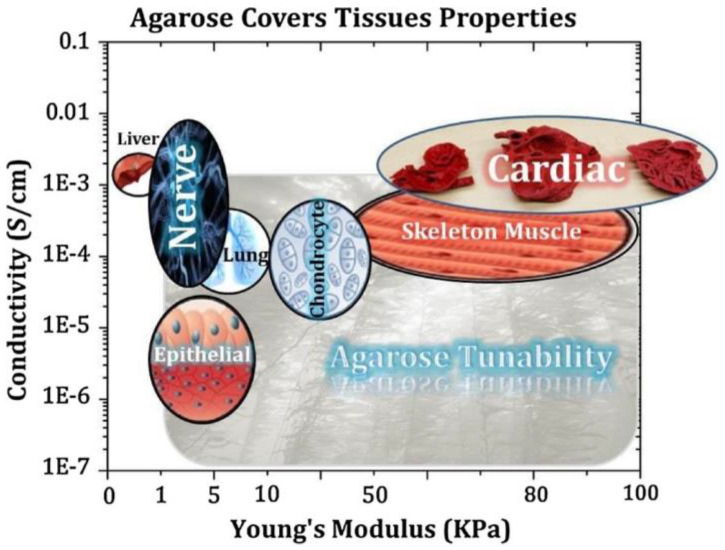
Figure 1
Figure 1
Adjustable features of agarose can result in flexible characteristics similar to cells and tissues. Here, the conductivity and Young’s modulus of agarose-based biomaterials are patterned. Reprinted with permission from [18].
Figure 2
Figure 2
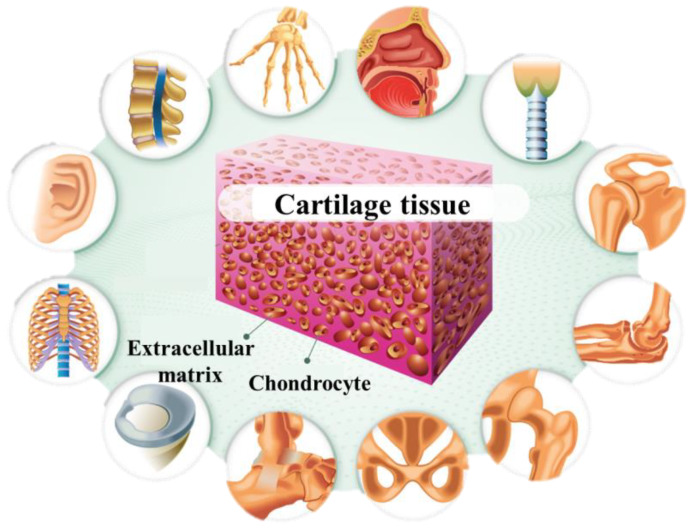
Schematic of the cartilage tissue structure. (a) Collagen (type II) and chondrocytes are two major components of cartilage tissue, the application of cartilage tissue in different parts of the human body (reproduced with permission from [42]).
Figure 3
Figure 3
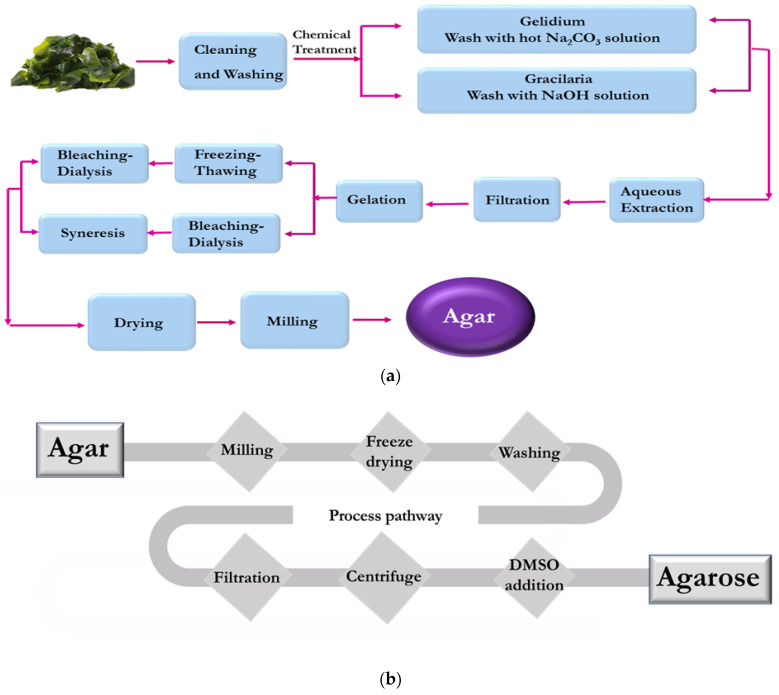
Schematic illustration of extraction route for the production of (a) agar from algae through a chemical treatment and physical filtration for (b) agarose from agar source using DMSO solution.
Figure 4
Figure 4
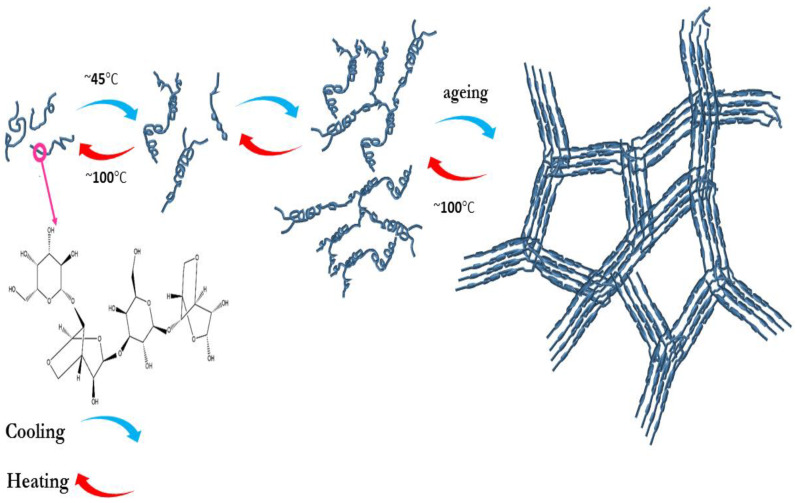
The molecular structure of agarose and schematic of its gelling process (reprinted from [21]).
Figure 5
Figure 5
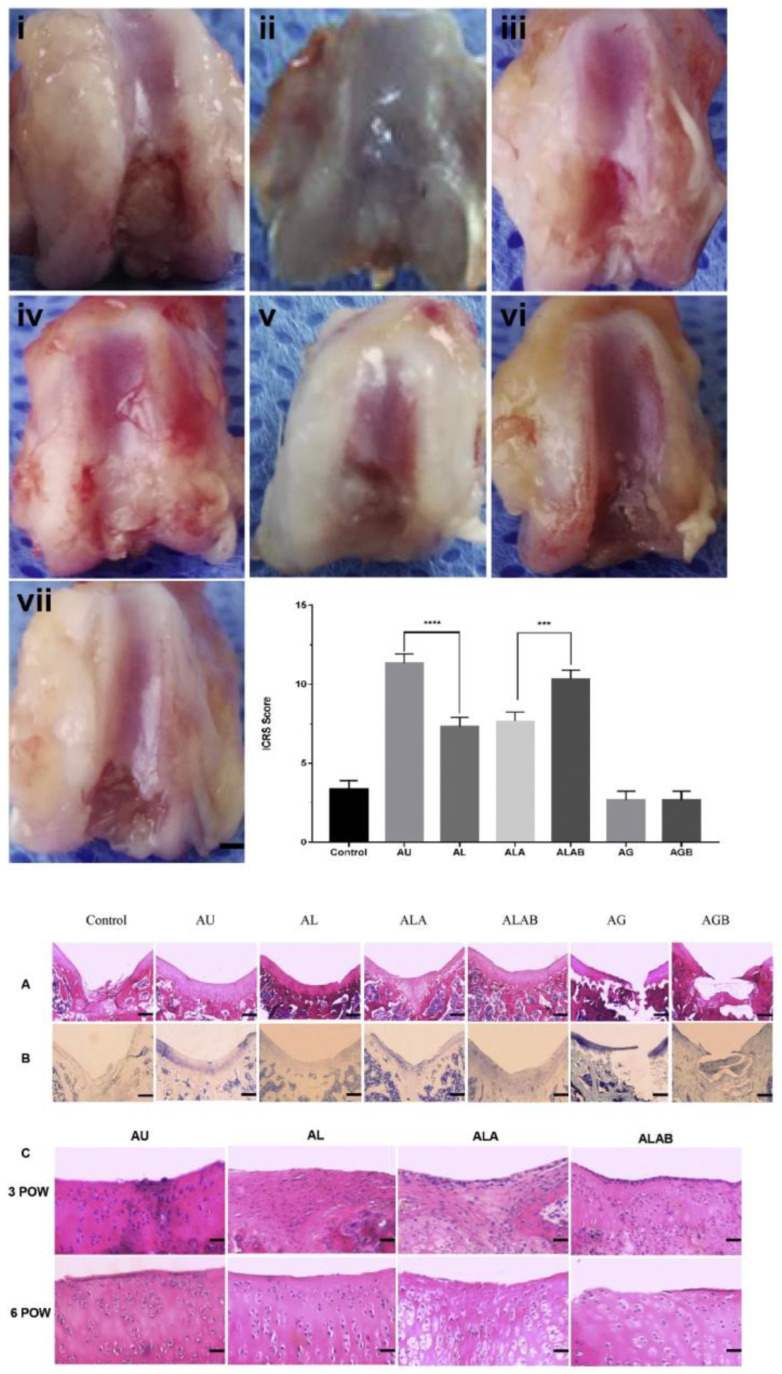
cartilage injury after transplantation of different groups: (i) nontransplant control, (ii) autologous articular cartilage (AU), (iii) allogeneic (same species, different rat) articular cartilage (AL), (iv) allogeneic articular cartilage replacing agarose gel (ALA), (v) allogeneic articular cartilage replacing agarose gel with bFGF (ALAB), (vi) agarose gel (AG), and (vii) agarose gel with bFGF (AGB). The cartilage restoration evaluation was drastically greater in the AU group than that in the AL group, as was the ALAB group compared with the ALA group. Assessment of histological data after transplantation. (A,B) Nontransplant control: amorphous reparative tissue filling the subchondral region. AU: intensive staining covering the defect. AL: the intensity of staining in the regenerated region was less than that of AU and ALAB. ALA: partly positive cartilage organization in the area. ALAB: amounts of cartilage-like tissue restored in the full-thickness defect. AG and AGB showed the agarose gel occupied the space and hindered the reconstructive process. (C) Histological findings in knee cartilage in the transplantation site at postoperative week (POW) 3 and POW 6 (hematoxylin and eosin). At POWs 3 and 6, the ALAB and AU groups showed no obvious evidence of rejection. In the other two groups, chondrocytes with small, condensed nuclei were visible at each time point. Scale bar is 50 μm for all images (Reprinted with permission form [83]).

References

    1. Robbins S., Abram F., Boily M., Pelletier J.-P., Martel-Pelletier J. Relationship between alignment and cartilage thickness in patients with non-traumatic and post-traumatic knee osteoarthritis. Osteoarthr. Cartil. 2019;27:630–637. doi: 10.1016/j.joca.2019.01.002. - DOI - PubMed
    1. Farokhi M., Mottaghitalab F., Fatahi Y., Saeb M.R., Zarrintaj P., Kundu S.C., Khademhosseini A.J. Silk fibroin scaffolds for common cartilage injuries: Possibilities for future clinical applications. Eur. Polym. J. 2019;115:251–267. doi: 10.1016/j.eurpolymj.2019.03.035. - DOI
    1. Orman O., Ozturk K., Baydar M., Guneren E., Taslidere E., Orman M., Ozel O. Influence of articular arthroscopy-like washout on fracture healing of intra-articular fractures. Anim. Exp. 2020;3:18–29. doi: 10.30714/j-ebr.2020157450. - DOI
    1. Khalili R., Zarrintaj P., Jafari S.H., Vahabi H., Saeb M.R. Electroactive poly (p-phenylene sulfide)/r-Graphene Oxide/Chitosan as a novel potential candidate for tissue engineering. Int. J. Biol. Macromol. 2020;154:18–24. doi: 10.1016/j.ijbiomac.2020.03.029. - DOI - PubMed
    1. Samadi A., Hasanzadeh R., Azdast T., Abdollahi H., Zarrintaj P., Saeb M.R. Piezoelectric Performance of Microcellular Polypropylene Foams Fabricated Using Foam Injection Molding as a Potential Scaffold for Bone Tissue Engineering. J. Macromol. Sci. Part B. 2020:1–14. doi: 10.1080/00222348.2020.1730573. - DOI

LinkOut - more resources