


Fracture toughness of a metal-organic framework glass
- PMID: 32444664
- PMCID: PMC7244719
- DOI: 10.1038/s41467-020-16382-7
Fracture toughness of a metal-organic framework glass
Abstract
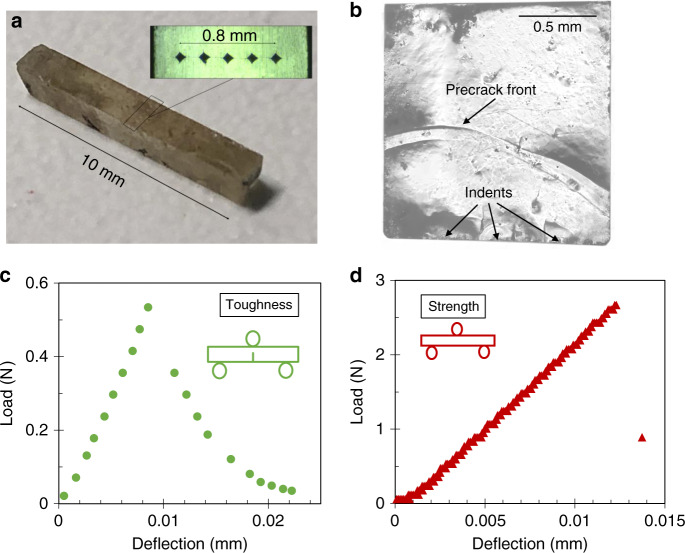
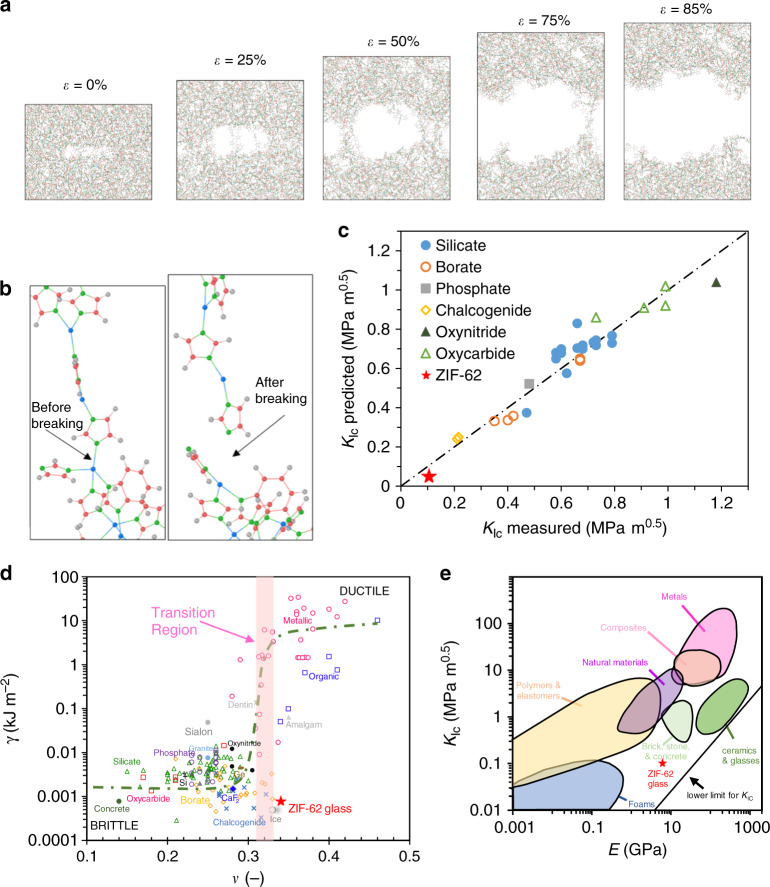
Metal-organic framework glasses feature unique thermal, structural, and chemical properties compared to traditional metallic, organic, and oxide glasses. So far, there is a lack of knowledge of their mechanical properties, especially toughness and strength, owing to the challenge in preparing large bulk glass samples for mechanical testing. However, a recently developed melting method enables fabrication of large bulk glass samples (>25 mm3) from zeolitic imidazolate frameworks. Here, fracture toughness (KIc) of a representative glass, namely ZIF-62 glass (Zn(C3H3N2)1.75(C7H5N2)0.25), is measured using single-edge precracked beam method and simulated using reactive molecular dynamics. KIc is determined to be ~0.1 MPa m0.5, which is even lower than that of brittle oxide glasses due to the preferential breakage of the weak coordinative bonds (Zn-N). The glass is found to exhibit an anomalous brittle-to-ductile transition behavior, considering its low fracture surface energy despite similar Poisson's ratio to that of many ductile metallic and organic glasses.
Conflict of interest statement
The authors declare no competing interests.
Figures

References
-
- Mason JA, et al. Methane storage in flexible metal-organic frameworks with intrinsic thermal management. Nature. 2015;527:357–361. - PubMed
-
- Su Z, et al. Shock Wave Chemistry in a metal-organic framework. J. Am. Chem. Soc. 2017;139:4619–4622. - PubMed
-
- Yoon JW, et al. Selective nitrogen capture by porous hybrid materials containing accessible transition metal ion sites. Nat. Mater. 2017;16:526–531. - PubMed
-
- Mondloch JE, et al. Destruction of chemical warfare agents using metal-organic frameworks. Nat. Mater. 2015;14:512–516. - PubMed
-
- Wu T, Feng X, Elsaidi SK, Thallapally PK, Carreon MA. Zeolitic imidazolate framework-8 (ZIF-8) membranes for Kr/Xe separation. Ind. Eng. Chem. Res. 2017;56:1682–1686.
