


Perinatal outcomes from preterm and early term births in a multicenter cohort of low risk nulliparous women
- PMID: 32444773
- PMCID: PMC7244568
- DOI: 10.1038/s41598-020-65022-z
Perinatal outcomes from preterm and early term births in a multicenter cohort of low risk nulliparous women
Abstract
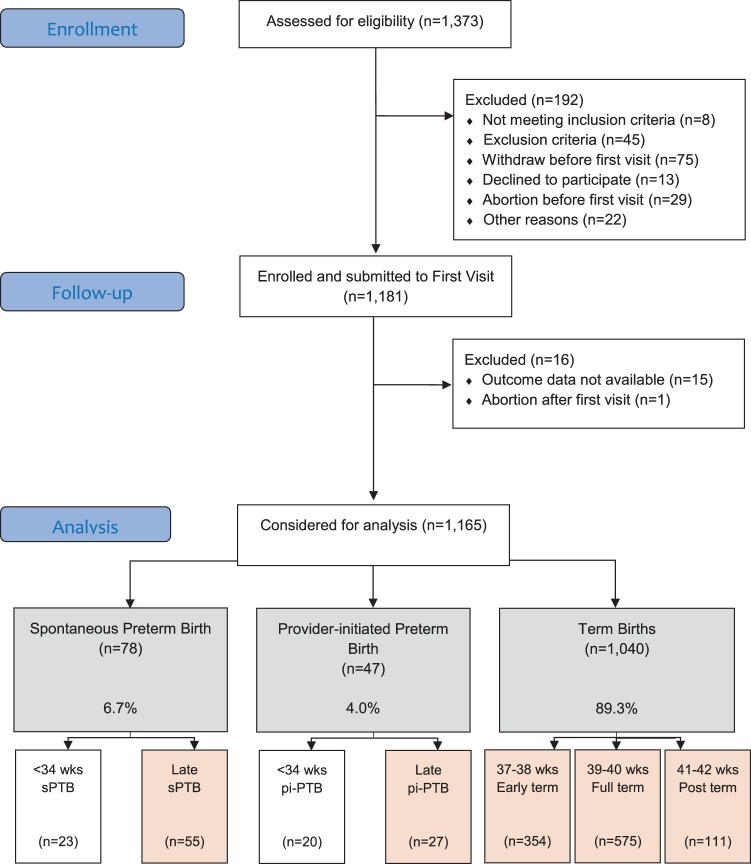
Preterm birth is the major contributor for neonatal and under-five years mortality rates and also accounts for a short- and long-term adverse consequences up to adulthood. Perinatal outcomes may vary according to lots of factors as preterm subtype, late prematurity, which account for the vast majority of cases, country and population characteristics. An under-recognition of the perinatal outcomes and its associated factors might have underpowered strategies to provide adequate care and prevent its occurrence. We aim to estimate the frequency of maternal and perinatal outcomes in women with different categories of preterm and term births, factors associated with poorer perinatal outcomes and related management interventions. A multicentre prospective cohort in five maternities in Brazil between 2015 and 2018. Nulliparous low-risk women with singletons were included. Comprehensive data were collected during three antenatal visits (at 19-21weeks, 27-29 weeks and 37-39 weeks). Maternal and perinatal outcomes were also collected according to maternal and neonatal medical records. Women who had spontaneous (sPTB) and provider-initiated (pi-PTB) preterm birth were compared to those who had term birth. Also, late preterm birth (after 34 weeks), and early term (37-38 weeks) were compared to full term birth (39-40 weeks). Bivariate analysis estimated risk ratios for maternal and adverse outcomes. Finally, a multivariate analysis was conducted to address factors independently associated with any adverse perinatal outcome (APO). In total, 1,165 women had outcome data available, from which 6.7% had sPTB, 4.0% had pi-PTB and 89.3% had a term birth. sPTB and pi-PTb were associated with poorer perinatal outcomes, as well as late sPTB, late pi-PTB and early term neonates. pi-PTB (RRadj 8.12, 95% CI [2.54-25.93], p-value 0.007), maternal weight gain between 20 and 27 weeks <p10 (RRadj 2.04, 95% CI [1.23-3.38], p-value 0.018) and participants from the Northeast centres (RRadj 2.35, 95% CI [1.11-4.95], p-value 0.034) were independently associated with APO. According to our findings, Brazil would benefit from strategies to more accurately identify women at higher risk for PTB, to promote evidenced-based decision in preterm and early term provider-initiated deliveries, and to prevent perinatal adverse outcomes.
Conflict of interest statement
The authors declare no competing interests.
Figures
References
-
- Morisaki N, et al. Risk factors for spontaneous and provider-initiated preterm delivery in high and low Human Development Index countries: a secondary analysis of the World Health Organization Multicountry Survey on Maternal and Newborn Health. BJOG: an international journal of obstetrics and gynaecology. 2014;121(Supp l):101–9. doi: 10.1111/1471-0528.12631. - DOI - PubMed
Publication types
MeSH terms
LinkOut - more resources
Full Text Sources
Research Materials
Miscellaneous
