


A role for the right dorsolateral prefrontal cortex in enhancing regulation of both craving and negative emotions in internet gaming disorder: A randomized trial
- PMID: 32446706
- PMCID: PMC8292795
- DOI: 10.1016/j.euroneuro.2020.04.003
A role for the right dorsolateral prefrontal cortex in enhancing regulation of both craving and negative emotions in internet gaming disorder: A randomized trial
Abstract
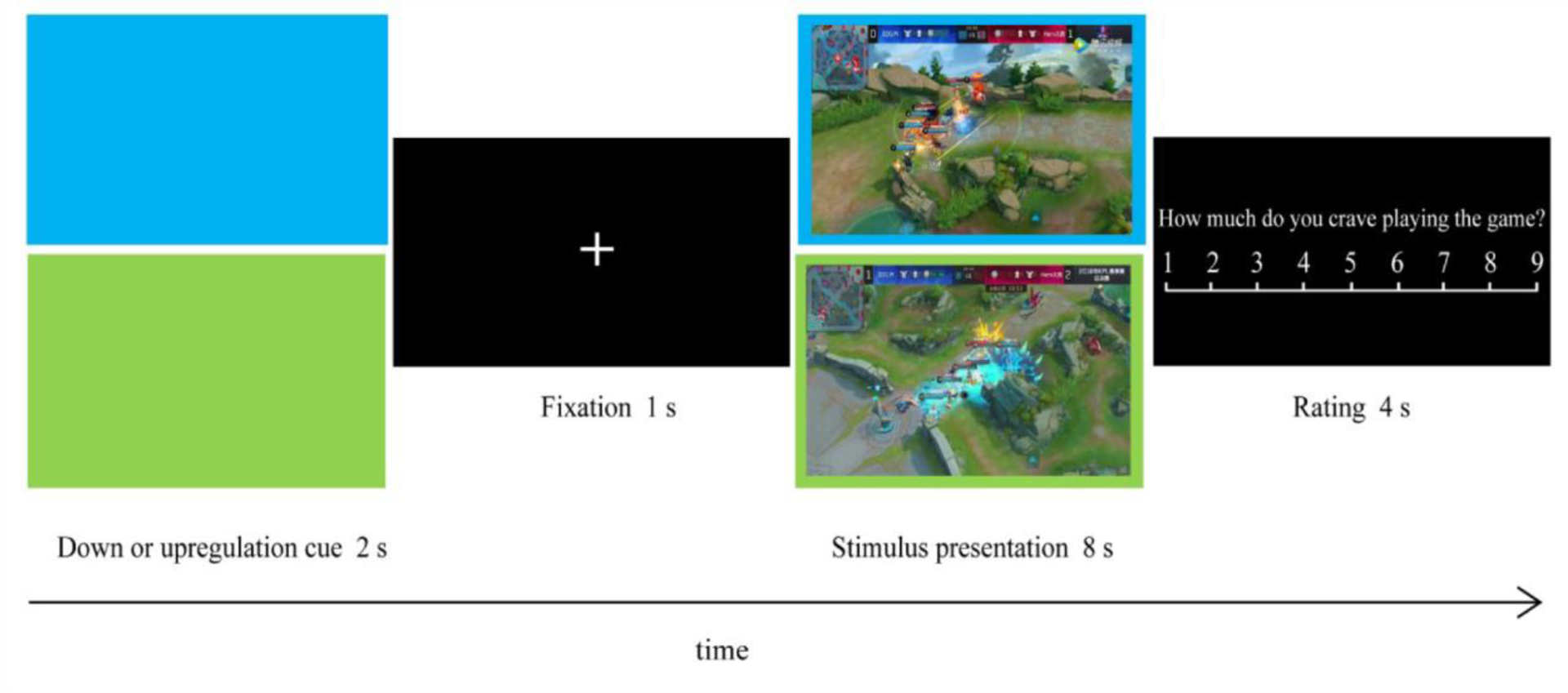
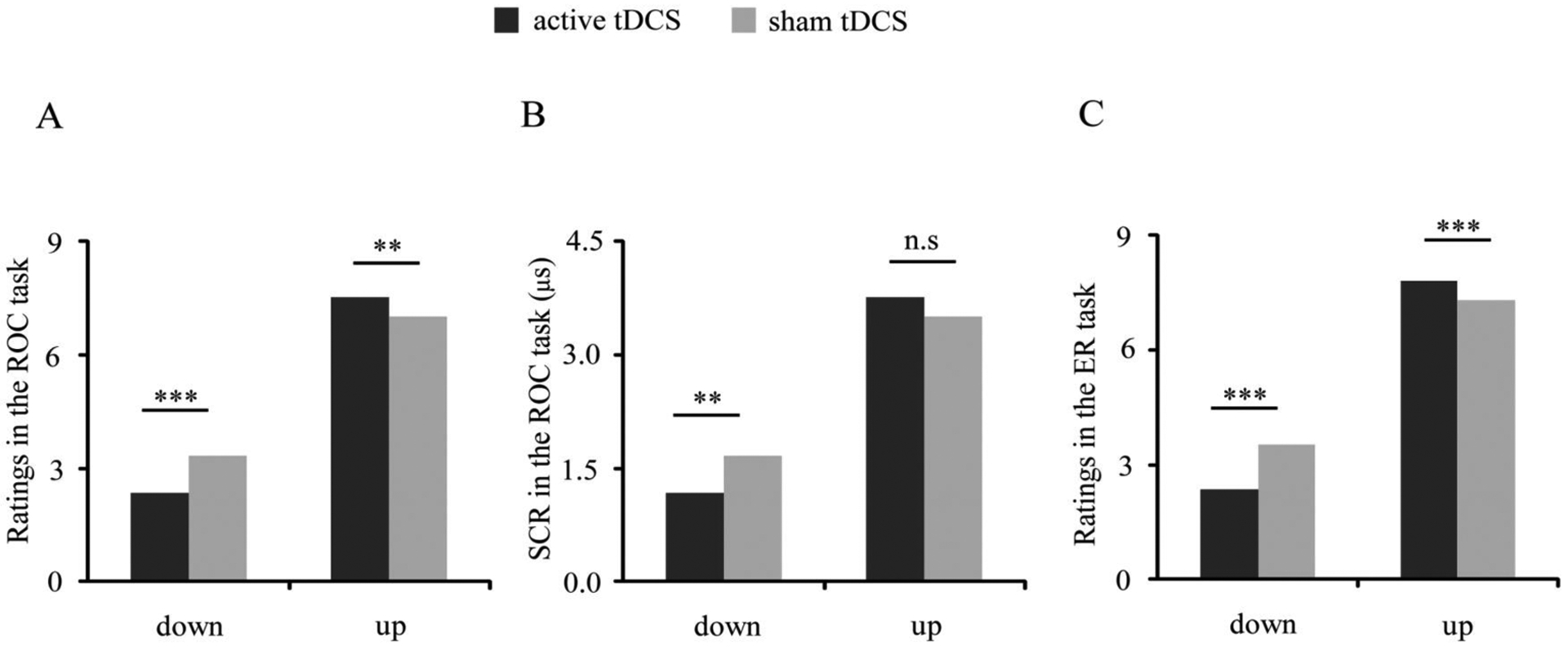
Reward-seeking and relief from negative emotions are two central motivational drives underlying addictions. Impaired executive control over craving and negative emotions contributes to compulsive addictive behaviors. Neuroimaging evidence has implicated the prefrontal cortex (PFC) in regulating craving or emotions. This study aims at examining whether anodal transcranial direct current stimulation (tDCS) over a specific region of the PFC would enhance both regulation processes. Thirty-three men with internet gaming disorder received active (1.5 mA for 20 minutes) and sham tDCS over the right dorsolateral PFC (dlPFC) one week apart in a randomized order. During each stimulation session, participants regulated craving for gaming during a regulation of craving (ROC) task and negative emotions during an emotion regulation (ER) task using cognitive reappraisal. Subjective ratings of craving and negative emotions and skin conductance responses (SCRs) were recorded. For both craving and negative emotions, tDCS of the right dlPFC facilitated downregulation and upregulation: active relative to sham tDCS decreased ratings (ROC: 95% CI of difference -1.38 to -0.56, p < 0.001; ER: -1.65 to -0.70, p < 0.001) and/or SCRs (ROC: -1.99 to -0.41 μs, p = 0.004) for downregulation, and increased ratings (ROC: 0.24 to 0.82, p = 0.001; ER: 0.26 to 0.72, p < 0.001) for upregulation. These findings provide the first experimental evidence confirming that tDCS of the right dlPFC enhances both craving- and negative-emotion-regulation. This suggests a promising approach for concurrently enhancing executive control over two central motivational drives underlying addictions.
Keywords: Craving regulation; Internet gaming disorder; Negative emotion regulation; Transcranial direct current stimulation.
Copyright © 2020. Published by Elsevier B.V.
Conflict of interest statement
Conflict of Interest The authors declare no conflict of interest.
Figures
References
-
- Albein-Urios N, Verdejo-Roman J, Asensio S, Soriano-Mas C, Martinez-Gonzalez JM, Verdejo-Garcia A, 2014. Re-appraisal of negative emotions in cocaine dependence: dysfunctional corticolimbic activation and connectivity. Addict Biol. 19, 415–426. - PubMed
-
- American Psychiatric Association, 2013. Diagnostic and Statistical Manual of Mental Disorders (5th ed). Washington, DC: American Psychiatric Publishing.
-
- Baker TB, Piper ME, McCarthy DE, Majeskie MR, Fiore MC, 2004. Addiction motivation reformulated: an affective processing model of negative reinforcement. Psychol Rev. 111, 33–51. - PubMed
-
- Boggio PS, Sultani N, Fecteau S, Merabet L, Mecca T, Pascual-Leone A, Basaglia A, Fregni F, 2008. Prefrontal cortex modulation using transcranial DC stimulation reduces alcohol craving: A double-blind, sham-controlled study. Drug Alcohol Depend. 92, 55–60. - PubMed
Publication types
MeSH terms
Grants and funding
LinkOut - more resources
Full Text Sources
Miscellaneous
