Editorial
. 2020 Jun;94(6):2263-2272.
doi: 10.1007/s00204-020-02787-2. Epub 2020 May 23.

Harnessing the power of novel animal-free test methods for the development of COVID-19 drugs and vaccines

Affiliations
Editorial

Harnessing the power of novel animal-free test methods for the development of COVID-19 drugs and vaccines

Francois Busquet et al. Arch Toxicol. 2020 Jun.

Abstract

The COVID-19-inducing virus, SARS-CoV2, is likely to remain a threat to human health unless efficient drugs or vaccines become available. Given the extent of the current pandemic (people in over one hundred countries infected) and its disastrous effect on world economy (associated with limitations of human rights), speedy drug discovery is critical. In this situation, past investments into the development of new (animal-free) approach methods (NAM) for drug safety, efficacy, and quality evaluation can be leveraged. For this, we provide an overview of repurposing ideas to shortcut drug development times. Animal-based testing would be too lengthy, and it largely fails, when a pathogen is species-specific or if the desired drug is based on specific features of human biology. Fortunately, industry has already largely shifted to NAM, and some public funding programs have advanced the development of animal-free technologies. For instance, NAM can predict genotoxicity (a major aspect of carcinogenicity) within days, human antibodies targeting virus epitopes can be generated in molecular biology laboratories within weeks, and various human cell-based organoids are available to test virus infectivity and the biological processes controlling them. The European Medicines Agency (EMA) has formed an expert group to pave the way for the use of such approaches for accelerated drug development. This situation illustrates the importance of diversification in drug discovery strategies and clearly shows the shortcomings of an approach that invests 95% of resources into a single technology (animal experimentation) in the face of challenges that require alternative approaches.


Conflict of interest statement

TH is named inventor on a patent by Johns Hopkins University on the production of mini-brains (also called BrainSpheres), which is licensed to AxoSim, New Orleans, LA, USA. He consults AxoSim and is a shareholder.

Figures
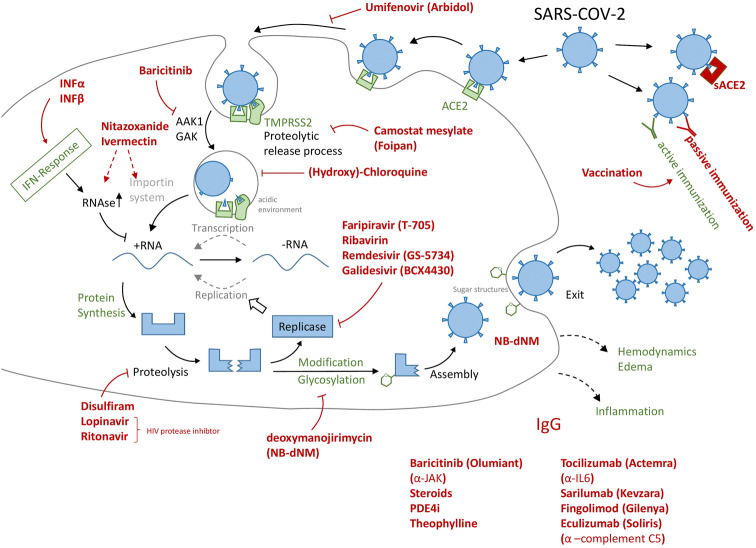
Fig. 1
Fig. 1
Overview of some drug repurposing approaches for COVID-19. The black structures indicate the target cell, and green structures refer to host components and processes. The virus or its elements are shown in blue, while drugs are presented in red. The drugs in the lower right corner have been considered to fight inflammation or to smoothen a potential cytokine storm, i.e. they act on processes not directly linked to the virus or its target cell (type II pneumocyte) in the lung. Arrows refer to drug targets or target processes, as they have been suggested in the literature. Sometimes the exact targets, and respective drug efficacy are not known. The selection of drugs (and drug types) is exemplary, and good other approaches may be missing, while some of those shown may be of little use. The intention was to highlight the broad variety of approaches, many of them also used clinically in case studies, compassionate trials or initial stages of testing programs. At this stage, NAM would be useful to (i) determine the target structures, (ii) define exact biological effects of drug candidates, (iii) investigate and quantify efficacy, and (iv) close gaps in safety knowledge on some candidates not yet approved or used clinically in other settings (e.g. dosing schedule). ACE2 angiotensin converting enzyme-2, sACE2 recombinant soluble domain of ACE2, IFN interferon, TMPRSS2 transmembrane serine protease subtype-2, AAK1, GAK enzymes involved in endocytosis, JAK kinase (janus kinase family) involved in cytokine signaling (inflammation) (color figure online)

References

    1. Abreu CM, Gama L, Krasemann S, et al. Microglia increase inflammatory responses in iPSC-derived human brain spheres. Front Microbiol. 2018;9:2766. doi: 10.3389/fmicb.2018.02766. - DOI - PMC - PubMed
    1. Alepee N, Bahinski A, Daneshian M, et al. State-of-the-art of 3D cultures (organs-on-a-chip) in safety testing and pathophysiology. Altex. 2014;31(4):441–477. doi: 10.14573/altex.1406111. - DOI - PMC - PubMed
    1. Almagro JC, Pedraza-Escalona M, Arrieta HI, Perez-Tapia SM. Phage display libraries for antibody therapeutic discovery and development. Antibodies (Basel) 2019 doi: 10.3390/antib8030044. - DOI - PMC - PubMed
    1. Bailey J, Thew M, Balls M. An analysis of the use of animal models in predicting human toxicology and drug safety. Altern Lab Anim. 2014;42(3):181–199. doi: 10.1177/026119291404200306. - DOI - PubMed
    1. Bailey J, Thew M, Balls M. Predicting human drug toxicity and safety via animal tests: can any one species predict drug toxicity in any other, and do monkeys help? Altern Lab Anim. 2015;43(6):393–403. doi: 10.1177/026119291504300607. - DOI - PubMed

Publication types
