


Re-engaging an inactive cohort of young adults: evaluating recruitment for the Kidskin Young Adult Myopia Study
- PMID: 32448147
- PMCID: PMC7245800
- DOI: 10.1186/s12874-020-00996-y
Re-engaging an inactive cohort of young adults: evaluating recruitment for the Kidskin Young Adult Myopia Study
Abstract
Background: Recent changes in communication technologies, including increased reliance on mobile phones and the internet, may present challenges and/or opportunities to re-engaging inactive study cohorts. We evaluate our ability to recruit participants for the Kidskin Young Adult Myopia Study (KYAMS), a follow-up of the Kidskin Study.
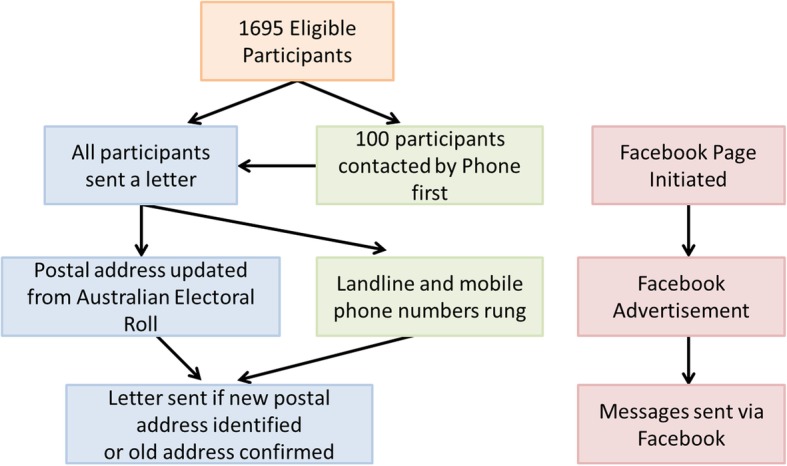
Methods: KYAMS participants were recruited from the Kidskin Study, a sun exposure-intervention study for 5-6 year-olds running from 1995 to 1999 with most recent follow-up in 2005. From 2015 to 2019, the KYAMS used mail-outs, phone calls and social media to contact Kidskin Study participants. Multivariable logistic regression was used to identify variables associated with successful contact of a Kidskin Study participant or family member and KYAMS participation.
Results: Of 1695 eligible participants, 599 (35.5%) participants (or a family member) were contacted and 303 (17.9%) participated in the KYAMS. KYAMS participation was more likely in those who participated in the 2005 follow-up (odds ratio [OR] = 5.09, 95% confidence interval [CI]: 3.67-7.06) and had a mobile phone number on record (OR = 2.25, CI: 1.57-3.23). Of those contacted, participants who were the first point of contact (OR = 4.84, CI: 2.89-8.10) and who were contacted by letter in the first (OR = 6.53, CI: 3.35-12.75) or second (OR = 5.77, CI: 2.85-11.67) round were more likely to participate in the KYAMS, compared to contact by landline phone.
Conclusions: We recruited approximately one-fifth of Kidskin Study participants for the KYAMS. Participants were more likely to participate in the KYAMS if they were contacted directly, rather than through a family member, and if they were contacted by invitation letter.
Trial registration: ACTRN12617000812392.
Keywords: Cohort; Recruitment; Retention; Young adult.
Conflict of interest statement
The authors declare they have no competing interests.
Figures


References
-
- Lingham G, Milne E, Cross D, English DR, Johnston RS, Lucas RM, Yazar S, Mackey DA. Investigating the long-term impact of a childhood sun-exposure intervention, with a focus on eye health: protocol for the kidskin-Young adult myopia study. BMJ Open. 2018;8(1):e020868. doi: 10.1136/bmjopen-2017-020868. - DOI - PMC - PubMed
Publication types
MeSH terms
Associated data
Grants and funding
LinkOut - more resources
Full Text Sources
