


Non-invasive venous waveform analysis (NIVA) for volume assessment in patients undergoing hemodialysis: an observational study
- PMID: 32448178
- PMCID: PMC7245891
- DOI: 10.1186/s12882-020-01845-2
Non-invasive venous waveform analysis (NIVA) for volume assessment in patients undergoing hemodialysis: an observational study
Abstract
Background: Accurate assessment of volume status to direct dialysis remains a clinical challenge. Despite current attempts at volume-directed dialysis, inadequate dialysis and intradialytic hypotension (IDH) are common occurrences. Peripheral venous waveform analysis has recently been developed as a method to accurately determine intravascular volume status through algorithmic quantification of changes in the waveform that occur at different volume states. A noninvasive method to capture peripheral venous signals is described (Non-Invasive Venous waveform Analysis, NIVA). The objective of this proof-of-concept study was to characterize changes in NIVA signal with dialysis. We hypothesized that there would be a change in signal after dialysis and that the rate of intradialytic change in signal would be predictive of IDH.
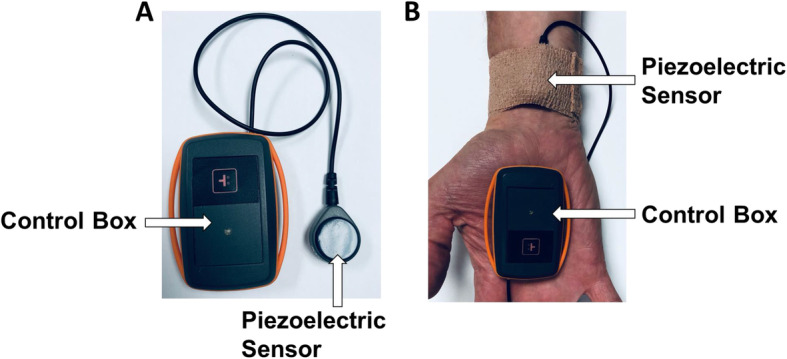
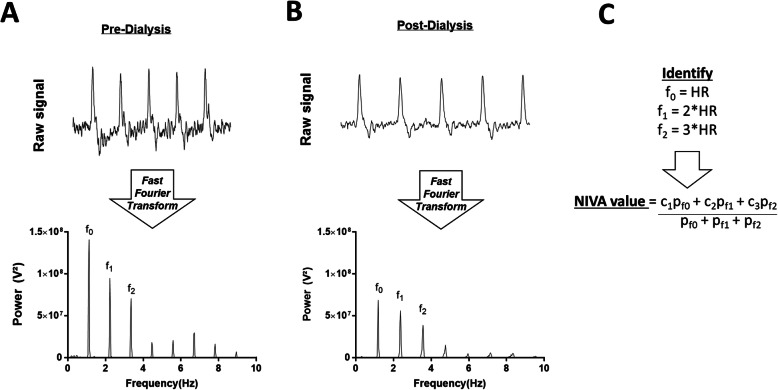
Methods: Fifty subjects undergoing inpatient hemodialysis were enrolled. A 10-mm piezoelectric sensor was secured to the middle volar aspect of the wrist on the extremity opposite to the access site. Signals were obtained fifteen minutes before, throughout, and up to fifteen minutes after hemodialysis. Waveforms were analyzed after a fast Fourier transformation and identification of the frequencies corresponding to the cardiac rate, with a NIVA value generated based on the weighted powers of these frequencies.
Results: Adequate quality (signal to noise ratio > 20) signals pre- and post- dialysis were obtained in 38 patients (76%). NIVA values were significantly lower at the end of dialysis compared to pre-dialysis levels (1.203 vs 0.868, p < 0.05, n = 38). Only 16 patients had adequate signals for analysis throughout dialysis, but in this small cohort the rate of change in NIVA value was predictive of IDH with a sensitivity of 80% and specificity of 100%.
Conclusions: This observational, proof-of-concept study using a NIVA prototype device suggests that NIVA represents a novel and non-invasive technique that with further development and improvements in signal quality may provide static and continuous measures of volume status to assist with volume directed dialysis and prevent intradialytic hypotension.
Keywords: Dialysis; Monitoring; Venous waveform analysis.
Conflict of interest statement
Kyle Hocking, PhD, is Founder, CEO and President of VoluMetrix and an inventor on intellectual property in the field of venous waveform analysis assigned to Vanderbilt and licensed to VoluMetrix. Colleen Brophy, MD, is Founder and CMO of VoluMetrix and an inventor on intellectual property in the field of venous waveform analysis assigned to Vanderbilt and licensed to VoluMetrix. Jon Whitfield, ME is an engineer and owns stock with VoluMetrix. Bret Alvis, MD, owns stock in VoluMetrix and an inventor on intellectual property in the field of venous waveform analysis assigned to Vanderbilt and licensed to VoluMetrix and is married to the COO of VoluMetrix. Susan Eagle, MD is former founder and CEO of Volumetrix and an inventor on intellectual property in the field of venous waveform analysis assigned to Vanderbilt and licensed to Volumetrix.
Figures


References
-
- United States Renal Data System . 2018 USRDS annual data report: Epidemiology of kidney disease in the United States. Bethesda: National Institutes of Health, National Institute of Diabetes and Digestive and Kidney Diseases; 2018.
-
- K/DOQI Clinical Practice Guidelines for Cardiovascular Disease in Dialysis Patients. Am J Kidney Dis. 2005;45(4):S76–81. - PubMed
Publication types
MeSH terms
Grants and funding
LinkOut - more resources
Full Text Sources
Medical
