


Substantial and sustained reduction in under-5 mortality, diarrhea, and pneumonia in Oshikhandass, Pakistan: evidence from two longitudinal cohort studies 15 years apart
- PMID: 32448276
- PMCID: PMC7245818
- DOI: 10.1186/s12889-020-08847-7
Substantial and sustained reduction in under-5 mortality, diarrhea, and pneumonia in Oshikhandass, Pakistan: evidence from two longitudinal cohort studies 15 years apart
Abstract
Background: Oshikhandass is a rural village in northern Pakistan where a 1989-1991 verbal autopsy study showed that diarrhea and pneumonia were the top causes of under-5 mortality. Intensive surveillance, active community health education and child health interventions were delivered in 1989-1996; here we assess improvements in under-5 mortality, diarrhea, and pneumonia over this period and 15 years later.
Methods: Two prospective open-cohort studies in Oshikhandass from 1989 to 1996 (Study 1) and 2011-2014 (Study 2) enrolled all children under age 60 months. Study staff trained using WHO guidelines, conducted weekly household surveillance and promoted knowledge on causes and management of diarrhea and pneumonia. Information about household characteristics and socioeconomic status was collected. Hurdle models were constructed to examine putative risk factors for diarrhea and pneumonia.
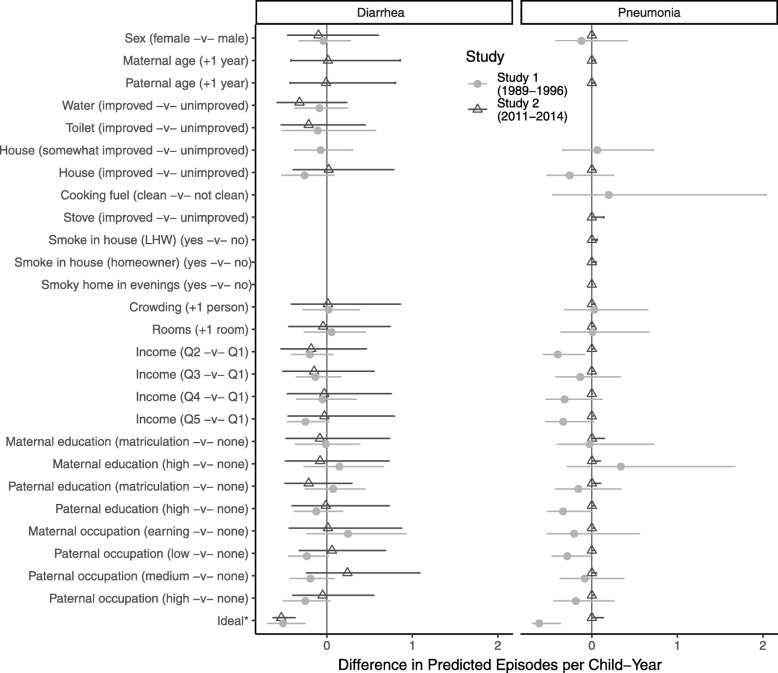
Results: Against a backdrop of considerable change in the socioeconomic status of the community, under-5 mortality, which declined over the course of Study 1 (from 114.3 to 79.5 deaths/1000 live births (LB) between 1989 and 1996), exceeded Sustainable Development Goal 3 by Study 2 (19.8 deaths/ 1000 LB). Reductions in diarrhea prevalence (20.3 to 2.2 days/ Child Year [CY]), incidence (2.1 to 0.5 episodes/ CY), and number of bloody diarrhea episodes (18.6 to 5.2%) seen during Study 1, were sustained in Study 2. Pneumonia incidence was 0.5 episodes /CY in Study 1 and 0.2/CY in Study 2; only 5% of episodes were categorized as severe or very severe in both studies. While no individual factors predicted a statistically significant difference in diarrhea or pneumonia episodes, the combined effect of water, toilet and housing materials was associated with a significant decrease in diarrhea; higher household income was the most protective factor for pneumonia in Study 1.
Conclusions: We report a 4-fold decrease in overall childhood mortality, and a 2-fold decrease in childhood morbidity from diarrhea and pneumonia in a remote rural village in Pakistan between 1989 and 2014. We conclude that significant, sustainable improvements in child health may be achieved through improved socioeconomic status and promoting interactions between locally engaged health workers and the community, but that continued efforts are needed to improve health worker training, supervision, and the rational use of medications.
Trial registration: Not Applicable.
Keywords: Community-based healthcare; Diarrhea; Infant mortality; Pakistan; Pneumonia; Under-5 mortality.
Conflict of interest statement
The authors declare that they have no competing interests.
Figures


References
-
- Ceptureanu S, Ceptureanu E, Luchian C, Luchian I. Community Based Programs Sustainability. A Multidimensional Analysis of Sustainability Factors. Sustainability. 2018;10(3):870. doi: 10.3390/su10030870. - DOI
-
- McAllister DA, Liu L, Shi T, Chu Y, Reed C, Burrows J, et al. Global, regional, and national estimates of pneumonia morbidity and mortality in children younger than 5 years between 2000 and 2015: a systematic analysis. Lancet Glob Health. 2019;7(1):e47–e57. doi: 10.1016/S2214-109X(18)30408-X. - DOI - PMC - PubMed
MeSH terms
Grants and funding
LinkOut - more resources
Full Text Sources
Medical
