Review
. 2020 May 24;12(1):72.
doi: 10.1186/s13148-020-00862-0.

Symphony of epigenetic and metabolic regulation-interaction between the histone methyltransferase EZH2 and metabolism of tumor

Affiliations
Review

Symphony of epigenetic and metabolic regulation-interaction between the histone methyltransferase EZH2 and metabolism of tumor

Tengrui Zhang et al. Clin Epigenetics. .

Abstract

Increasing evidence has suggested that epigenetic and metabolic alterations in cancer cells are highly intertwined. As the master epigenetic regulator, enhancer of zeste homolog 2 (EZH2) suppresses gene transcription mainly by catalyzing the trimethylation of histone H3 at lysine 27 (H3K27me3) and exerts highly enzymatic activity in cancer cells. Cancer cells undergo the profound metabolic reprogramming and manifest the distinct metabolic profile. The emerging studies have explored that EZH2 is involved in altering the metabolic profiles of tumor cells by multiple pathways, which cover glucose, lipid, and amino acid metabolism. Meanwhile, the stability and methyltransferase activity of EZH2 can be also affected by the metabolic activity of tumor cells through various mechanisms, including post-translational modification. In this review, we have summarized the correlation between EZH2 and cellular metabolic activity during tumor progression and drug treatment. Finally, as a promising target, we proposed a novel strategy through a combination of EZH2 inhibitors with metabolic regulators for future cancer therapy.

Keywords: EZH2; Histone modification; Metabolism; Tumor therapy.


Conflict of interest statement

The authors declare that they have no competing interests.

Figures
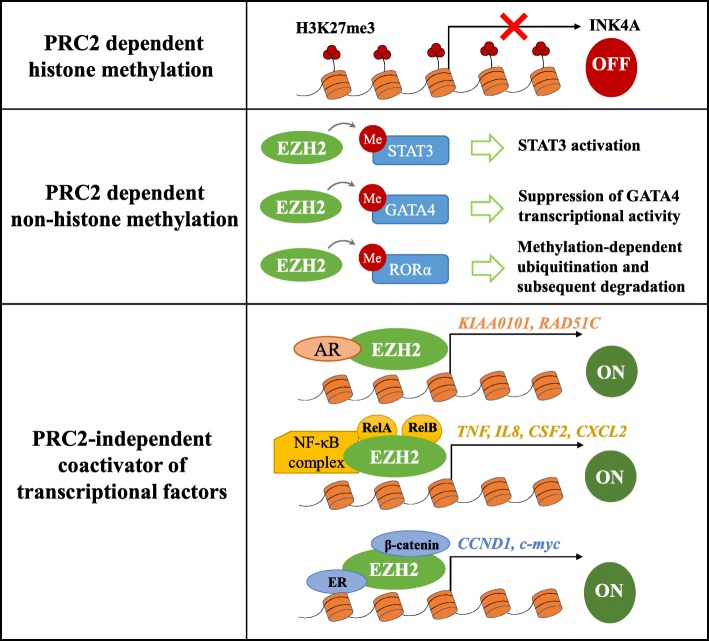
Fig. 1
Fig. 1
The mechanism of EZH2 in promoting tumorigenesis. (1) EZH2 methylates Histone 3 on lysine 27 depend on PRC2, which contributes to transcriptional silencing. (2) EZH2 is also capable of methylating some non-histone protein substrates which include STAT3, GATA4, and RORα. (3) EZH2 also can act as a coactivator of transcription factors in a PRC2-independent manner, such as AR, NF-κB complex, and ERα
Fig. 2
Fig. 2
EZH2 regulates glutamine metabolism by silencing BCAT1 transcription through catalyzing H3K27me3. a BCAT1 is repressed by EZH2-PRC2 mediated H3K27me3 in normal hematopoietic processes. b BCAT1 is abnormally activated in EZH2-deficient myeloid neoplasms and EZH2 inactivated leukemia stem cells
Fig. 3
Fig. 3
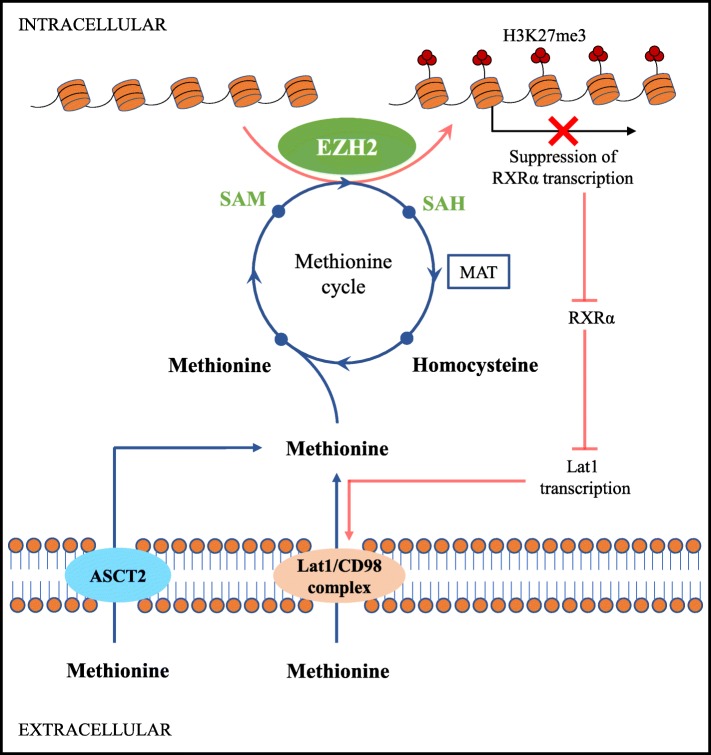
EZH2/Lat1 positive feedback loop promotes the generation of SAM. EZH2 derepresses Lat1 expression and promotes the generation of SAM through direct promoter binding and subsequent transcriptional repression of RXRα
Fig. 4
Fig. 4
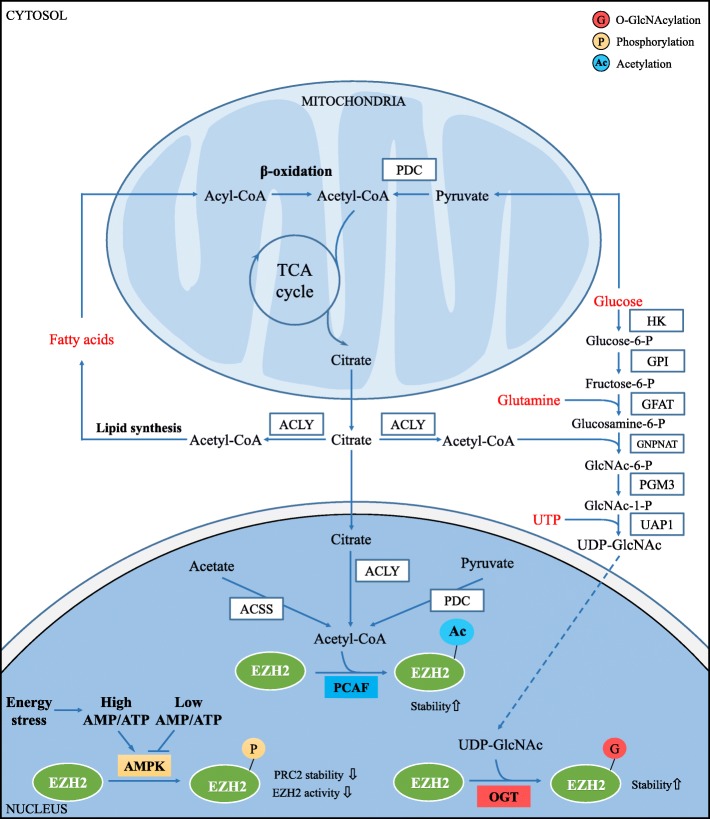
Effects of metabolites on post-translational modification of EZH2 protein. Post-translational modification of EZH2 requires metabolites to participate. EZH2 acetylation by P300/CBP-related factor (PCAF) uses the metabolite acetyl-CoA, enhancing the stability of EZH2. Acetyl-CoA is synthesized in the cytoplasm and nucleus from acetate, citrate, or pyruvate by acyl-CoA synthetase short-chain family member 2 (ACSS2), ATP-citrate lyase (ACLY), and pyruvate dehydrogenase complex (PDC), respectively. EZH2 GlcNAcylation is mediated by O-GlcNAc transferase (OGT) utilizing UDP-glucosamine (UDP-GlcNAc) which is generated from the hexosamine biosynthetic pathway. The stability and function of EZH2 is enhanced by O-GlcNAcylation modification. Energetic stress can affect EZH2 phosphorylation by activating AMP-activated protein kinase (AMPK), leading to a decrease in PRC2 stability and EZH2 activity

References

    1. Hoy SM. Tazemetostat: First Approval. Drugs. 2020;80(5):513–521. - PubMed
    1. Leslie M. First EZH2 inhibitor approved-for rare sarcoma. AMER ASSOC CANCER RESEARCH 615 CHESTNUT ST, 17TH FLOOR, PHILADELPHIA, PA …; 2020. - PubMed
    1. Liberti MV, Locasale JW. The Warburg effect: how does it benefit cancer cells? Trends in biochemical sciences. 2016;41(3):211–218. - PMC - PubMed
    1. Stoiber K, Nagło O, Pernpeintner C, Zhang S, Koeberle A, Ulrich M, et al. Targeting de novo lipogenesis as a novel approach in anti-cancer therapy. Br J Cancer. 2018;118(1):43–51. - PMC - PubMed
    1. Altman BJ, Stine ZE, Dang CV. From Krebs to clinic: glutamine metabolism to cancer therapy. Nature Rev Cancer. 2016;16(10):619–634. - PMC - PubMed

Publication types

Substances