


Off-label use of tocilizumab for the treatment of SARS-CoV-2 pneumonia in Milan, Italy
- PMID: 32448770
- PMCID: PMC7241995
- DOI: 10.1016/j.ejim.2020.05.011
Off-label use of tocilizumab for the treatment of SARS-CoV-2 pneumonia in Milan, Italy
Abstract
Background: Tocilizumab, a humanized monoclonal antibody, targets IL-6 receptors blocking downstream pro-inflammatory effects of IL-6. In preliminary reports it was suggested to be beneficial in patients with severe COVID-19.
Methods: In this open-label prospective study we describe clinical characteristics and outcome of 51 patients hospitalized with confirmed and severe COVID-19 pneumonia treated with tocilizumab intravenously. All patients had elevated IL-6 plasma level (>40 pg/mL) and oxygen saturation <93% in ambient air. Clinical outcomes, oxygen support, laboratory data and adverse events were collected over a follow-up of 30 days.
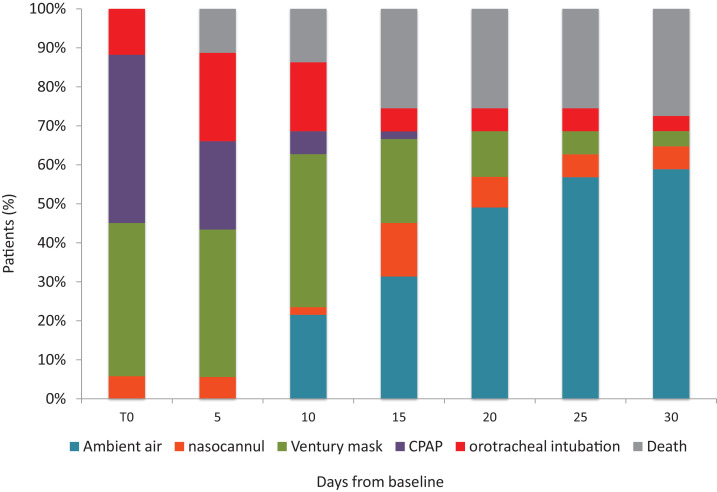
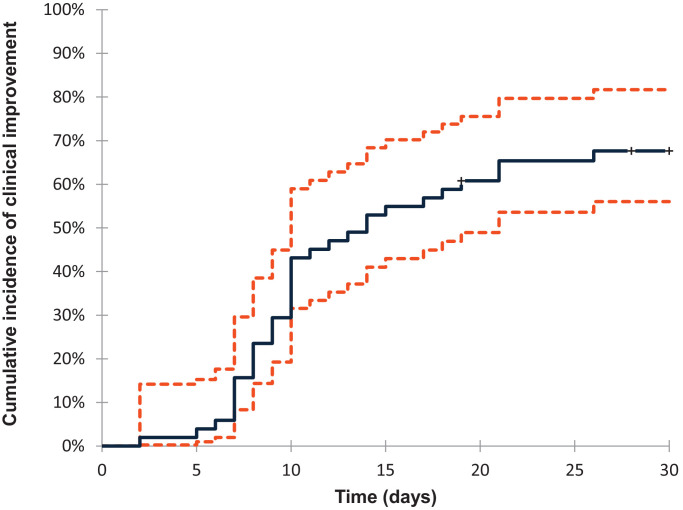
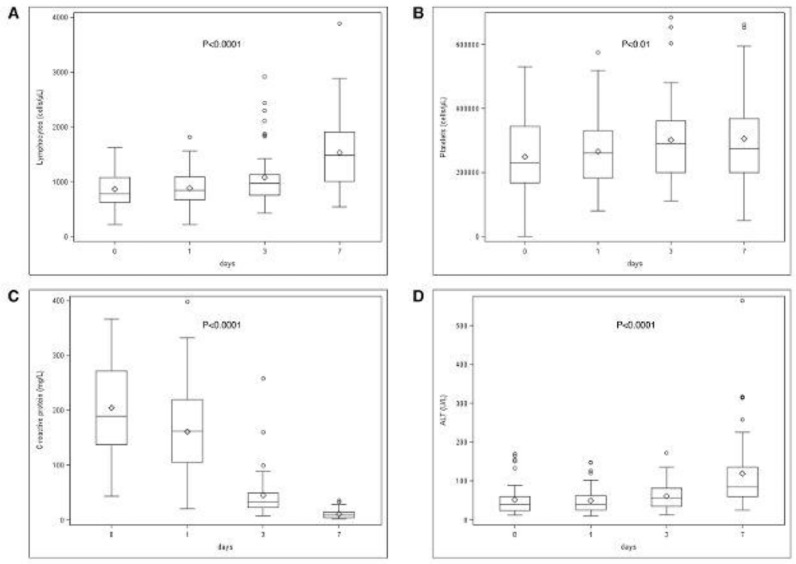
Results: Forty-five patients (88%) were on high-flow oxygen supplementation, six of whom with invasive ventilation. From baseline to day 7 after tocilizumab we observed a dramatic drop of body temperature and CRP value with a significant increase in lymphocyte count (p<0.001). Over a median follow-up time of 34 days from tocilizumab, 34 patients (67%) showed an improvement in their clinical severity class; 31 were discharged; 17 (33%) showed a worsening of their clinical status, of these 14 died (27%). The mortality rate was significantly associated with mechanical ventilation at baseline (83.3% vs 20% of patients on non-invasive oxygen support; p=0.0001). The most frequent side effects were an increase of hepatic enzymes (29%), thrombocytopenia (14%), and serious bacterial and fungal infections (27%).
Conclusion: Tocilizumab exerts a rapidly beneficial effect on fever and inflammatory markers, although no significant impact on the clinical outcome can be inferred by our results. Critically ill patients seem to have a high risk of serious infections with this drug.
Keywords: COVID-19; IL-6 inhibitors; tocilizumab.
Copyright © 2020 European Federation of Internal Medicine. Published by Elsevier B.V. All rights reserved.
Conflict of interest statement
Declaration of Competing Interests None.
Figures


Comment in
-
Tocilizumab for severe COVID-19: A promising intervention affecting inflammation and coagulation.Eur J Intern Med. 2020 Jun;76:21-22. doi: 10.1016/j.ejim.2020.05.018. Epub 2020 May 16. Eur J Intern Med. 2020. PMID: 32425364 Free PMC article. No abstract available.
References
-
- Zhu N, Zhang D, Wang W, Li X, Yang B, Song J, Zhao X, Huang B, Shi W, Lu R, Niu P, Zhan F, Ma X, Wang D, Xu W, Wu G, Gao GF, Tan W, China Novel Coronavirus Investigating, Research Team A novel coronavirus from patients with Pneumonia in China, 2019. N Engl J Med. 2020;382:727–733. doi: 10.1056/NEJMoa2001017. - DOI - PMC - PubMed
-
- Lu R, Zhao X, Li J, Niu P, Yang B, Wu H, Wang W, Song H, Huang B, Zhu N, Bi Y, Ma X, Zhan F, Wang L, Hu T, Zhou H, Hu Z, Zhou W, Zhao L, Chen J, Meng Y, Wang J, Lin Y, Yuan J, Xie Z, Ma J, Liu WJ, Wang D, Xu W, Holmes EC, Gao GF, Wu G, Chen W, Shi W, Tan W. Genomic characterisation and epidemiology of 2019 novel coronavirus: implications for virus origins and receptor binding. Lancet. 2020;395:565–574. doi: 10.1016/S0140-6736(20)30251-8. - DOI - PMC - PubMed
-
- European Centre for Disease Prevention and Control (ECDC). https://www.ecdc.europa.eu/en/geographical-distribution-2019-ncov-cases. [Accessed April 19, 2020].
-
- Spiteri G, Fielding J, Diercke M, Campese C, Enouf V, Gaymard A, Bella A, Sognamiglio P, Sierra Moros MJ, Riutort AN, Demina YV, Mahieu R, Broas M, Bengnér M, Buda S, Schilling J, Filleul L, Lepoutre A, Saura C, Mailles A, Levy-Bruhl D, Coignard B, Bernard-Stoecklin S, Behillil S, van der Werf S, Valette M, Lina B, Riccardo F, Nicastri E, Casas I, Larrauri A, Salom Castell M, Pozo F, Maksyutov RA, Martin C, Van Ranst M, Bossuyt N, Siira L, Sane J, Tegmark-Wisell K, Palmérus M, Broberg EK, Beauté J, Jorgensen P, Bundle N, Pereyaslov D, Adlhoch C, Pukkila J, Pebody R, Olsen S, Ciancio BC. First cases of coronavirus disease 2019 (COVID-19) in the WHO European Region, 24 January to 21 February 2020. Euro Surveill. 2020;25(9) doi: 10.2807/1560-7917.ES.2020.25.9.2000178. - DOI - PMC - PubMed
-
- WHO. Coronavirus Disease 2019 (COVID-19) Situation Report-90. https://www.who.int/emergencies/diseases/novel-coronavirus-2019/situatio.... [Accessed April 19, 2020].
MeSH terms
Substances
LinkOut - more resources
Full Text Sources
Medical
Research Materials
Miscellaneous
