Review
. 2020 Nov;77(22):4523-4551.
doi: 10.1007/s00018-020-03547-2. Epub 2020 May 24.

Metabolism and growth adaptation to environmental conditions in Drosophila

Affiliations
Review

Metabolism and growth adaptation to environmental conditions in Drosophila

Takashi Koyama et al. Cell Mol Life Sci. 2020 Nov.

Abstract

Organisms adapt to changing environments by adjusting their development, metabolism, and behavior to improve their chances of survival and reproduction. To achieve such flexibility, organisms must be able to sense and respond to changes in external environmental conditions and their internal state. Metabolic adaptation in response to altered nutrient availability is key to maintaining energy homeostasis and sustaining developmental growth. Furthermore, environmental variables exert major influences on growth and final adult body size in animals. This developmental plasticity depends on adaptive responses to internal state and external cues that are essential for developmental processes. Genetic studies have shown that the fruit fly Drosophila, similarly to mammals, regulates its metabolism, growth, and behavior in response to the environment through several key hormones including insulin, peptides with glucagon-like function, and steroid hormones. Here we review emerging evidence showing that various environmental cues and internal conditions are sensed in different organs that, via inter-organ communication, relay information to neuroendocrine centers that control insulin and steroid signaling. This review focuses on endocrine regulation of development, metabolism, and behavior in Drosophila, highlighting recent advances in the role of the neuroendocrine system as a signaling hub that integrates environmental inputs and drives adaptive responses.

Keywords: Adipokinetic hormone; Drosophila; Ecdysone; Insulin; Metabolism; PTTH.


Figures
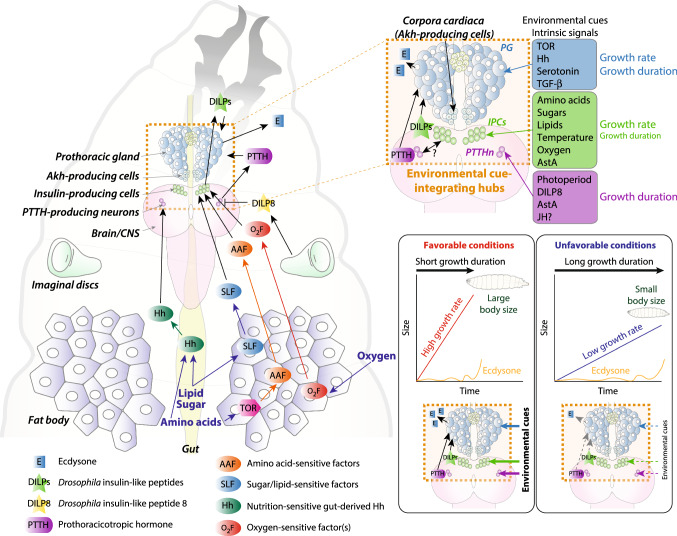
Fig. 1
Fig. 1
Growth-regulating environmental and internal cues are integrated through inter-organ communication in the Drosophila larva. In the main panel, larval organs communicate with one another via diffusible factors to govern growth and development. The upper right panel shows a magnified view of the larval central nervous system including the insulin-producing cells (IPCs) and PTTH-producing neurons (PTTHn) and the ring gland, which comprises the ecdysone-synthesizing prothoracic gland (PG), the Akh-producing cells (APCs) of the corpora cardiaca (CC), and the JH-producing corpora allata (between the lobes of the PG). Factors that act on growth and development via these various cells are indicated. The bottom-right schematic illustrates the relationships between size, growth rate, and growth duration
Fig. 2
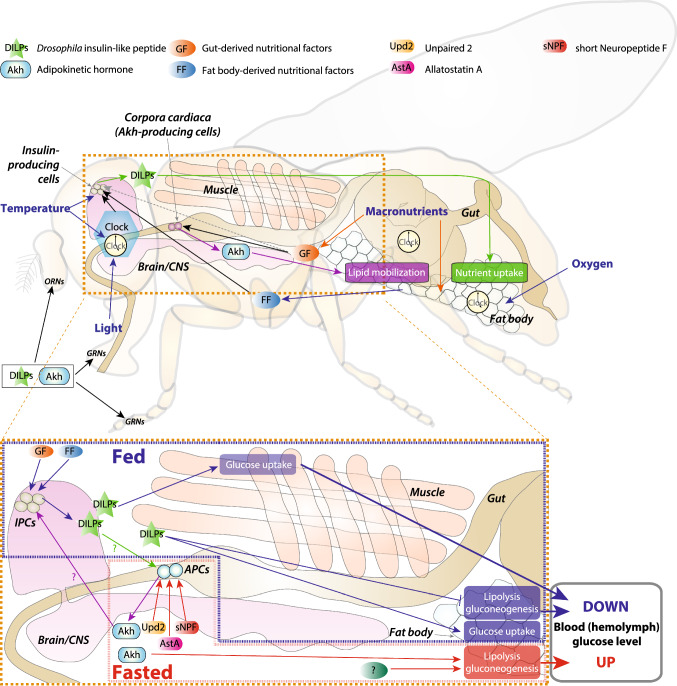
Fig. 2
Metabolism and behavior are regulated via the integration of environmental and internal cues through inter-organ communications in Drosophila adults. The top panel shows adult organs and the diffusible factors that link them to control metabolism and feeding behaviors. Circadian clocks are located within the brain as well as in peripheral tissues and regulate tissue physiology. Gustatory and olfactory receptor neurons (GRNs and ORNs) are regulated by DILP and Akh signaling (as well as many other factors) and influence feeding behavior. The bottom panel schematizes adult organs and interactions that govern the level of circulating sugars

References

    1. Lemaitre B, Miguel-Aliaga I. The digestive tract of Drosophila melanogaster. Annu Rev Genet. 2013;47:377–404. doi: 10.1146/annurev-genet-111212-133343. - DOI - PubMed
    1. Sondergaard L. Homology between the mammalian liver and the Drosophila fat body. Trends Genet. 1993;9(6):193. doi: 10.1016/0168-9525(93)90113-v. - DOI - PubMed
    1. Gutierrez E, Wiggins D, Fielding B, Gould AP. Specialized hepatocyte-like cells regulate Drosophila lipid metabolism. Nature. 2007;445(7125):275–280. doi: 10.1038/nature05382. - DOI - PubMed
    1. Danielsen ET, Moeller ME, Rewitz KF. Nutrient signaling and developmental timing of maturation. Curr Top Dev Biol. 2013;105:37–67. doi: 10.1016/B978-0-12-396968-2.00002-6. - DOI - PubMed
    1. Rewitz KF, Yamanaka N, O'Connor MB. Developmental checkpoints and feedback circuits time insect maturation. Curr Top Dev Biol. 2013;103:1–33. doi: 10.1016/B978-0-12-385979-2.00001-0. - DOI - PMC - PubMed

LinkOut - more resources