


Relationship between MLH1, PMS2, MSH2 and MSH6 gene-specific alterations and tumor mutational burden in 1057 microsatellite instability-high solid tumors
- PMID: 32449172
- PMCID: PMC7530095
- DOI: 10.1002/ijc.33115
Relationship between MLH1, PMS2, MSH2 and MSH6 gene-specific alterations and tumor mutational burden in 1057 microsatellite instability-high solid tumors
Abstract
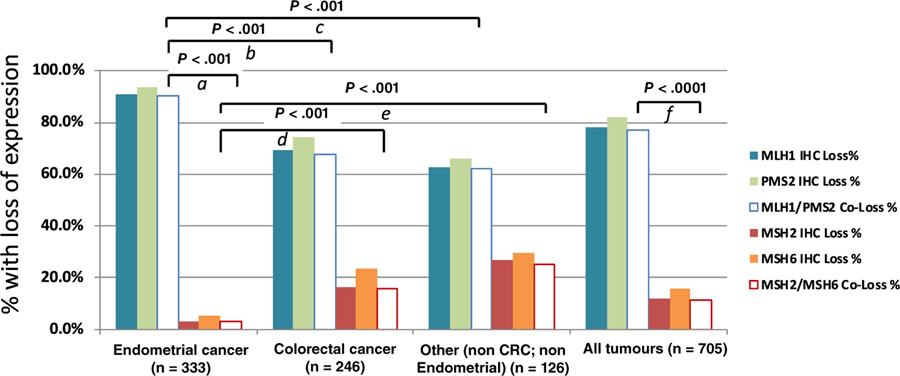
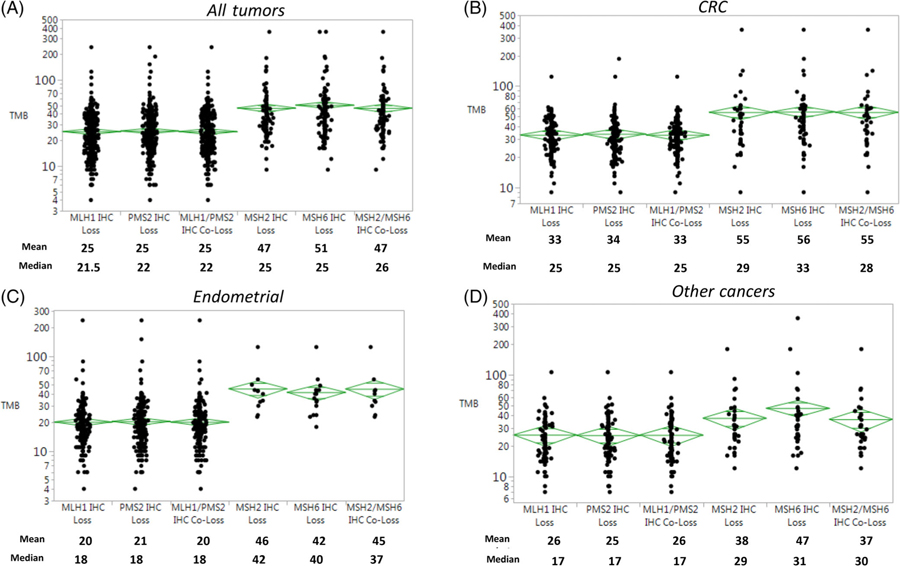
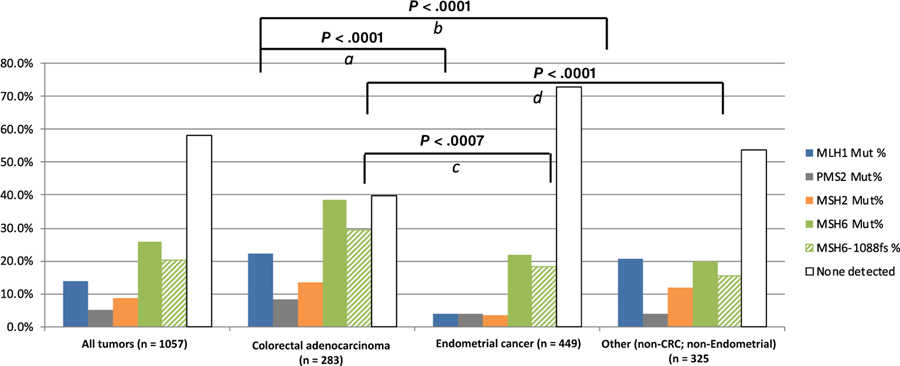
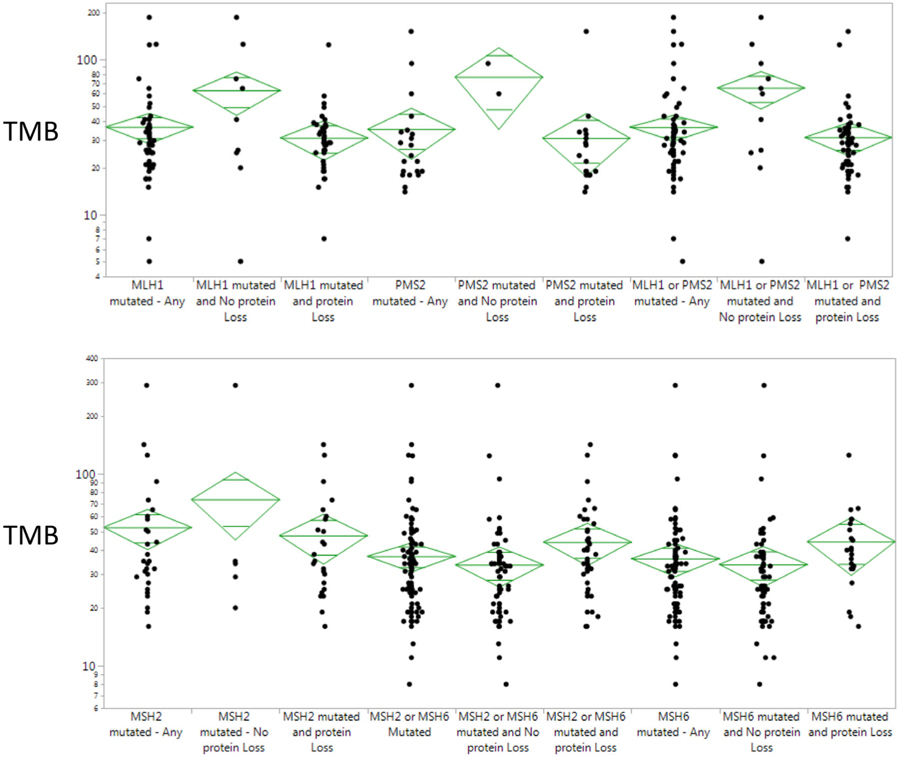
Microsatellite instability-high (MSI-H) and tumor mutational burden (TMB) are predictive biomarkers for immune-checkpoint inhibitors (ICIs). Still, the relationship between the underlying cause(s) of MSI and TMB in tumors remains poorly defined. We investigated associations of TMB to mismatch repair (MMR) protein expression patterns by immunohistochemistry (IHC) and MMR mutations in a diverse sample of tumors. Hypothesized differences were identified by the protein/gene affected/mutated and the tumor histology/primary site. Overall, 1057 MSI-H tumors were identified from the 32 932 tested. MSI was examined by NGS using 7000+ target microsatellite loci. TMB was calculated using only nonsynonymous missense mutations sequenced with a 592-gene panel; a subset of MSI-H tumors also had MMR IHC performed. Analyses examined TMB by MMR protein heterodimer impacted (loss of MLH1/PMS2 vs. MSH2/MSH6 expression) and gene-specific mutations. The sample was 54.6% female; mean age was 63.5 years. Among IHC tested tumors, loss of co-expression of MLH1/PMS2 was more common (n = 544/705, 77.2%) than loss of MSH2/MSH6 (n = 81/705, 11.5%; P < .0001), and was associated with lower mean TMB (MLH1/PMS2: 25.03 mut/Mb vs MSH2/MSH6 46.83 mut/Mb; P < .0001). TMB also varied by tumor histology: colorectal cancers demonstrating MLH1/PMS2 loss had higher TMBs (33.14 mut/Mb) than endometrial cancers (20.60 mut/Mb) and other tumors (25.59 mut/Mb; P < .0001). MMR gene mutations were detected in 42.0% of tumors; among these, MSH6 mutations were most common (25.7%). MSH6 mutation patterns showed variability by tumor histology and TMB. TMB varies by underlying cause(s) of MSI and tumor histology; this heterogeneity may contribute to differences in response to ICI.
Keywords: MSI; TMB; immune checkpoint inhibitors; microsatellite instability; mismatch repair; tumor mutational burden.
© 2020 UICC.
Conflict of interest statement
CONFLICT OF INTEREST
Drs J. N. B., A. P., E. S. K., A. F. S., A. G. and W. M. W. declare no potential conflicts of interest. Dr J. X. is employed by Caris Life Sciences. Dr W. M. K. is employed by Caris Life Sciences and stock option holder with Caris Life Sciences, consultant for Merck and Sharp & Dohme. Dr J. L. M. was an interim CMO in 2018 for Caris Life Sciences, is consultant and speaker for Merck, Genentech, Bayer, Taiho, Amgen, Celgene. Dr R. M. G. is consultant for Merck, Taiho, Genentech, Novartis. Dr M. E. S. received travel support from Caris Life Sciences, and is consultant and speaker for Taiho, BMS, Merck. Dr H.-F. L. is advisory board for Caris Life Sciences and BMS. Dr M. J. H. received travel support from Caris Life Sciences, and performed collaborative research with Myriad Genetics, Invitae, Gene Dx, Ambry Genetics Corporation and Caris Life Sciences. His institution received payments for the Keynote-177 trial (Merck) and for the POLO trial (AstraZeneca) based on patients accrual as PI site.
Figures
References
-
- Li GM. Mechanisms and functions of DNA mismatch repair. Cell Res. 2008;18(1):85–98. - PubMed
Publication types
MeSH terms
Substances
Grants and funding
LinkOut - more resources
Full Text Sources
Medical
Miscellaneous
