. 2020 May 25;10(1):8632.
doi: 10.1038/s41598-020-65618-5.

Transient receptor potential ankyrin 1 contributes to somatic pain hypersensitivity in experimental colitis

Affiliations

Transient receptor potential ankyrin 1 contributes to somatic pain hypersensitivity in experimental colitis

Piyush Jain et al. Sci Rep. .

Abstract

Pain evoked by visceral inflammation is often 'referred' to the somatic level. Transient receptor potential ankyrin 1 (TRPA1) has been reported to contribute to visceral pain-like behavior in dextran sulfate sodium (DSS)-evoked colitis. However, the role of TRPA1 in somatic component of hypersensitivity due to visceral inflammation is unknown. The present study investigated the role of TRPA1 in colitis-evoked mechanical hypersensitivity at the somatic level. Colitis was induced in mice by adding DSS to drinking water for one week. Control and DSS-treated mice were tested for various parameters of colitis as well as mechanical pain sensitivity in abdominal and facial regions. DSS treatment caused mechanical hypersensitivity in the abdominal and facial skin. Pharmacological blockade or genetic deletion of TRPA1 prevented the colitis-associated mechanical hypersensitivity in the abdominal and facial skin areas although the severity of colitis remained unaltered. DSS treatment increased expression of TRPA1 mRNA in cultured dorsal root ganglion (DRG) neurons, but not trigeminal ganglion neurons, and selectively enhanced currents evoked by the TRPA1 agonist, allyl isothiocyanate, in cultured DRG neurons. Our findings indicate that the TRPA1 channel contributes to colitis-associated mechanical hypersensitivity in somatic tissues, an effect associated with upregulation of TRPA1 expression and responsiveness in DRG nociceptors.


Conflict of interest statement

The authors declare no competing interests.

Figures

Figure 1
Figure 1
Effect of HC-030031 (HC) or its vehicle (Veh) in control (Con) mice and mice treated with DSS for 7 days on mechanical pain sensitivity of the abdominal (a,b) and periorbital (facial, c) region measured on day 0 (basal conditions, a) and day 8 (b,c). HC (100 mg/kg, i.p.) or its vehicle was injected one hour prior to the test. Values are expressed as means +/− SEM (n = 8). Repeated measures ANOVA did not show any DSS × HC × forces interaction in the withdrawal responses to abdominal stimulation under basal conditions (a). Under post Veh/HC conditions (b), repeated measures ANOVA demonstrated a DSS × HC × forces interaction at the 0.008, 0.02 (P < 0.01) and 0.04 g (P < 0.001) test forces. Bonferroni’s multiple comparison analysis revealed that the withdrawal responses to forces of 0.008 g (P < 0.001 vs. Con + Veh), 0.02 g (P < 0.001 vs. Con + Veh) and 0.04 g (P < 0.001 vs. Con + Veh) were significantly increased in DSS-treated mice (b). HC-030031 administration to DSS-treated mice led to a significant decrease in the withdrawal response to forces of 0.008 g (P < 0.01 vs. DSS + Veh), 0.02 g (P < 0.001 vs. DSS + Veh) and 0.04 g (P < 0.001 vs. DSS + Veh). In the periorbital (facial) region, there was no DSS × HC interaction and any DSS or HC effect on the withdrawal threshold to mechanical stimulation under basal conditions (two-way ANOVA, c). Two-way ANOVA of the data obtained under pre Veh/HC conditions revealed a DSS effect (aP < 0.001, c), and post-hoc Bonferroni’s multiple comparison analysis demonstrated significant differences under post Veh/HC conditions: *P < 0.05 vs. Con + Veh, $P < 0.05 vs. DSS + Veh (c).
Figure 2
Figure 2
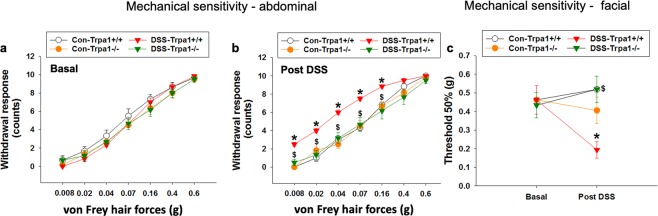
Effect of genetic deletion of TRPA1 in control (Con) mice and mice treated with DSS for 7 days on mechanical pain sensitivity of the abdomen (a,b) and periorbital (facial, c) region measured on day 0 (basal conditions, a) and day 8 (b,c). Values are expressed as means +/− SEM (n = 6). Repeated measures ANOVA did not show any DSS × genotype × forces interaction in the withdrawal response to abdominal stimulation under basal conditions (a). Following control or DSS treatment (post DSS, b), repeated measures ANOVA demonstrated a DSS × genotype × forces interaction at the 0.008 g (P < 0.001), 0.02 g (P < 0.01), 0.04 g (P < 0.05), 0.07 g and 0.16 g (P < 0.001) test forces. Bonferroni’s multiple comparison analysis revealed that the withdrawal responses to forces of 0.008 g, 0.02 g, 0.04 g, 0.07 g (P < 0.001 vs. Con-Trpa1+/+) and 0.16 g (P < 0.05 vs. Con-Trpa1+/+) were significantly increased in DSS-treated Trpa1+/+ (DSS-Trpa1+/+) mice (b). In DSS-treated Trpa1−/− (DSS-Trpa1−/−) mice the withdrawal responses to forces of 0.008 g, 0.02 g, 0.04 g (P < 0.001 vs. DSS-Trpa1+/+), 0.07 g and 0.16 g (P < 0.01 vs. DSS-Trpa1+/+) were significantly smaller than in DSS-treated Trpa1+/+ mice (b). In the periorbital (facial) region, there was no DSS × genotype interaction and any DSS or genotype effect on the withdrawal threshold to mechanical stimulation under basal conditions (two-way ANOVA, c). Two-way ANOVA of the data obtained after DSS treatment (post DSS) disclosed a DSS × genotype interaction (P < 0.01), and post-hoc Bonferroni’s multiple comparison analysis demonstrated significant differences under post DSS conditions: *P < 0.05 vs. Con-Trpa1+/+; $P < 0.05 vs. DSS-Trpa1+/+ (b,c).
Figure 3
Figure 3
Effect of the selective TRPA1 antagonist HC-030031 (HC) or its vehicle (Veh) on colitis-related parameters (a–e) in control (Con) and DSS-treated mice. The parameters were measured on day 8 following a 7-day treatment period (study 1, set 1). HC (100 mg/kg, i.p.) or its vehicle was injected one hour prior to sacrifice of mice. The body weight change shown in panel A is calculated as a percentage of the weight measured before the treatment started. Values are expressed as means +/− SEM (n = 8 mice, A–D) (n = 3–4 mice, E). Two-way ANOVA did not show any DSS × HC interaction and any HC effect, but revealed a DSS effect (aP < 0.05 vs. Con).
Figure 4
Figure 4
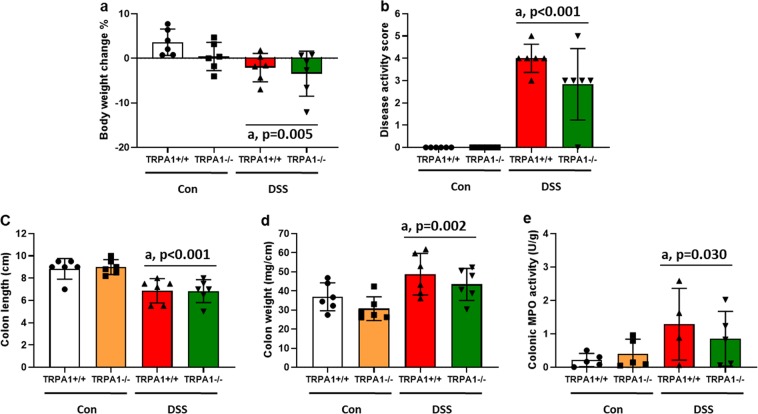
Effect of genetic deletion of TRPA1 on colitis-related parameters (a–e) in control (Con) and DSS-treated mice. The parameters were measured on day 8 following a 7-day treatment period (study 1, set 2). Values are expressed as means +/− SEM (n = 6 mice, A-D) (n = 5 mice, E). Two-way ANOVA did not show any interaction between DSS × genotype and any genetic deletion effect but revealed a DSS effect (aP < 0.05 vs. Con).
Figure 5
Figure 5
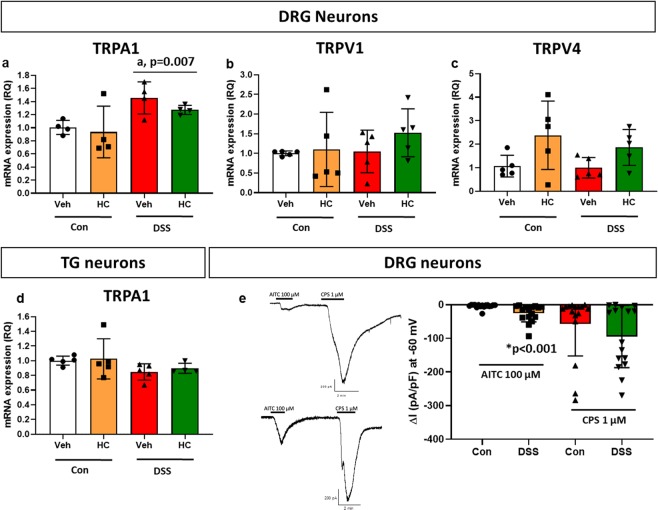
Effect of HC-030031 (HC) or its vehicle (Veh) on expression of TRPA1, TRPV1 and TRPV4 mRNA in lumbosacral DRGs (a–c) and TGs (d) isolated from control (Con) mice and mice treated with DSS for 7 days. HC (100 mg/kg, i.p.) or its vehicle was injected one hour prior to sacrifice of mice. Values are expressed as means + SEM (n = 4–5). Two-way ANOVA did not show any DSS × HC interaction and any HC effect but revealed a DSS effect on the expression of TRPA1 mRNA (aP < 0.05). (e) typical traces and pooled data of the inward currents evoked by AITC and capsaicin (CPS) in thoracosacral DRG neurons isolated from control (Con) mice and mice treated with DSS for 7 days. ΔI refers to the difference between current amplitude measured at -60 mV before and after application of AITC/CPS. The inward currents are shown as current density pA/pF. Values are expressed as means - SEM (n = 16 neurons from 3 mice/group). Mann-Whitney U test demonstrated a significant difference between the AITC responses of the Con and DSS groups (*P < 0.05).

References

    1. Baumgart Daniel C, Sandborn William J. Crohn's disease. The Lancet. 2012;380(9853):1590–1605. - PubMed
    1. Ordás Ingrid, Eckmann Lars, Talamini Mark, Baumgart Daniel C, Sandborn William J. Ulcerative colitis. The Lancet. 2012;380(9853):1606–1619. - PubMed
    1. Halpin Stephen J, Ford Alexander C. Prevalence of Symptoms Meeting Criteria for Irritable Bowel Syndrome in Inflammatory Bowel Disease: Systematic Review and Meta-Analysis. American Journal of Gastroenterology. 2012;107(10):1474–1482. - PubMed
    1. Schirbel Anja. Impact of pain on health-related quality of life in patients with inflammatory bowel disease. World Journal of Gastroenterology. 2010;16(25):3168. - PMC - PubMed
    1. Bielefeldt Klaus, Davis Brian, Binion David G. Pain and inflammatory bowel disease. Inflammatory Bowel Diseases. 2009;15(5):778–788. - PMC - PubMed

Publication types

MeSH terms

Substances

LinkOut - more resources