


Using Reports of Symptoms and Diagnoses on Social Media to Predict COVID-19 Case Counts in Mainland China: Observational Infoveillance Study
- PMID: 32452804
- PMCID: PMC7257484
- DOI: 10.2196/19421
Using Reports of Symptoms and Diagnoses on Social Media to Predict COVID-19 Case Counts in Mainland China: Observational Infoveillance Study
Abstract
Background: Coronavirus disease (COVID-19) has affected more than 200 countries and territories worldwide. This disease poses an extraordinary challenge for public health systems because screening and surveillance capacity is often severely limited, especially during the beginning of the outbreak; this can fuel the outbreak, as many patients can unknowingly infect other people.
Objective: The aim of this study was to collect and analyze posts related to COVID-19 on Weibo, a popular Twitter-like social media site in China. To our knowledge, this infoveillance study employs the largest, most comprehensive, and most fine-grained social media data to date to predict COVID-19 case counts in mainland China.
Methods: We built a Weibo user pool of 250 million people, approximately half the entire monthly active Weibo user population. Using a comprehensive list of 167 keywords, we retrieved and analyzed around 15 million COVID-19-related posts from our user pool from November 1, 2019 to March 31, 2020. We developed a machine learning classifier to identify "sick posts," in which users report their own or other people's symptoms and diagnoses related to COVID-19. Using officially reported case counts as the outcome, we then estimated the Granger causality of sick posts and other COVID-19 posts on daily case counts. For a subset of geotagged posts (3.10% of all retrieved posts), we also ran separate predictive models for Hubei province, the epicenter of the initial outbreak, and the rest of mainland China.
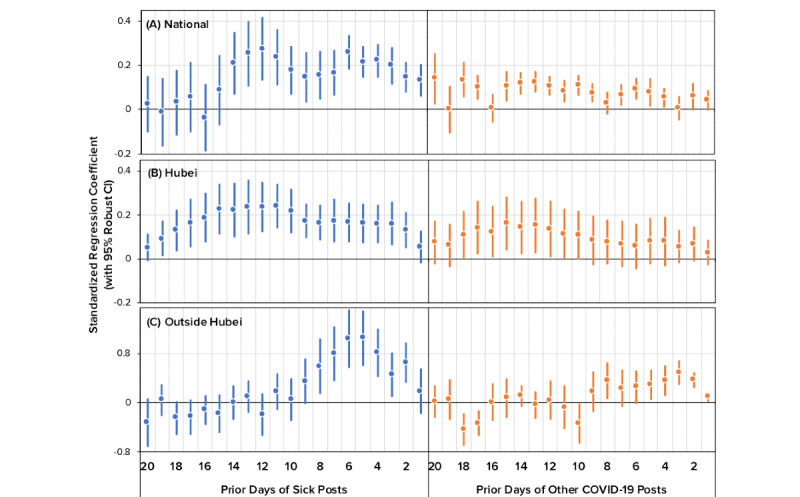
Results: We found that reports of symptoms and diagnosis of COVID-19 significantly predicted daily case counts up to 14 days ahead of official statistics, whereas other COVID-19 posts did not have similar predictive power. For the subset of geotagged posts, we found that the predictive pattern held true for both Hubei province and the rest of mainland China regardless of the unequal distribution of health care resources and the outbreak timeline.
Conclusions: Public social media data can be usefully harnessed to predict infection cases and inform timely responses. Researchers and disease control agencies should pay close attention to the social media infosphere regarding COVID-19. In addition to monitoring overall search and posting activities, leveraging machine learning approaches and theoretical understanding of information sharing behaviors is a promising approach to identify true disease signals and improve the effectiveness of infoveillance.
Keywords: COVID-19; China; SARS-CoV-2; Weibo; disease surveillance; infectious disease; infodemiology; infoveillance; novel coronavirus; social media; surveillance.
©Cuihua Shen, Anfan Chen, Chen Luo, Jingwen Zhang, Bo Feng, Wang Liao. Originally published in the Journal of Medical Internet Research (http://www.jmir.org), 28.05.2020.
Conflict of interest statement
Conflicts of Interest: None declared.
Figures
References
-
- Huang C, Wang Y, Li X, Ren L, Zhao J, Hu Y, Zhang L, Fan G, Xu J, Gu X, Cheng Z, Yu T, Xia J, Wei Y, Wu W, Xie X, Yin W, Li H, Liu M, Xiao Y, Gao H, Guo L, Xie J, Wang G, Jiang R, Gao Z, Jin Q, Wang J, Cao B. Clinical features of patients infected with 2019 novel coronavirus in Wuhan, China. Lancet. 2020 Feb;395(10223):497–506. doi: 10.1016/s0140-6736(20)30183-5. - DOI - PMC - PubMed
-
- Wu F, Zhao S, Yu B, Chen Y, Wang W, Song Z, Hu Y, Tao Z, Tian J, Pei Y, Yuan M, Zhang Y, Dai F, Liu Y, Wang Q, Zheng J, Xu L, Holmes EC, Zhang Y. A new coronavirus associated with human respiratory disease in China. Nature. 2020 Feb 3;579(7798):265–269. doi: 10.1038/s41586-020-2008-3. - DOI - PMC - PubMed
-
- World Health Organization. 2020. May 16, [2020-05-26]. Coronavirus disease 2019 (COVID-19) Situation Report 117 https://www.who.int/docs/default-source/coronaviruse/situation-reports/2....
-
- Zhang J, Centola D. Social Networks and Health: New Developments in Diffusion, Online and Offline. Annu Rev Sociol. 2019 Jul 30;45(1):91–109. doi: 10.1146/annurev-soc-073117-041421. - DOI
-
- Chew C, Eysenbach G. Pandemics in the age of Twitter: content analysis of Tweets during the 2009 H1N1 outbreak. PLoS One. 2010 Nov 29;5(11):e14118. doi: 10.1371/journal.pone.0014118. http://dx.plos.org/10.1371/journal.pone.0014118 - DOI - PMC - PubMed
MeSH terms
LinkOut - more resources
Full Text Sources
Other Literature Sources
Miscellaneous
