Review
. 2020 Jul 15:111:20-28.
doi: 10.1016/j.actbio.2020.05.026. Epub 2020 May 23.

Self-assembling prodrug nanotherapeutics for synergistic tumor targeted drug delivery

Affiliations
Review

Self-assembling prodrug nanotherapeutics for synergistic tumor targeted drug delivery

Zhiren Wang et al. Acta Biomater. .

Abstract

Self-assembling prodrugs represents a robust and effective nanotherapeutic approach for delivering poorly soluble anticancer drugs. With numerous intrinsic advantages, self-assembling prodrugs possess the maximum drug loading capacity, controlled drug release kinetics, prolonged blood circulation, and preferential tumor accumulation based on the enhanced permeability and retention (EPR) effect. These prodrug conjugates allow for efficient self-assembly into nanodrugs with the potential of encapsulating other therapeutic agents that have different molecular targets, enabling simultaneous temporal-spatial release of drugs for synergistic antitumor efficacy with reduced systemic side effects. The aim of this review is to summarize the recent progress of self-assembling prodrug cancer nanotherapeutics that are made through conjugating therapeutically active agents to Polyethylene glycol, Vitamin E, or drugs with different physicochemical properties via rational design, for synergistic tumor targeted drug delivery. STATEMENT OF SIGNIFICANCE: All current FDA-approved nanomedicines use inert biomaterials as drug delivery carriers. These biomaterials lack any therapeutic potential, contributing not only to the cost, but may also elicit severe unfavorable adverse effects. Despite the reduction in toxicity associated with the payload, these nanotherapeutics have been met with limited clinical success, likely due to the monotherapy regimen. The self-assembling prodrug (SAP) has been emerging as a powerful platform for enhancing efficacy through co-delivering other therapeutic modalities with distinct molecular targets. Herein, we opportunely present a comprehensive review article summarizing three unique approaches of making SAP for synergistic drug delivery: pegylation, vitamin E-derivatization, and drug-drug conjugation. These SAPs may inevitably pave the way for developing more efficacious, clinically translatable, combination cancer nanotherapies.

Keywords: Enhanced Cancer Therapy; Nanotherapeutics; Self-assembling prodrug; Synergistic drug delivery.


Conflict of interest statement

Declaration of Competing Interest There are no conflicts of interest to declare.

Figures
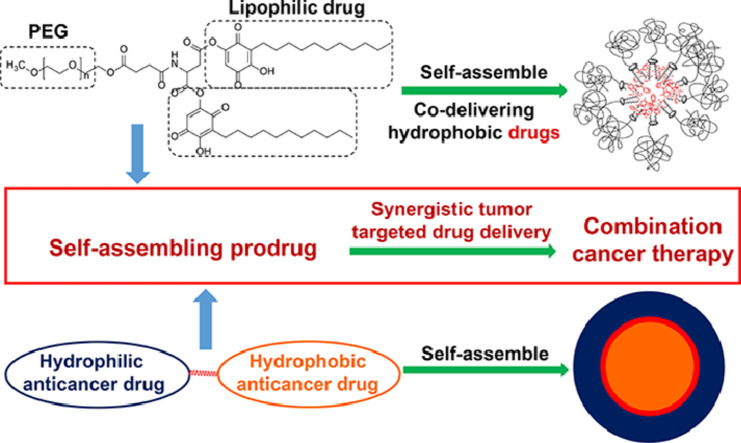
Image, graphical abstract
Graphical abstract
Fig 1
Fig. 1
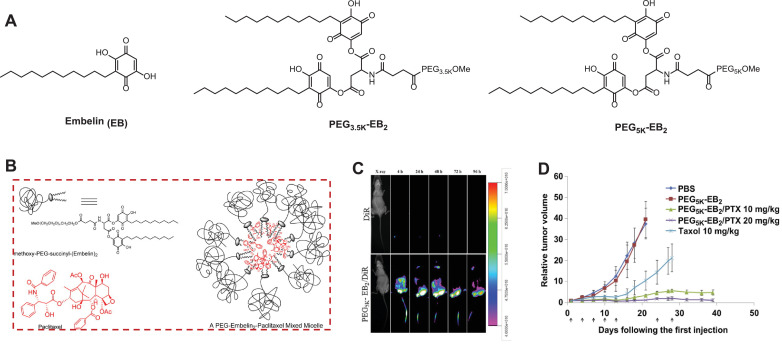
(A) Chemical structures of Embelin (EB), PEG3.5K-EB2, and PEG5K-EB2. (B) Schematic illustration of self-assembling PEG-EB2 prodrug conjugate with Paclitaxel loaded inside. (C) In vivo NIRF optical imaging of CL1 lung tumor-bearing SCID mice after intravenous (IV) injection of free DiR dye and DiR-loaded PEG5K-EB2 micelles. (D) Improved anticancer efficacy of PTX formulated in PEG5K-EB2 micelles in nude mice-bearing PC-3 prostate tumors. A week after injecting 2 × 106 cells/mouse subcutaneously, mice were IV administered with different treatments on days 1, 3, 7, 10, 13, 24, and 28, and relative tumor volume was plotted (N = 6). P < 0.005 (20 mg/kg PTX/PEG5K-EB2 vs. Taxol), P < 0.01(10 mg/kg PTX/PEG5K-EB2 vs. Taxol), P < 0.05 (20 mg/kg PTX/PEG5K-EB2 VS 10 mg/kg PTX/PEG5K-EB2). Reproduced with permission from [6,10,58] . (For interpretation of the references to colour in this figure legend, the reader is referred to the web version of this article.)
Fig 2
Fig. 2
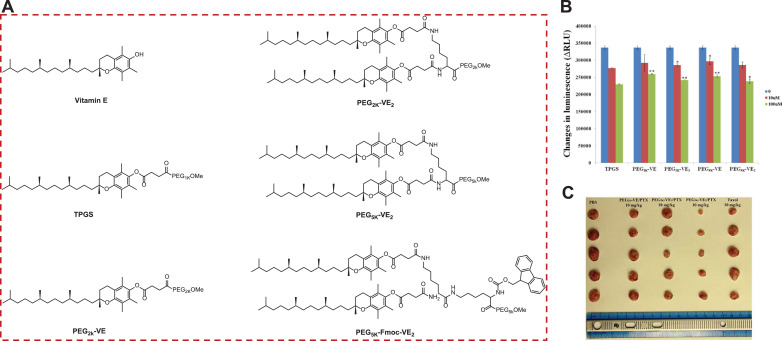
(A) Chemical structures of Vitamin E (VE), TPGS, PEG2K-VE, PEG2K-VE2, and PEG5K-VE2, PEG5K-Fmoc-VE2. (B) Inhibition on verapamil-stimulated P-gp ATPase activity for PEG-derived VE conjugates. *p < 0.05 and **p < 0.001 (vs TPGS of equivalent concentration). (C) The tumor images excised at the completion of the anticancer efficacy study in 4T1.2 breast tumor-bearing mice (n = 5), which were IV treated with various PEG-VE/PTX nanomicelles. P < 0.02 (PEG5K–VE2/PTX vs Taxol PEG2K–VE/PTX or FEG2K–VE2/PTX). Reproduced with permission from .
Fig 3
Fig. 3
Chemical structures of Salirasib (FTS), PEG5K-FTS2 (L, labile), and PEG5K-FTS2 (S, Stable). Reproduced with permission from .
Fig 4
Fig. 4
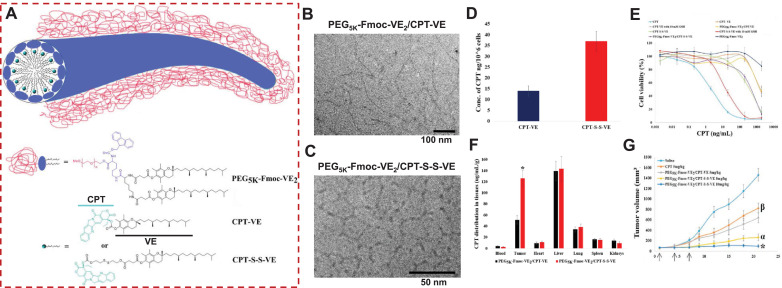
(A) Mechanistic representation of self-assembly of CPT-VE or CPT-S-S-VE to nanofibers upon stabilization by PEG5K-Fmoc-VE2. Cryo-electron microscopy (cryoEM) imaging of PEG5K-Fmoc-VE2/CPT-S-S-VE (B) and PEG5K-Fmoc-VE2/CPT-VE (C). (D) Intracellular release of CPT in 4T1.2 cells treated with CPT-VE and CPT-S-S-VE (100 ng/mL in terms of CPT) for 24 h. (E) The cytotoxicity of different CPT formulations in 4T1.2 cancer cells treated with indicated concentrations for 72 h and was then assessed by MTT assay. (F) Tissue biodistribution of PEG5K-Fmoc-VE2/CPT-VE and PEG5K-Fmoc-VE2/CPT-S-S-VE (5 mg CPT/kg) in 4T1.2-tumor bearing mice. *p < 0.001, compared to PEG5K-Fmoc-VE2/CPT-VE. (G) In vivo therapeutic efficacy of various VE-derived CPT prodrug nanotherapeutics in breast tumor mouse model (n = 5). Arrows stand for the IV injection. *p < 0.01, compared to PEG5K-Fmoc-VE2/CPT-S-S-VE (5 mg/kg); αp < 0.001, compared to PEG5K-Fmoc-VE2/CPT-VE (5 mg/kg) and CPT (5 mg/kg); βp < 0.001, compared to saline. Reproduced with permission from [9] . (For interpretation of the references to colour in this figure legend, the reader is referred to the web version of this article.)
Fig 5
Fig. 5
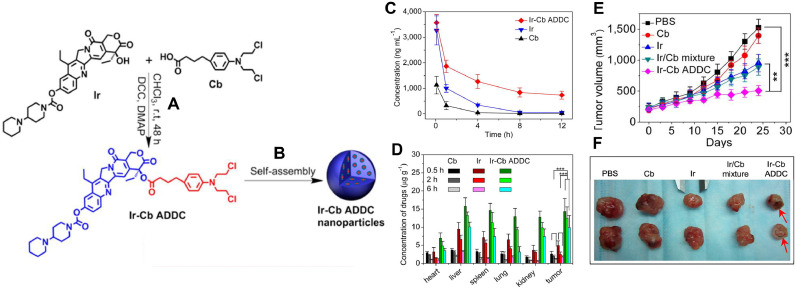
(A) Synthetic route of Irinotecan-Chlorambucil (Ir-Cb) amphiphilic drug-drug conjugates (ADDC). (B) The Ir–Cb ADDC self-assembles into spherical nanoparticles. (C) Representative plasma concentration–time profiles of free Cb, Ir, and Ir–Cb ADDC after IV injection into rats (a dose of 8 mg/kg) (n = 4). (D) Tissue distribution of Cb, Ir, and Ir–Cb ADDC after IV administration of free Cb (3.5 mg/kg), Ir (6.7 mg/kg), and Ir–Cb ADDC nanoparticles (10 mg/kg) in MCF-7 tumor-bearing nude mice (n = 4). (E) Changes of tumor volume post IV injection of PBS, Cb, Ir, Ir/Cb mixture, and Ir–Cb ADDC nanoparticles in MCF-7 tumor-bearing nude mice (n = 6). (F) Representative tumors separated from animals after IV injection of PBS, Cb, Ir, Ir/Cb mixture, and Ir–Cb ADDC nanoparticles. Data are represented as average ± standard error. Statistical significance: **P < 0.005; ***P < 0.001. Reproduced with permission from .

References

    1. Zhang Y., Huang Y., Li S. Polymeric micelles: nanocarriers for cancer-targeted drug delivery. AAPS Pharm. Sci. Tech. 2014;15(4):862–871. - PMC - PubMed
    1. Peer D., Karp J.M., Hong S., Farokhzad O.C., Margalit R., Langer R. Nanocarriers as an emerging platform for cancer therapy. Nat. Nanotechnol. 2007;2(12):751–760. - PubMed
    1. Senapati S., Mahanta A.K., Kumar S., Maiti P. Controlled drug delivery vehicles for cancer treatment and their performance. Signal Trans. Targeted Ther. 2018;3:7. - PMC - PubMed
    1. Yingchoncharoen P., Kalinowski D.S., Richardson D.R. Lipid-based drug delivery systems in cancer therapy: what is available and what is yet to come. Pharmacol. Rev. 2016;68(3):701–787. - PMC - PubMed
    1. Torchilin V.P. Micellar nanocarriers: pharmaceutical perspectives. Pharm. Res. 2007;24(1):1–16. - PubMed

Publication types