


Adapting IAPT services to support frontline NHS staff during the Covid-19 pandemic: the Homerton Covid Psychological Support (HCPS) pathway
- PMID: 32454891
- PMCID: PMC7235312
- DOI: 10.1017/S1754470X20000148
Adapting IAPT services to support frontline NHS staff during the Covid-19 pandemic: the Homerton Covid Psychological Support (HCPS) pathway
Abstract
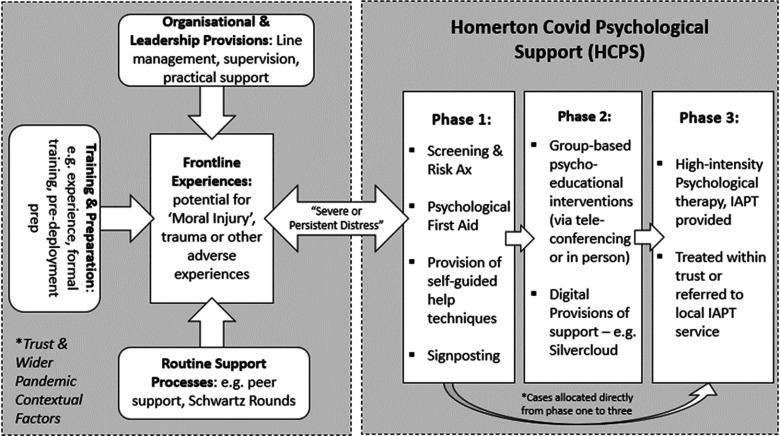
The Coronavirus (Covid-19) pandemic is exerting unprecedented pressure on NHS Health and Social Care provisions, with frontline staff, such as those of critical care units, encountering vast practical and emotional challenges on a daily basis. Although staff are being supported through organisational provisions, facilitated by those in leadership roles, the emergence of mental health difficulties or the exacerbation of existing ones amongst these members of staff is a cause for concern. Acknowledging this, academics and healthcare professionals alike are calling for psychological support for frontline staff, which not only addresses distress during the initial phases of the outbreak but also over the months, if not years, that follow. Fortunately, mental health services and psychology professional bodies across the United Kingdom have issued guidance to meet these needs. An attempt has been made to translate these sets of guidance into clinical provisions via the recently established Homerton Covid Psychological Support (HCPS) pathway delivered by Talk Changes (Hackney & City IAPT). This article describes the phased, stepped-care and evidence-based approach that has been adopted by the service to support local frontline NHS staff. We wish to share our service design and pathway of care with other Improving Access to Psychological Therapies (IAPT) services who may also seek to support hospital frontline staff within their associated NHS Trusts and in doing so, lay the foundations of a coordinated response.
Key learning aims: (1)To understand the ways staff can be psychologically and emotionally impacted by working on the frontline of disease outbreaks.(2)To understand the ways in which IAPT services have previously supported populations exposed to crises.(3)To learn ways of delivering psychological support and interventions during a pandemic context based on existing guidance and research.
Keywords: IAPT; cognitive behavioural therapy; disaster response; healthcare workers; pandemic; trauma.
© British Association for Behavioural and Cognitive Psychotherapies 2020.
Figures
References
-
- Albert, I. (2019). Psychological Trauma Outreach, Screen and Support Service for London Terrorist Incidents October 2017–September 2019 Retrieved from: https://www.kcl.ac.uk/ioppn/depts/pm/research/imparts/Quick-links/Semina...
-
- Babin, B. J. , & Boles, J. S. (1996). The effects of perceived co-worker involvement and supervisor support on service provider role stress, performance and job satisfaction. Journal of Retailing, 72, 57–75. 10.1016/S0022-4359(96)90005-6 - DOI
-
- Bailey, A. , & Heke, S. (2019). Real World Trauma Therapy in a Changing Environment. Workshop as part of ‘Making CBT Work in Challenging Times, London.
-
- Beck, A. (2019). Understanding Black and Minority Ethnic service users’ experience of racism as part of the assessment, formulation and treatment of mental health problems in cognitive behaviour therapy. the Cognitive Behaviour Therapist, 12. doi: 10.1017/S1754470X18000223 - DOI
-
- Billings J., Kember, T. , Greene, T. , Grey, N. , El-Leithy, S. , Lee, D. , … & Bloomfield, M. (2020). Guidance for Planners of the Psychological Response to Stress Experienced by Hospital Staff Associated with COVID: Early Interventions Retrieved from: https://232fe0d6-f8f4-43eb-bc5d-6aa50ee47dc5.filesusr.com/ugd/6b474f_562...
Grants and funding
LinkOut - more resources
Full Text Sources