Review
. 2020 May 8:2020:1954398.
doi: 10.1155/2020/1954398. eCollection 2020.

Unveiling the Role of Inflammation and Oxidative Stress on Age-Related Cardiovascular Diseases

Affiliations
Review

Unveiling the Role of Inflammation and Oxidative Stress on Age-Related Cardiovascular Diseases

Arthur José Pontes Oliveira de Almeida et al. Oxid Med Cell Longev. .

Abstract

The global population above 60 years has been growing exponentially in the last decades, which is accompanied by an increase in the prevalence of age-related chronic diseases, highlighting cardiovascular diseases (CVDs), such as hypertension, atherosclerosis, and heart failure. Aging is the main risk factor for these diseases. Such susceptibility to disease is explained, at least in part, by the increase of oxidative stress, in which it damages cellular components such as proteins, DNA, and lipids. In addition, the chronic inflammatory process in aging "inflammaging" also contributes to cell damage, creating a stressful environment which drives to the development of CVDs. Taken together, it is possible to identify the molecular connection between oxidative stress and the inflammatory process, especially by the crosstalk between the transcription factors Nrf-2 and NF-κB which are mediated by redox signalling and are involved in aging. Therapies that control this process are key targets in the prevention/combat of age-related CVDs. In this review, we show the basics of inflammation and oxidative stress, including the crosstalk between them, and the implications on age-related CVDs.


Conflict of interest statement

The authors report no conflict of interests.

Figures
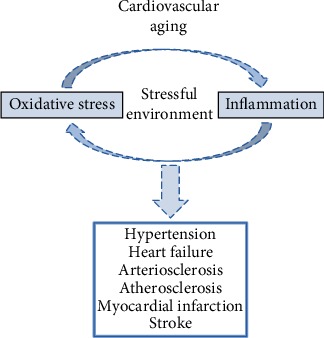
Figure 1
Figure 1
Aging and CVDs. The cardiac and arterial aging is characterized by a stressful environment to the cells, derived, at least in part, from the high levels of oxidative stress and chronic inflammation. The crosstalk between them is a vicious and gradual cycle, which accompanies the course of aging. These changes drive to the development of CVDs, such as hypertension, heart failure, arteriosclerosis, atherosclerosis, myocardial infarction, and stroke.
Figure 2
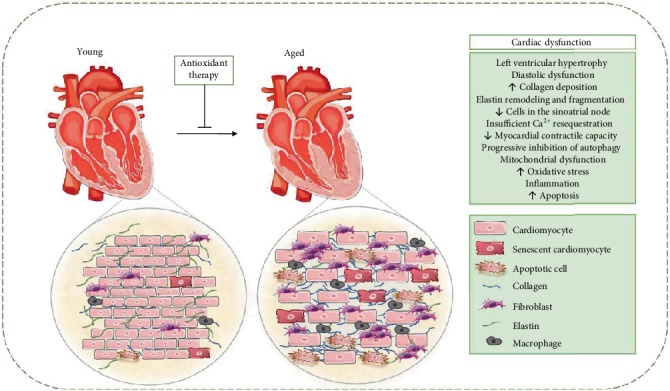
Figure 2
Cardiac structural and functional alterations during aging. In cardiac aging, there is a significant increase in myocardial thickness, characterized by an increase in heart size, whereas there is a decrease in the total number of cardiomyocytes. These changes alter the overall shape of the heart from elliptical to spheroid and generate greater stress on the heart wall and compromise the contractile efficiency of the heart. Fibrosis, one of the main determinants of cardiac remodelling, is characterized by increased collagen deposition, resulting in increased myocardial stiffness and, consequently, cardiac dysfunction. In the aged heart, there is diastolic dysfunction due to oxidative damage to the SERCA of the sarcoplasmic reticulum, decreasing its subsequent Ca2+ activity, prolonging diastolic relaxation. Finally, mitochondrial dysfunction, augmentation of inflammation and oxidative stress, and apoptotic and necrotic myocyte cell death are important determinants of the aging process, possibly mediating the occurrence of cardiac dysfunction in aging.
Figure 3
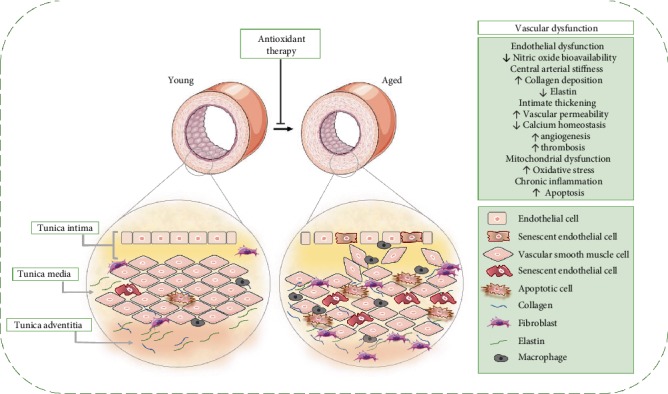
Figure 3
Vascular structural and functional alterations during aging. Vascular aging is associated with critical modifications of the vascular wall such as endothelial dysfunction and increased arterial thickness and stiffness. Endothelial dysfunction includes reduced vasodilatory and antithrombotic properties, with increased oxidative stress and inflammatory cytokines, increasing the risk of atherosclerosis and thrombosis. Furthermore, the endothelial barrier becomes porous and vascular smooth muscle cells migrate to subendothelial spaces and deposit extracellular matrix proteins resulting in the thickening of the tunica intima. Central arterial stiffness is related to the loss of elastic fibers and the increase of collagen accumulation in the vessel wall, which deteriorates vascular functionality. Endothelial dysfunction and arterial stiffness are mediators connected closely in vascular dysfunction during aging. If the artery is more rigid, greater will be the exposure of the endothelium to hemodynamic load, promoting endothelial activation, inflammation, and oxidative damage. Antioxidant therapies have been shown to attenuate aging-induced changes through endothelial dysfunction and changes in the extracellular arterial matrix that cause central arterial stiffness.
Figure 4
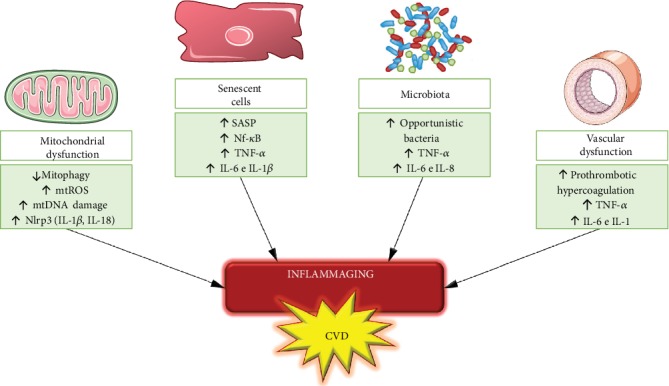
Figure 4
Different sources contribute to inflammation in aging. Aging is accompanied by mitochondrial dysfunction, increase in senescent cells numbers, dysregulated microbiota, and a hypercoagulation state that mediate the inflammatory processes that are characteristics of aging. Together, these processes play a key role on the development of age-related cardiovascular diseases.
Figure 5
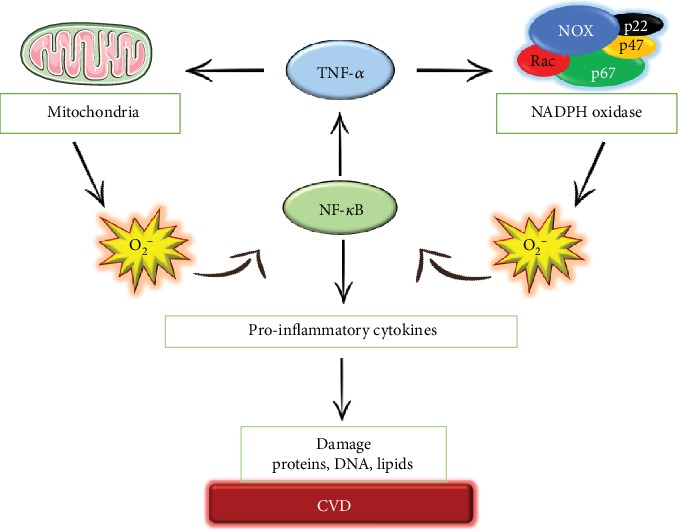
Figure 5
Many ROS/inflammation interactions are controlled by autoregulatory mechanisms. ROS produced by both NADPH oxidase and mitochondria induce proinflammatory release via NF-κB, such as TNF-α, which modulates an increase in NADPH oxidase and contributes to mitochondrial dysfunction, resulting in more ROS. The upregulation of these mechanisms contributes to cellular damage and eventually drives to cardiovascular diseases.
Figure 6
Figure 6
The crosstalk between Nrf-2 and NF-κB transcription factors. The stress environment caused by oxidative stress leads to functional modifications in both Nrf-2 and NF-κB transcription factors. Oxidation occurs at the thiol's sites of cysteine residues, allowing dissociation with their cytosolic inhibitors (Keap1 and IκB, respectively), leading to nucleus translocation and consequent encoding of target genes. Oxidative stress can interfere in both pathways indirectly by activating signalling pathways, such as ERK1/2, MAPK, JNK, and p38, which leads to the phosphorylation of these transcription factors. However, in basal situations, Nrf-2 and NF-κB are degraded via proteasome, which maintain homeostasis.

References

    1. Brown G. C. Living too long: The current focus of medical research on increasing the quantity, rather than the quality, of life is damaging our health and harming the economy. EMBO Reports. 2014;16(2):137–141. doi: 10.15252/embr.201439518. - DOI - PMC - PubMed
    1. UN. HelpAge, Global AgeWatch Index 2015: Insight Report. London, UK: HelpAge International; 2015. UNDESA Population Division, World Population Prospects: the 2015 Revision.
    1. Franceschi C., Garagnani P., Morsiani C., et al. The continuum of aging and age-related diseases: common mechanisms but different rates. Frontiers in Medicine. 2018;5:p. 61. doi: 10.3389/fmed.2018.00061. - DOI - PMC - PubMed
    1. Jaul E., Barron J. Age-related diseases and clinical and public health implications for the 85 years old and over population. Frontiers in Public Health. 2017;5:335–335. doi: 10.3389/fpubh.2017.00335. - DOI - PMC - PubMed
    1. Niccoli T., Partridge L. Ageing as a risk factor for disease. Current Biology. 2012;22(17):R741–R752. doi: 10.1016/j.cub.2012.07.024. - DOI - PubMed

Substances

LinkOut - more resources