


Rosemary (Rosmarinus officinalis L., syn Salvia rosmarinus Spenn.) and Its Topical Applications: A Review
- PMID: 32455585
- PMCID: PMC7284349
- DOI: 10.3390/plants9050651
Rosemary (Rosmarinus officinalis L., syn Salvia rosmarinus Spenn.) and Its Topical Applications: A Review
Abstract
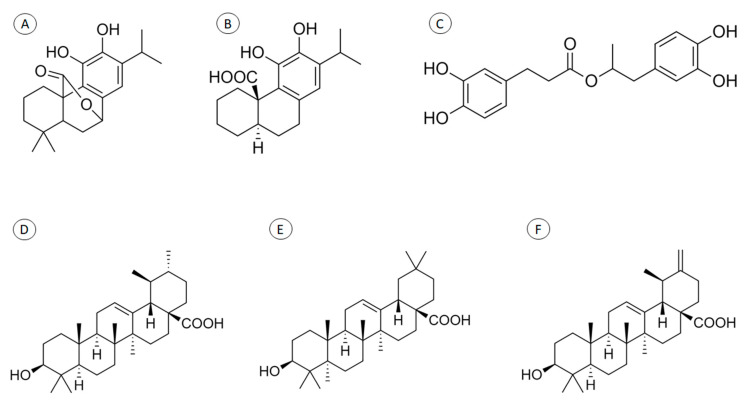
Topical application is an important administration route for drugs requiring local action on the skin, thereby avoiding their systemic absorption and adverse side effects. Rosmarinus officinalis L. (syn. Salvia rosmarinus Spenn.), popularly known as rosemary, is an aromatic plant with needle-like leaves belonging to the Lamiaceae family. Rosemary has therapeutic properties and has been used in the folk medicine, pharmaceutical, and cosmetics industries, mainly for its antioxidant and anti-inflammatory properties, which are attributed to the presence of carnosol/carnosic and ursolic acids. The therapeutic use of rosemary has been explored for the treatment of inflammatory diseases; however, other uses have been studied, such as wound healing and skin cancer and mycoses treatments, among others. Besides it therapeutic uses, rosemary has potential applications in cosmetic formulations and in the treatment of pathological and non-pathological conditions, such as cellulite, alopecia, ultraviolet damage, and aging. This review aims to critically discuss the topical applications of rosemary found in the literature while also offering relevant information for the development of topical formulations of its bioactive compounds.
Keywords: anti-inflammatory; antioxidant; flavonoids; polyphenols; rosemary; terpenes.
Conflict of interest statement
The authors declare no conflict of interest.
Figures
References
-
- Pérez-Sánchez A., Barrajón-Catalán E., Caturla N., Castillo J., Benavente-García O., Alcaraz M., Micol V. Protective effects of citrus and rosemary extracts on UV-induced damage in skin cell model and human volunteers. J. Photochem. Photobiol. B Biol. 2014;136:12–18. doi: 10.1016/j.jphotobiol.2014.04.007. - DOI - PubMed
Publication types
Grants and funding
LinkOut - more resources
Full Text Sources
Other Literature Sources
Miscellaneous
