


Antimicrobials from Venomous Animals: An Overview
- PMID: 32455792
- PMCID: PMC7287856
- DOI: 10.3390/molecules25102402
Antimicrobials from Venomous Animals: An Overview
Abstract
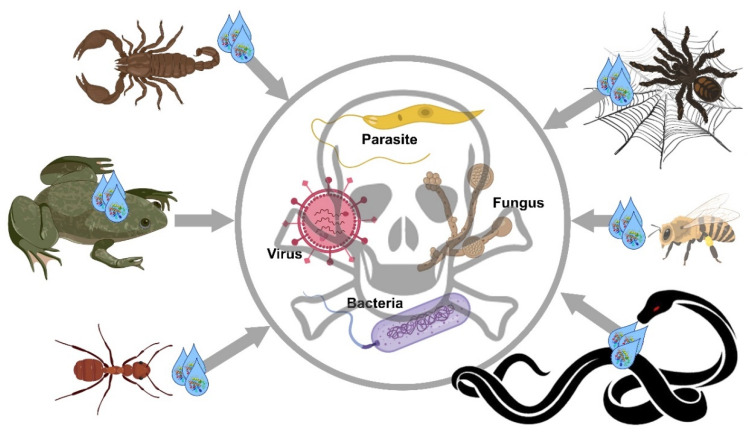
The inappropriate or excessive use of antimicrobial agents caused an emerging public health problem due to the resulting resistance developed by microbes. Therefore, there is an urgent need to develop effective antimicrobial strategies relying on natural agents with different mechanisms of action. Nature has been known to offer many bioactive compounds, in the form of animal venoms, algae, and plant extracts that were used for decades in traditional medicine. Animal venoms and secretions have been deeply studied for their wealth in pharmaceutically promising molecules. As such, they were reported to exhibit many biological activities of interest, such as antibacterial, antiviral, anticancer, and anti-inflammatory activities. In this review, we summarize recent findings on the antimicrobial activities of crude animal venoms/secretions, and describe the peptides that are responsible of these activities.
Keywords: ant; antimicrobial activities; bee; frog; scorpion; snake; spider.
Conflict of interest statement
The authors declare no conflict of interest.
Figures
References
-
- World Health Organization . Prioritization of Pathogens to Guide Discovery, Research and Development of New Antibiotics for Drug-Resistant Bacterial Infections, Including Tuberculosis. WHO; Geneva, Switzerland: 2017.
-
- World Health Organization . Tackling Antimicrobial Resistance. Eurohealth (Lond) Volume 26 WHO; Geneva, Switzerland: 2020.
-
- Centre for Disease Control . Antibiotic resistance threats in the United States. CDC; Atlanta, GA, USA: 2019.
-
- Le M.N.-T., Kayama S., Yoshikawa M., Hara T., Kashiyama S., Hisatsune J., Tsuruda K., Onodera M., Ohge H., Tsuga K., et al. Oral colonisation by antimicrobial-resistant Gram-negative bacteria among long-term care facility residents: Prevalence, risk factors, and molecular epidemiology. Antimicrob. Resist. Infect. Control. 2020;9:45. doi: 10.1186/s13756-020-0705-1. - DOI - PMC - PubMed
Publication types
MeSH terms
Substances
LinkOut - more resources
Full Text Sources
Other Literature Sources
Research Materials
