


Bullying, social support and adolescents' mental health: Results from a follow-up study
- PMID: 32456594
- PMCID: PMC8056700
- DOI: 10.1177/1403494820921666
Bullying, social support and adolescents' mental health: Results from a follow-up study
Abstract
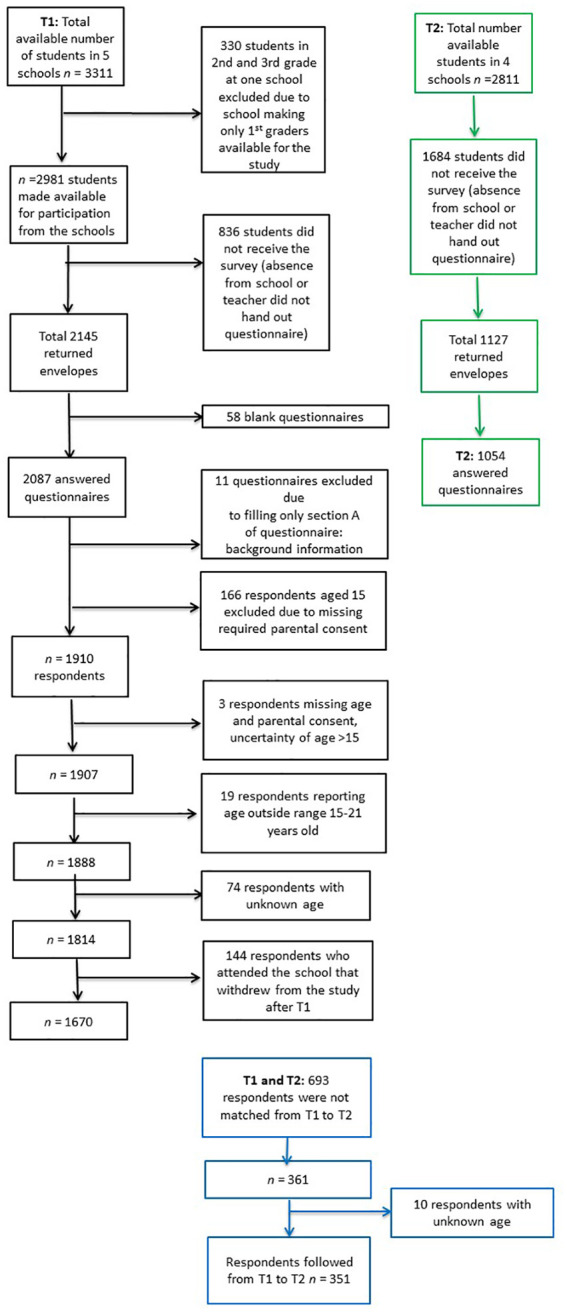
Aims: The aim of this study was to examine the predictive roles of being bullied and perceived social support in association with adolescents' mental health. Methods: At two time points, September 2016 and April-June 2017, questionnaires were distributed to students between 15 and 21 years of age in four upper-secondary schools in Norway, with a total sample size of 351. Random- and fixed-effects regression models were used to estimate the effects of being bullied and social support on adolescents' mental health. Results: In the random-effects models, being bullied was associated with lower scores on mental well-being and higher scores on anxiety and depression symptoms. Social support from family and friends was associated with higher scores on mental well-being, as well as fewer anxiety and depression symptoms. However, the results from the fixed-effects model, with more realistic assumptions, indicated that being bullied was only associated with more anxiety and depression symptoms, while support from friends was associated with higher scores on mental well-being and fewer anxiety and depression symptoms. Conclusions: Based on the fixed-effects models, being bullied was associated with more anxiety and depression symptoms. However, being bullied was not significantly associated with mental well-being. Social support from family was not significantly associated with either aspects of mental health. Moreover, social support from friends was associated with higher scores on mental well-being and fewer anxiety and depression symptoms. The two sources of social support did not buffer the negative effects of being bullied on either aspect of mental health.
Keywords: Mental well-being; adolescents; anxiety; bullying; depression; mental health; social support.
Conflict of interest statement
Figures
References
-
- Norwegian Institute of Public Health. Mental disorders among children and adolescents in Norway. Public health report 2014, https://www.fhi.no/en/op/public-health-report-2014/health–disease/mental... (2014, acccessed 15 September 2018).
-
- Sletten MA, Bakken A. Psykiske helseplager blant ungdom–- tidstrender og samfunnsmessige forklaringer. Notat nr 4/16. [Mental health problems among youth – time trends and social explanations.] Oslo: NOVA, 2016.
-
- Rose T, Joe S, Williams A, et al. Measuring mental wellbeing among adolescents: a systematic review of instruments. J Child Fam Stud 2017;26:1–14.
-
- Fullchange A, Furlong MJ. An exploration of effects of bullying victimization from a complete mental health perspective. Sage Open 2016;6.
MeSH terms
LinkOut - more resources
Full Text Sources
Medical
Miscellaneous
