. 2020 May 27;18(1):130.
doi: 10.1186/s12916-020-01587-w.

Serum free thiols predict cardiovascular events and all-cause mortality in the general population: a prospective cohort study

Affiliations

Serum free thiols predict cardiovascular events and all-cause mortality in the general population: a prospective cohort study

Amaal E Abdulle et al. BMC Med. .

Abstract

Background: Serum free thiols (R-SH, sulfhydryl groups) reliably reflect systemic oxidative stress. Since serum free thiols are rapidly oxidized by reactive species, systemic oxidative stress is generally associated with reduced serum free thiol levels. Free thiols associate with favorable disease outcomes in many patient cohorts, and the current hypothesis is that oxidative stress might also play an important role in cardiovascular disease. In this study, we aimed to establish the role of serum free thiols in the general population by investigating their relationship with the risk of cardiovascular (CV) events and all-cause mortality.

Methods: Participants (n = 5955) of the Prevention of REnal and Vascular ENd-stage Disease (PREVEND) cohort study from the general population were included. At baseline, serum levels of free thiols were quantified and adjusted to total protein levels. Protein-adjusted serum free thiol levels were studied for their associations with clinical and biochemical parameters, as well as with the risk of CV events and all-cause mortality.

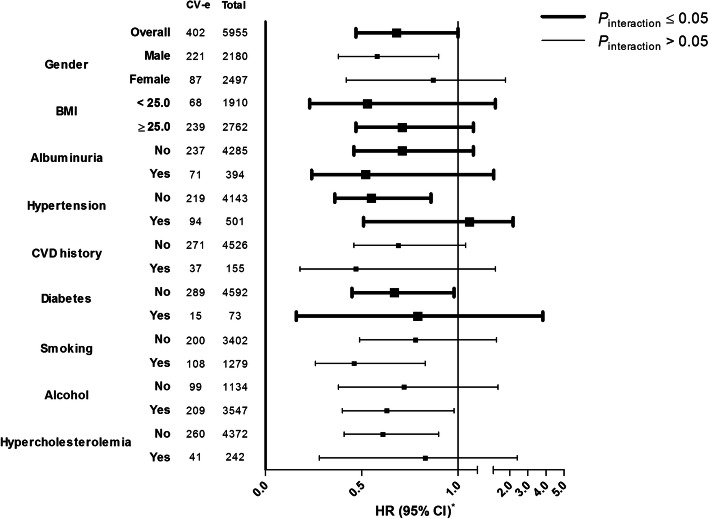
Results: The mean protein-adjusted serum free thiol level was 5.05 ± 1.02 μmol/g of protein. Protein-adjusted serum free thiols significantly predicted the risk of CV events, even after adjustment for potential confounding factors (hazard ratio [HR] per doubling 0.68 [95% confidence interval [CI] 0.47-1.00], P = 0.048). Similarly, protein-adjusted serum free thiols were significantly predictive of the risk of all-cause mortality (HR per doubling 0.66 [95% CI 0.44-1.00], P = 0.050). Stratified analyses revealed lower HRs for subjects with a lower body mass index (BMI), without hypertension, and without diabetes. Conversely, HRs were lower in subjects with albuminuria.

Conclusions: In this large population-based cohort study, serum free thiols significantly predicted the risk of CV events and all-cause mortality. Our results highlight the potential significance and clinical applicability of serum free thiols since they are amendable to therapeutic intervention.

Keywords: Cardiovascular disease; Free thiols; Mortality; Oxidative stress; Population study.


Conflict of interest statement

The authors declare that they have no competing interests.

Figures

Fig. 1
Fig. 1
Distributions of tertiles of protein-adjusted serum free thiol concentrations among survivor and non-survivors (a) and subjects with and without a CV event (b). Tertile 1, protein-adjusted serum free thiol concentration range < 4.65; tertile 2, protein-adjusted serum free thiol concentration range 4.65–5.45; tertile 3, protein-adjusted serum free thiol concentration range > 5.46
Fig. 2
Fig. 2
Kaplan-Meier survival distributions for tertiles of protein-adjusted serum free thiol concentrations. a Kaplan-Meier curve representing cardiovascular disease-free survival with the highest rate of cardiovascular events occurring in the lowest tertile of protein-adjusted serum free thiols (log-rank test, P < 0.0001). b Kaplan-Meier curve representing survival with the highest mortality rate occurring in the lowest tertile of protein-adjusted serum free thiols (log-rank test, P < 0.0001)
Fig. 3
Fig. 3
af Receiver operating characteristic (ROC) curves with associated Harrell C indices (95% confidence interval [CI]) of the different Cox proportional hazards regression models. ac Discriminative ability of Cox regression models for the association between protein-adjusted serum free thiols and cardiovascular events. df Discriminative ability of Cox regression models for the association between protein-adjusted serum free thiols and all-cause mortality
Fig. 4
Fig. 4
Associations between protein-adjusted serum free thiol levels and the risk of cardiovascular (CV) events across various subgroups. Hazard ratios (HRs) are shown with corresponding 95% confidence intervals (CI). HRs represent consistently inverse associations across subgroups, with the exception of stratification by the presence of hypertension (Pinteraction < 0.001). Stratifications by BMI, albuminuria, hypertension, diabetes, and hypercholesterolemia show significant interactions. Corresponding HRs are consistently lower for subjects with a more favorable cardiovascular risk profile (i.e., lower BMI and the absence of hypertension and diabetes), whereas the presence of CVD history or albuminuria shows lower HRs as well. *HRs adjusted for potential confounding factors (sex, age, hsCRP, current smoking, systolic blood pressure, total cholesterol, diabetes, and BMI). CV-e, cardiovascular events; BMI, body mass index; eGFR, estimated glomerular filtration rate; CVD, cardiovascular disease; HR, hazard ratio; CI, confidence interval
Fig. 5
Fig. 5
Receiver operating characteristic (ROC) curves with associated Harrell C indices (95% confidence interval [CI]) of Cox proportional hazards regression models in subjects with and without a history of cardiovascular disease (CVD). a, b Discriminative ability of Cox regression models for the association between protein-adjusted serum-free thiols and cardiovascular events in both subgroups. c, d Discriminative ability of Cox regression models for the association between protein-adjusted serum free thiols and all-cause mortality in both subgroups. CVD, cardiovascular disease

References

    1. Lozano R, Naghavi M, Foreman K, Lim S, Shibuya K, Aboyans V, et al. Global and regional mortality from 235 causes of death for 20 age groups in 1990 and 2010: a systematic analysis for the Global Burden of Disease Study 2010. Lancet. 2012;380:2095–2128. doi: 10.1016/S0140-6736(12)61728-0. - DOI - PMC - PubMed
    1. Wang H, Naghavi M, Allen C, Barber RM, Carter A, Casey DC, et al. Global, regional, and national life expectancy, all-cause mortality, and cause-specific mortality for 249 causes of death, 1980–2015: a systematic analysis for the Global Burden of Disease Study 2015. Lancet. 2016;388:1459–1544. doi: 10.1016/S0140-6736(16)31012-1. - DOI - PMC - PubMed
    1. D’Agostino RB, Pencina MJ, Massaro JM, Coady S. Cardiovascular disease risk assessment: insights from Framingham. Glob Heart. 2013;8:11–23. doi: 10.1016/j.gheart.2013.01.001. - DOI - PMC - PubMed
    1. Banne AF, Amiri A, Pero RW. Reduced level of serum thiols in patients with a diagnosis of active disease. J Anti Aging Med. 2003;6:327–334. doi: 10.1089/109454503323028920. - DOI - PubMed
    1. Cortese-Krott MM, Koning A, Kuhnle GGC, Nagy P, Bianco CL, Pasch A, et al. The reactive species interactome: evolutionary emergence, biological significance, and opportunities for redox metabolomics and personalized medicine. Antioxid Redox Signal. 2017;27(10):684–712. - PMC - PubMed

Publication types

Substances

LinkOut - more resources