. 2020 Nov 1;88(9):719-726.
doi: 10.1016/j.biopsych.2020.03.020. Epub 2020 Apr 10.

The Mouse Claustrum Is Required for Optimal Behavioral Performance Under High Cognitive Demand

Affiliations

The Mouse Claustrum Is Required for Optimal Behavioral Performance Under High Cognitive Demand

Michael G White et al. Biol Psychiatry. .

Abstract

Background: To achieve goals, organisms are often faced with complex tasks that require enhanced control of cognitive faculties for optimal performance. However, the neural circuit mechanisms underlying this ability are unclear. The claustrum is proposed to mediate a variety of functions ranging from sensory binding to cognitive control of action, but direct functional assessments of this telencephalic nucleus are lacking.

Methods: Here, we employed the Gnb4 (guanine nucleotide-binding subunit beta-4) cre driver line in mice to selectively monitor and manipulate claustrum projection neurons during 1-choice versus 5-choice serial reaction time task performance.

Results: Using fiber photometry, we found elevated claustrum activity prior to an expected cue during correct performance on the cognitively demanding 5-choice response assay relative to the less demanding 1-choice version of the task. Claustrum activity during reward acquisition was also enhanced when task demand was higher. Furthermore, optogenetically inhibiting the claustrum prior to the onset of the cue reduced choice accuracy on the 5-choice task but not on the 1-choice task.

Conclusions: These results suggest that the claustrum supports a cognitive control function necessary for optimal behavioral performance under cognitively demanding conditions.

Keywords: Attention; Cognition; Glutamate; Gnb4; Networks; Photometry.


Conflict of interest statement

Financial disclosure

We report no biomedical financial interests or potential conflicts of interest.

Figures
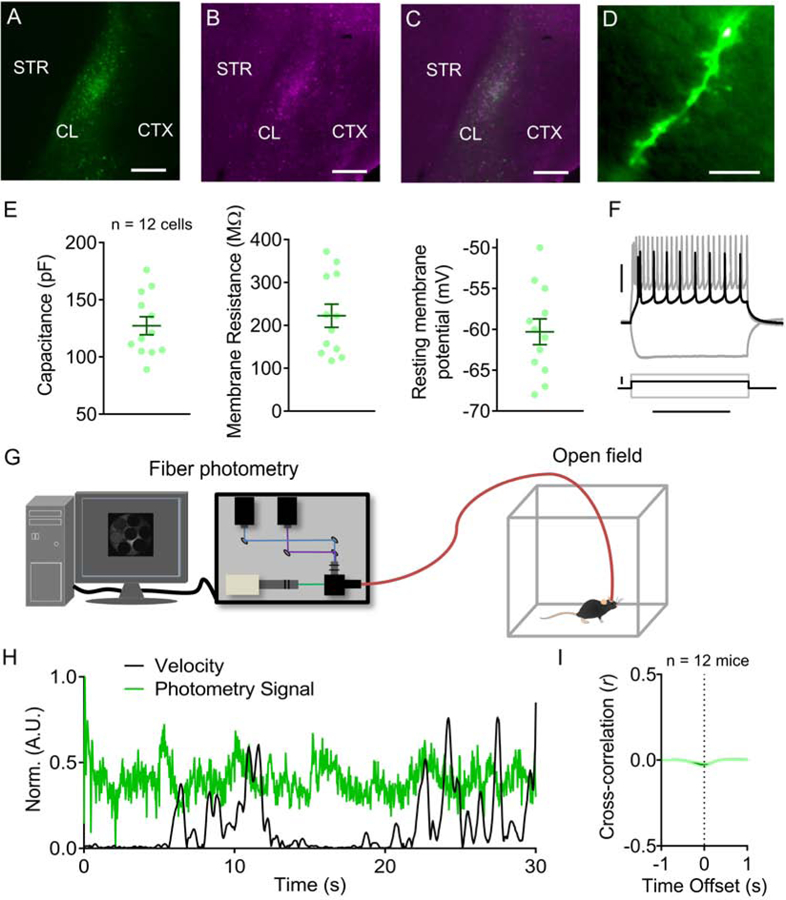
Figure 1:
Figure 1:. The GNB4-cre transgenic mouse line provides genetic access to claustrum (CL) projection neurons and allows for recording CL activity.
(A) Cre-dependent viral expression of eYFP in mouse CL. (B) Immunostaining of CL parvalbumin (PV) expression. (C) Labeling of virally-expressed eYFP and immunolabeled PV were isomorphic. (D) Dendritic spines were evident upon whole-cell patch clamp records of GNB4-positive CL neurons using an internal solution including AlexFluor®−594. (E) Left: Mean membrane capacitance from labeled neurons was 127 ± 9 (mean ± SD) pF. Middle: Mean membrane resistance was 222 ± 34 MΩ. Right: Mean resting membrane potential was −60 ± 2 mV. (F) Representative traces from labeled neurons in response to current injection steps. (G) Experimental schematic illustrating that CL activity was monitored during freely moving behavior in GNB4-cre mice injected with AAV-FLEX-GCaMP6f into the CL. (H) Representative traces of normalized CL activity (green) and speed (black) during movement from GNB4-cre mice. (I) Cross-correlation between the photometry signal and movement speed. Horizontal scale bars = 200 µm (A-C), 10 µm (D), 400 ms (F). Vertical scale bars = 30 mV (F [top]), 200 pA (F [bottom]).
Figure 2:
Figure 2:. CL activity during 5-choice serial reaction time task (5CSRTT) and one-choice serial reaction time task (1CSRTT) performance.
(A) Experimental schematic illustrating that CL activity was monitored during 5CSRTT performance in GNB4-cre mice injected with AAV-FLEX-GCaMP6f (n = 12). (B) Left: Average calcium-dependent activity of CL aligned to 5CSRTT cue onset is shown for correct (green) and incorrect (gray) trials. Right: During the ITI period (5 to 0s prior to cue onset), CL activity was greater for correct trials relative to incorrect trials. Paired t test, t(23) = 3.183, P = 0.004. (C) Left: Average CL activity aligned to correct or incorrect nose pokes during 5CSRTT performance is shown. Right: Average CL activity (1 s prior to 1 s after poke) was greater for correct nose pokes compared to incorrect nose pokes. Paired t test, t(11) = 3.14, P = 0.0095. (D) Average CL activity during the ITI for correct 5CSRTT trials (green) and correct 1CSRTT trials (blue). (E) CL activity during the ITI was greater for correct 5CSRTT trials compared to 1CSRTT trials. Paired t test, t(23) = 2.464, P = 0.0144. (F) Left: Average CL activity aligned to correct nose pokes during 5CSRTT performance and right: during 1CSRTT performance. (G) Left: CL activity prior to nose poke (average of 0.5 s prior, gray box) was not different between 5CSRTT and 1CSRTT. Paired t test, t(11) = 0.88, P = 0.40. Right: activity immediately subsequent to nose poke (average of 0.5 s subsequent, brown box) was not different between 5CSRTT and 1CSRTT. Paired t test, t(11) = 1.85, P = 0.09. (H) Left: Average CL activity aligned to collection of the reinforcement (sucrose pellet) on correct 5CSRTT trials and right: on correct 1CSRTT trials. (I) Left: CL activity prior to collection of reward pellet (average of 0.5 s prior) was greater for the 5CSRTT relative to the 1CSRTT. Paired t test, t(11) = 3.11, P = 0.01. Right: activity immediately subsequent to collection (average of 0.5 s subsequent) was greater for the 5CSRTT compared to the 1CSRTT. Paired t test, t(11) = 4.41, P = 0.0010.
Figure 3:
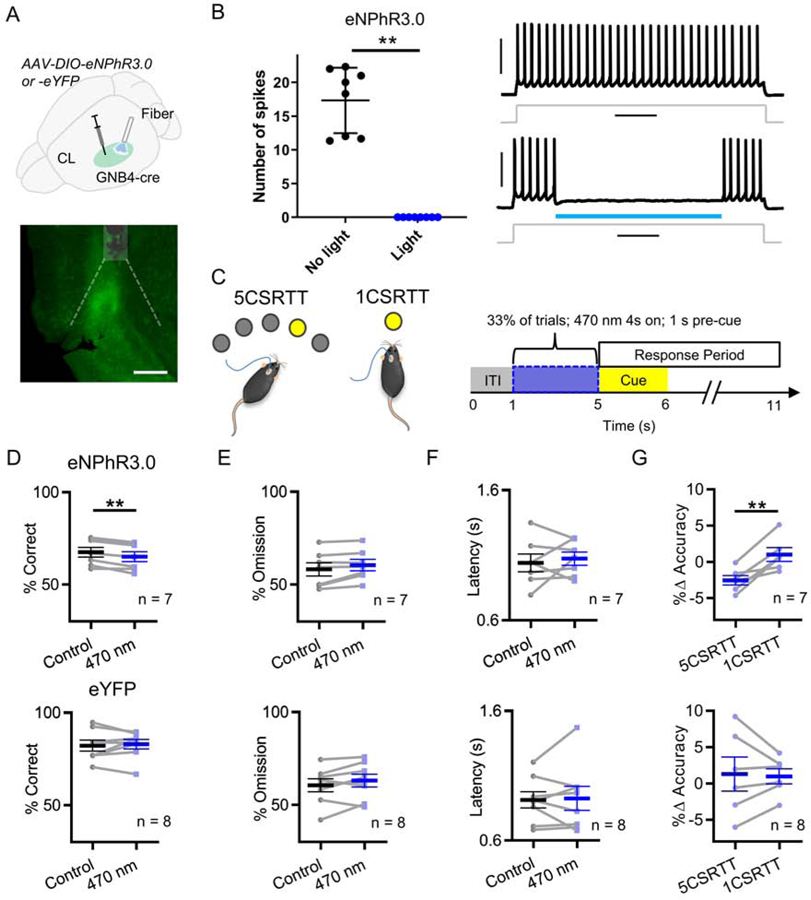
Figure 3:. Inactivation of CL prior to cue presentation disrupts response accuracy on 5CSRTT, but not 1CSRTT.
(A) Top: Schematic illustrating that a virus expressing either halorhodopsin (n = 7) or eYFP (n = 8) in a cre-dependent manner (AAV-DIO-eNPhR3.0 or -eYFP, respectively) was injected bilaterally into the CL of GNB4-cre mice. Optical fibers were chronically implanted bilaterally in the CL. Bottom: Photomicrograph illustrating fiber optic implant (white box) position above CL, estimated light path (dotted lines), and viral expression. (B) Left: CL neurons expressing halorhodopsin (eNPhR3.0) show loss of action potential firing in the presence of 470 nm light (4 s) compared to absence of 470 nm light during a depolarizing current injection (Wilcoxon rank-sum test, n = 8, P = 0.0078). Right: Top trace shows representative example of claustrum neuron expressing eNPhR3.0 generating action potentials in response to depolarizing current injection in the absence of 470 nm light. Bottom trace shows representative example of the same claustrum neuron, for which 470 nm light abolishes action potential generation. (C) Left: Mice were trained to perform the 5CSRTT and subsequently a one-choice control task (1CSRTT). Right: Experimental schematic illustrating that 470 nm light was delivered to the CL during the inter-trial interval (ITI) 4 s prior to the onset of the cue on 33% of 5CSRTT or 1CSRTT trials. (D) Top: For eNPhR3.0 mice performing the 5CSRTT, choice accuracy was reduced on trials paired with 470 nm light delivery pre-cue compared to control trials. Paired t test, t(7) = 4.41, P = 0.005. Bottom: No changes in choice accuracy were found on 5CSRTT trials paired with light delivery in eYFP mice. Paired t test, t(7) = 0.42, P = 0.691. (E) Top: The omission rate was not different on 5CSRTT trials paired with 470 nm light delivery compared to control trials for eNPhR3.0 mice. Paired t test, t(6) = 2.35, P = 0.057. Bottom: Light delivery did not alter omission rate in eYFP mice. Paired t test, t(7) = 1.57, P = 0.161. (F) Top: The latency to correctly respond was not different on 5CSRTT trials paired with 470 nm light delivery compared to control trials for eNPhR3.0 mice. Paired t test, t(6) = 0.55, P = 0.6029. Bottom: Light delivery did not alter latency to correctly respond in eYFP mice. Paired t test, t(7) = 0.26, P = 0.806. (G) Top: For eNPhR3.0 mice, the reduction in choice accuracy on the 5CSRTT resulting from 470 nm light delivery was significantly larger than the reduction during 1CSRTT performance. Paired t test, t(6) = 4.46, P = 0.0067. Bottom: For eYFP mice, there was no difference in the change in choice accuracy on the 5CSRTT resulting from 470 nm light delivery compared to the change during 1CSRTT performance. Paired t test, t(7) = 0.24, P = 0.823. Horizontal scale bars = 200 µm (A), 500 ms (B). Vertical scale bar = 30 mV.

References

    1. Heinrichs RW, Zakzanis KK (1998): Neurocognitive deficit in schizophrenia: A quantitative review of the evidence. Neuropsychology 12: 426–445. - PubMed
    1. Bressler SL, Menon V (2010, June): Large-scale brain networks in cognition: emerging methods and principles. Trends in Cognitive Sciences, vol. 14 pp 277–290. - PubMed
    1. Niendam TA, Laird AR, Ray KL, Dean YM, Glahn DC, Carter CS (2012): Meta-analytic evidence for a superordinate cognitive control network subserving diverse executive functions. Cogn Affect Behav Neurosci 12: 241–268. - PMC - PubMed
    1. Robbins TW, Arnsten AFT (2009): The Neuropsychopharmacology of Fronto-Executive Function: Monoaminergic Modulation. Annu Rev Neurosci 32: 267–287. - PMC - PubMed
    1. Vijayraghavan S, Major AJ, Everling S (2017, December 5): Neuromodulation of prefrontal cortex in non-human primates by dopaminergic receptors during rule-guided flexible behavior and cognitive control Frontiers in Neural Circuits, vol. 11 Frontiers Media S.A., p 91. - PMC - PubMed

Publication types