. 2020 May 26;10(1):8657.
doi: 10.1038/s41598-020-65291-8.

Controllable skyrmion chirality in ferroelectrics

Affiliations

Controllable skyrmion chirality in ferroelectrics

Yu Tikhonov et al. Sci Rep. .

Abstract

Chirality, an intrinsic handedness, is one of the most intriguing fundamental phenomena in nature. Materials composed of chiral molecules find broad applications in areas ranging from nonlinear optics and spintronics to biology and pharmaceuticals. However, chirality is usually an invariable inherent property of a given material that cannot be easily changed at will. Here, we demonstrate that ferroelectric nanodots support skyrmions the chirality of which can be controlled and switched. We devise protocols for realizing control and efficient manipulations of the different types of skyrmions. Our findings open the route for controlled chirality with potential applications in ferroelectric-based information technologies.


Conflict of interest statement

The authors declare no competing interests.

Figures
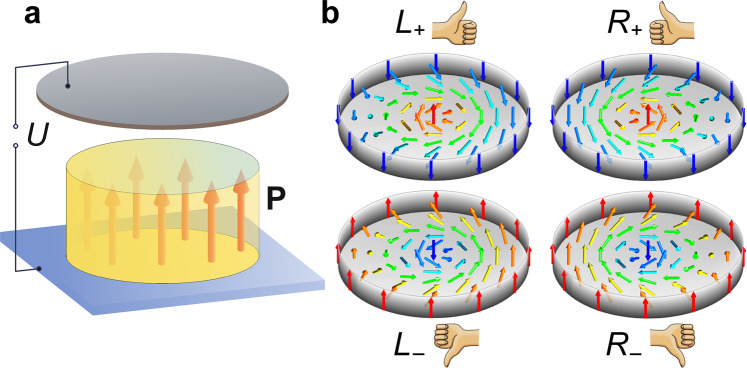
Figure 1
Figure 1
Ferroelectric switch circuit and skyrmion states. (a) The circuit is controlled by the external switching voltage U. The top electrode is separated from the ferroelectric nanodot carrying the polarization topological states. (b) Four types of the skyrmions, differing by their chirality and polarity. The hand pictograms define the classification of the skyrmions.
Figure 2
Figure 2
Field-tuned topological states in the nanodot. (a) Cross section of the nanodot displaying the polarization distribution, with white arrows showing the direction of the polarization. The polarization rotation over 180° in the plane of the Bloch domain walls results in the chirality distribution, χ(r), shown by the colour map. The legend to the map is given below in low-right corner of the figure. The crossed circle, , at the domain wall denotes the polarization vector going into the cross-section plane, and the circle with the central dot, ⊙, stands for the out–of–plane polarization. (b) The top view of the sinc-like distribution of the polarization at the near-surface layer of the nanodot. (c) Hysteresis behaviour of the polarization of the nanodot as a function of the applied field. The blue and red branches correspond to the up-down and down-up sweeps of the applied field. The numbers mark the different topological states of the polarization. (d) Hysteresis protocols of the chirality switching that allow to come to the L± and R± skyrmion states. The arrows show the direction of the sweep. The gray branch corresponds to the virgin curve of the poling of the nanodot reflecting both, positive and negative directions of the electric field variation. The blue and red branches again correspond to the up-down and down-up sweeps of the applied field. The violet and yellow branches correspond to the reversal of the field sweep from the blue and red branches, respectively. (e) The distribution of the polarization and chirality in the original polarization state (0) and in the sequence of the topological states arising during the re-polarization of the nanodot by the applied field (view from the bottom) that follows the blue branch of panels c and d. The yellow points mark the cross-section of the Bloch lines piercing the nanodot.

References

    1. Kelvin, W. T. B. The molecular tactics of a crystal (Clarendon Press, 1894).
    1. Hegstrom RA, Kondepudi DK. The handedness of the universe. Scientific American. 1990;262:108–115. doi: 10.1038/scientificamerican0190-108. - DOI
    1. Wagnière, G. H. On chirality and the universal asymmetry: reflections on image and mirror image (John Wiley & Sons, 2008).
    1. Berger R, Stohner J. Parity violation. Wiley Interdisciplinary Reviews: Computational Molecular Science. 2019;9:e1396.
    1. Neufeld O, Cohen O. Optical chirality in nonlinear optics: Application to high harmonic generation. Phys. Rev. Lett. 2018;120:133206. doi: 10.1103/PhysRevLett.120.133206. - DOI - PubMed
