. 2020 May 8:11:486.
doi: 10.3389/fphar.2020.00486. eCollection 2020.

Long-Distance Phasing of a Tentative "Enhancer" Single-Nucleotide Polymorphism With CYP2D6 Star Allele Definitions

Affiliations

Long-Distance Phasing of a Tentative "Enhancer" Single-Nucleotide Polymorphism With CYP2D6 Star Allele Definitions

Erin C Boone et al. Front Pharmacol. .

Abstract

Background: The CYP2D6 gene locus has been extensively studied over decades, yet a portion of variability in CYP2D6 activity cannot be explained by known sequence variations within the gene, copy number variation, or structural rearrangements. It was proposed that rs5758550, located 116 kb downstream of the CYP2D6 gene locus, increases gene expression and thus contributes to variability in CYP2D6 activity. This finding has, however, not been validated. The purpose of the study was to address a major technological barrier, i.e., experimentally linking rs5758550, also referred to as the "enhancer" single-nucleotide polymorphism (SNP), to CYP2D6 haplotypes >100 kb away. To overcome this challenge is essential to ultimately determine the contribution of the "enhancer" SNP to interindividual variability in CYP2D6 activity.

Methods: A large ethnically mixed population sample (n=3,162) was computationally phased to determine linkage between the "enhancer" SNP and CYP2D6 haplotypes (or star alleles). To experimentally validate predicted linkages, DropPhase2D6, a digital droplet PCR (ddPCR)-based method was developed. 10X Genomics Linked-Reads were utilized as a proof of concept.

Results: Phasing predicted that the "enhancer" SNP can occur on numerous CYP2D6 haplotypes including CYP2D6*1, *2, *5, and *41 and suggested that linkage is incomplete, i.e., a portion of these alleles do not have the "enhancer" SNP. Phasing also revealed differences among the European and African ancestry data sets regarding the proportion of alleles with and without the "enhancer" SNP. DropPhase2D6 was utilized to confirm or refute the predicted "enhancer" SNP location for individual samples, e.g., of n=3 samples genotyped as *1/*41, rs5758550 was on the *41 allele of two samples and on the *1 allele of one sample. Our findings highlight that the location of the "enhancer" SNP must not be assigned by "default." Furthermore, linkage between the "enhancer" SNP and CYP2D6 star allele haplotypes was confirmed with 10X Genomics technology.

Conclusions: Since the "enhancer" SNP can be present on a portion of normal, decreased, or no function alleles, the phase of the "enhancer" SNP must be considered when investigating the impact of the "enhancer" SNP on CYP2D6 activity.

Keywords: CYP2D6; allele definition; ddPCR = droplet digital PCR; enhancer SNP; phasing.


Figures

Figure 1
Figure 1
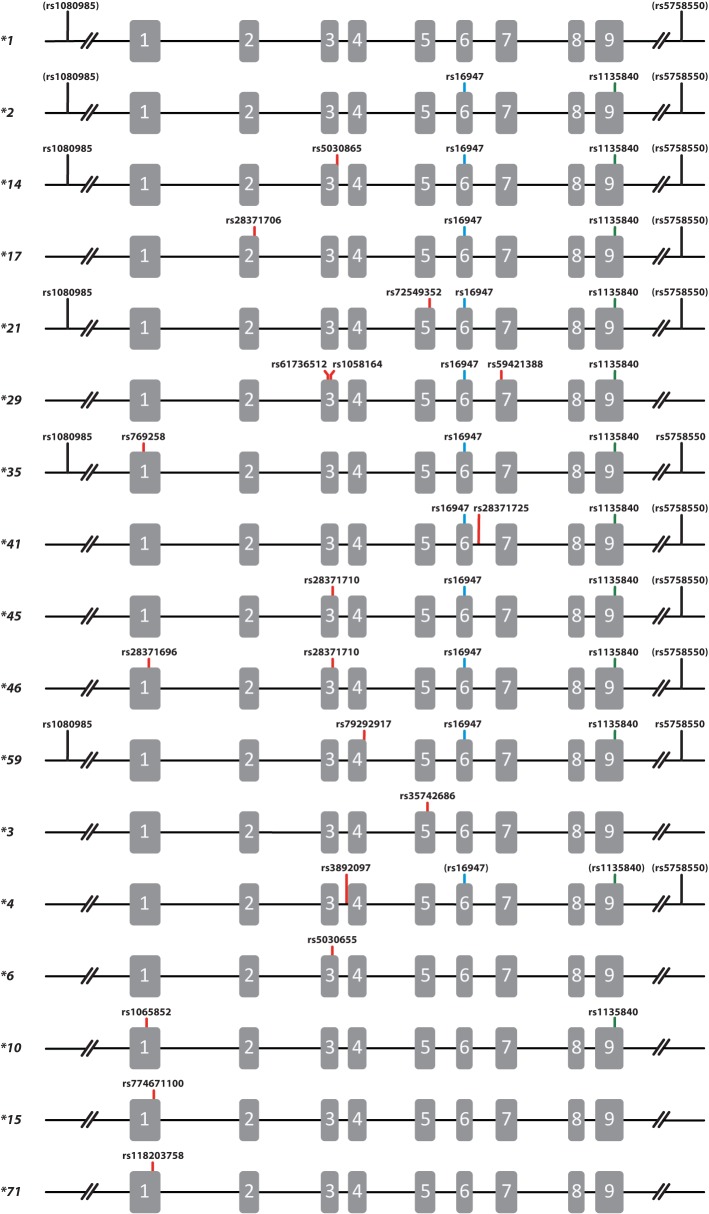
Graphical overview of CYP2D6 alleles relevant to this study. Gray boxes represent the nine exons and lines represent intervening sequences as well as upstream and downstream regions. Each allele is displayed with its core single-nucleotide polymorphism(s) [SNP(s)], i.e., SNPs that either cause an amino acid change or impact splicing. SNPs are represented using their respective rs IDs. The SNP shown with a blue line (rs16947, g.2851C>T) highlights the CYP2D6*2 core SNP which is also part of the CYP2D6*14, *17, *21, *29, *35, *41, *45, *46 and *59 core allele definitions. The SNP shown with a green line (rs1135840, g.4181G>C) is also part of many core allele definitions. SNPs highlighted by a red line denote core SNPs rs numbers in brackets occur in some but not all alleles. In addition, the graph also shows rs1080985 (g.-1584C>G), a SNP that is most often found on CYP2D6*2 (formerly known as *2A), but has also been shown to be part of other haplotypes including CYP2D6*14, *21, *35 and *59; it is displayed in brackets if it is not present on all known suballeles. Lastly, rs5758550 denotes the “enhancer” SNP, which is shown in brackets if it does not occur on all suballeles based on the findings of this study. We refer to pharmvar.org/gene/CYP2D6 for a complete list of all SNPs found on a star allele.
Figure 2
Figure 2
DropPhase2D6 assay development. Assays designed for DropPhase2D6 were evaluated using Coriell DNA samples with known genotypes. (A) NA20360 is homozygous variant for the two single-nucleotide polymorphisms (SNPs) of interest yielding three distinct clusters: green, VIC [droplets containing genomic DNA (gDNA) with rs5758550G)], blue FAM (droplets containing gDNA with rs16947T), and orange, denoting a double-positive cluster (droplets containing DNA molecules generating FAM and VIC signal). (B) HG00594 is heterozygous for both SNPs displaying the same cluster pattern as shown in (A). The observed “rain” on the scatter plot is a commonly observed feature believed to be due to probe competition for PCR reaction components. (C) NA19663 is homozygous reference for both loci, therefore no fluorescent signals are produced (no green, blue or orange clusters). A secondary cluster above the gray double-negative cluster was observed for HG00594 (B) and NA19663 (C) which is likely due to residual signal originating from the rs16947T-labeled binding to the rs16947C allele. This phenomenon is absent in the homozygous variant sample NA20360, which lacks rs16947C.
Figure 3
Figure 3
Mile Post experiment to establish single-nucleotide polymorphism (SNP) linkage. SNPs at increased distances relative to the CYP2D6*2 core SNP (rs16947) were interrogated to establish DropPhase2D6. The percent (%) linkage between SNPs is decreasing as the distance between interrogated SNPs increases. SNPs that are trans-configured show no/little linkage (e.g., rs16947A and rs5758550G). No linkage was observed when DNA was pre-treated with the restriction enzyme EcoRI. n/c, negative control, i.e., genotype does not support signal generation with respective probe/assay combinations.
Figure 4
Figure 4
DropPhase2D6 summary and data. The figure provides DropPhase2D6 results for selected samples, sample types and duplex reactions used to experimentally link the “enhancer” single-nucleotide polymorphism (SNP) with CYP2D6 haplotype. Phase-predicted genotypes were compiled from datasets_all (all ethnicities phased together). (A) Sample 1 was genotyped as CYP2D6*1/*2.001. The “enhancer” SNP was confirmed to be cis-configured, i.e., located on the *2.001 allele. The rs16947varT+rs5758550varG and rs16947refC+rs5758550varG duplex reactions were utilized to establish linkage. (B) Sample 36 was genotyped as CYP2D6*1/*5. The “enhancer” SNP was confirmed to be cis-configured, i.e., located on the *1 allele as predicted by computational phasing. The rs16947refC+rs5758550varG and rs16947refC+rs5758550refA duplex reactions were utilized to establish linkage for this case. (C) Sample 39 was genotyped as CYP2D6*5/*17. The duplex reactions rs16947varT+rs5758550varG and rs16947varT+rs5758550refA were used to establish linkage. The “enhancer” SNP was confirmed to be cis-configured, i.e., located on the CYP2D6*17 allele as predicted by computational phasing. The middle panel visualizes DNA molecules sequestered in droplets with colors representing SNPs generating VIC (green) or FAM (blue) signals. The right-hand table provides sample source (liver tissue; WB, whole blood; WBC, white blood cells), genotype and ethnicity (C), Caucasian/European ancestry, AA (African ancestry) Unk (unknown), and AA+C (mixed ancestry). The far-right column indicates to which allele the “enhancer” SNP was experimentally linked. DropPhase2D6 results for samples 11, 25 and 35 were confirmed with the assay for the CYP2D6*4 core SNP. Specifically, the reference allele of the “enhancer” SNP was linked with 1847G (rs3892097. reference G) for samples 11 and 35, while linkage between the “enhancer” SNP and 1847A (rs3892097, variant A) was confirmed for sample 25.

References

    1. Abduljalil K., Frank D., Gaedigk A., Klaassen T., Tomalik-Scharte D., Jetter A., et al. (2010). Assessment of activity levels for CYP2D6*1, CYP2D6*2, and CYP2D6*41 genes by population pharmacokinetics of dextromethorphan. Clin. Pharmacol. Ther. 88 (5), 643–651. 10.1038/clpt.2010.137 - DOI - PubMed
    1. Bell G. C., Caudle K. E., Whirl-Carrillo M., Gordon R. J., Hikino K., Prows C. A., et al. (2017). Clinical Pharmacogenetics Implementation Consortium (CPIC) guideline for CYP2D6 genotype and use of ondansetron and tropisetron. Clin. Pharmacol. Ther. 102 (2), 213–218. 10.1002/cpt.598 - DOI - PMC - PubMed
    1. Bérard A., Gaedigk A., Sheehy O., Chambers C., Roth M., Bozzo P., et al. (2017). Association between CYP2D6 Genotypes and the Risk of Antidepressant Discontinuation, Dosage Modification and the Occurrence of Maternal Depression during Pregnancy. Front. Pharmacol. 8, 402. 10.3389/fphar.2017.00402 - DOI - PMC - PubMed
    1. Brown J. T., Abdel-Rahman S. M., van Haandel L., Gaedigk A., Lin Y. S., Leeder J. S. (2016). Single dose, CYP2D6 genotype-stratified pharmacokinetic study of atomoxetine in children with ADHD. Clin. Pharmacol. Ther. 99 (6), 642–650. 10.1002/cpt.319 - DOI - PMC - PubMed
    1. Brown J. T., Bishop J. R., Sangkuhl K., Nurmi E. L., Mueller D. J., Dinh J. C., et al. (2019). Clinical Pharmacogenetics Implementation Consortium Guideline for Cytochrome P450 (CYP)2D6 Genotype and Atomoxetine Therapy. Clin. Pharmacol. Ther. 106 (1), 94–102. 10.1002/cpt.1409 - DOI - PMC - PubMed

LinkOut - more resources