. 2020 May 7:11:217.
doi: 10.3389/fendo.2020.00217. eCollection 2020.

Fasting-Induced Natriuresis and SGLT: A New Hypothesis for an Old Enigma

Affiliations

Fasting-Induced Natriuresis and SGLT: A New Hypothesis for an Old Enigma

Samuel N Heyman et al. Front Endocrinol (Lausanne). .

Abstract

For years, physicians and scientists were enthralled by the enigmatic phenomenon of fasting-associated diuresis and natriuresis and their reversal by feeding. This abrupt response is most prominent in obese and hypertensive individuals, and if repeated once and again may lead to the attenuation of blood pressure and improve insulin sensitivity. The mechanisms involved in early natriuresis and diuresis remain speculative as the renin-angiotensin-aldosterone axis and natriuretic peptides are initially suppressed. Based on gained insight using sodium-glucose transporter 2 (SGLT-2) inhibitors, herein, we propose a role for enhanced post-prandial proximal tubular sodium uptake, mediated by increased glucose-sodium co-transport, as daily filtered glucose increases, and reduced sodium uptake when glucose reabsorption diminishes. This phenomenon might be more pronounced in diabetics due to prolonged post-prandial hyperglycemia and intense SGLT-driven transport. Our hypothesis may also provide a physiologic basis for fasting-related reduced blood pressure in hypertension. This theory deserves challenging by experimental and clinical studies.

Keywords: SGLT-2; diabetes; fasting; glucose; hypertension; natriuresis; obesity; sodium.


Figures

Figure 1
Figure 1
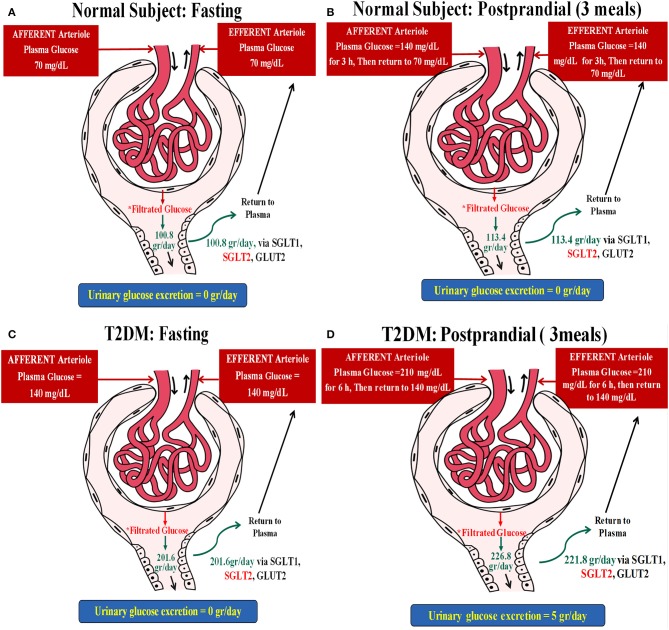
Two hypothetical examples illustrating the postulated impact of meals on glucose and concomitant sodium uptake in the proximal tubule. (A) A non-diabetic subject with stable glucose levels of 70 mg/dl and a glomerular filtration rate (GFR) of 100 ml/min. This individual will have a glucose reuptake of 70 mg/min (~100 g/day), as demonstrated below: Filtrated Glucose = PGluc × GFR = (70 mg/dl × 100 ml/min) × 24 h = (0.7 mg/ml × 100 ml/min) × 24 h = (70 mg/min) × 24 h = 70 ÷ 1,000 g/min × 1,440 min = 100.8 g/day. (B) This individual, now having three meals per day with three post-prandial increments of glucose levels to 140 mg for an hour will have an extra 12.6 g of glucose reabsorption per day: Filtrated Glucose = PGluc × eGFR = (70 mg/dl × 100 ml/min) × 21 h + (140 mg/dl × 100 ml/min) × 3 h = (0.7 mg/ml × 100 ml/min) × 21 h + (1.4 mg/ml × 100 ml/min) × 3 h = (70 ÷ 1,000 g/min × 1,260 min) + (140 ÷ 1,000 g/min × 180 min) = 88.2 + 25.2 = 113.4 g/day. Thus, ΔGlucose reabsorbed following meals = 113.4 – 100.8 = 12.6 g. (C) A type 2 diabetes mellitus (T2DM) patient with fasting glucose levels of 140 mg/dl without glycosuria and with a GFR of 100 ml/min will reabsorb 140 mg glucose/min, about 200 g/24 h while fasting: Filtrated Glucose = PGluc × eGFR = (140 mg/dl × 100 ml/min) × 24 h = (1.4 mg/ml × 100 ml/min) × 24 h = (140 mg/min) × 24 h = 140 ÷ 1,000 g/min × 1,440 min = 201.6 g/day. (D) Filtrated glucose in this patient post-prandial (three meals) = PGluc × eGFR = (140 mg/dl × 100 ml/min) × 18 h + (210 mg/dl × 100 ml/min) × 6 h = (1.4 mg/ml × 100 ml/min) × 18 h + (2.1 mg/ml × 100 ml/min) × 6 h = (140 ÷ 1,000 g/min × 1,080 min) + (210 ÷ 1,000 g/min × 360 min) = 151.2 + 75.6 = 226.8 g/day. Taking into account that this subject loses ~5 g of glucose per day, ΔGlucose reabsorbed = 226.8–201.6 = 25.2 g–5 g/day = 20.2 g/day. As proximal tubular transport of Na+ and glucose is matched with a 1:1 molar ratio for sodium–glucose co-transporter 2 (SGLT2), the non-diabetic individual (example 1), moving from a 24-h fast to regular eating, will have an additional daily uptake of 70 mEq Na+, while the diabetic patient (example 2) will have an enhanced sodium reuptake of 111 mEq. These amounts correspond to additional retentions of 4 and 6.5 g of sodium chloride per day for the non-diabetic and diabetic individuals, respectively. It translates to added water retentions of 0.5 and 0.66 L, respectively, in order to maintain extracellular osmolality, roughly the anecdotal reported acute weight reduction following fasting for a day, immediately reversed upon eating.
Figure 2
Figure 2
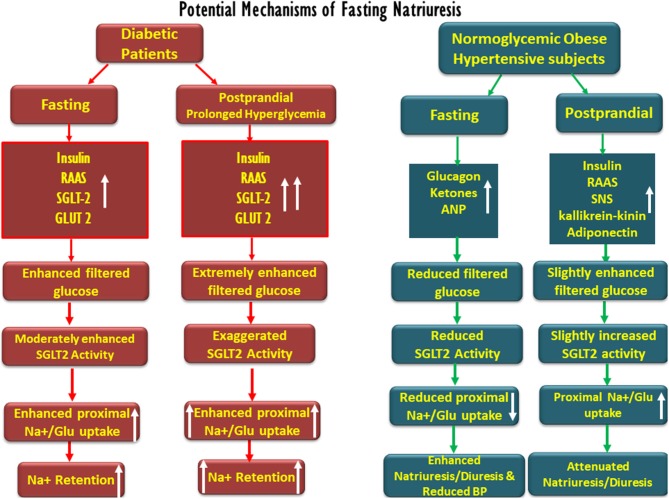
Schematic description of the potential factors involved in fasting-associated diuresis and natriuresis and their disappearance post-prandially in normoglycemic obese hypertensive subjects as compared with diabetic patients. Fasting natriuresis and post-prandial-induced antidiuresis are prominent especially among hypertensive patients. While glucagon, natriuretic peptides, and ketones have been suggested as mediators of fasting natriuresis, insulin and the activation of the renin–angiotensin–aldosterone (RAAS) system and the sympathetic nervous system (SNS) were suggested to enhance post-feeding sodium retention. At the tubular levels, fasting is associated with a reduced proximal tubular sodium uptake, mediated by an impaired SGLT-2 activity, whereas the opposite takes place post-prandially. The latter phenomenon might be more pronounced in diabetics due to prolonged post-prandial hyperglycemia and intense SGLT-driven transport.

References

    1. Veverbrants E, Arky RA. Effects of fasting refeeding. I. Studies on sodium, potassium and water excretion on a constant electrolyte and fluid intake. J Clin Endocrinol Metabol. (1969) 29:55–62. 10.1210/jcem-29-1-55 - DOI - PubMed
    1. Schloeder FX, Stinebaugh BJ. Renal tubular sites of natriuresis of fasting and glucose-induced sodium conservation. Metabolism. (1970) 19:1119–28. 10.1016/0026-0495(70)90037-5 - DOI - PubMed
    1. Kerndt PR, Naughton JL, Driscoll CE, Loxterkamp DA. Fasting: the history, pathophysiology and complications. West J Med. (1982) 137:379–99. - PMC - PubMed
    1. Kraikitpanitch S, Chrysant SG, Lindeman RD. Natriuresis and carbohydrate-induced antinatriuresis in fasted, hydrated hypertensives. Proc Soc Exp Biol Med. (1975) 149:319–24. 10.3181/00379727-149-38798 - DOI - PubMed
    1. Fitzgerald SM, Hall JE, Brands MW. Rapid hypotensive response to fasting in spontaneously hypertensive rats. Am J Hypertens. (2001) 14:1123–7. 10.1016/s0895-7061(01)02209-9 - DOI - PubMed