


VX-765 enhances autophagy of human umbilical cord mesenchymal stem cells against stroke-induced apoptosis and inflammatory responses via AMPK/mTOR signaling pathway
- PMID: 32459063
- PMCID: PMC7415204
- DOI: 10.1111/cns.13400
VX-765 enhances autophagy of human umbilical cord mesenchymal stem cells against stroke-induced apoptosis and inflammatory responses via AMPK/mTOR signaling pathway
Abstract
Introduction: To investigate the protective effect of VX-765 on human umbilical mesenchymal stem cells (HUMSCs) in stroke and its mechanism.
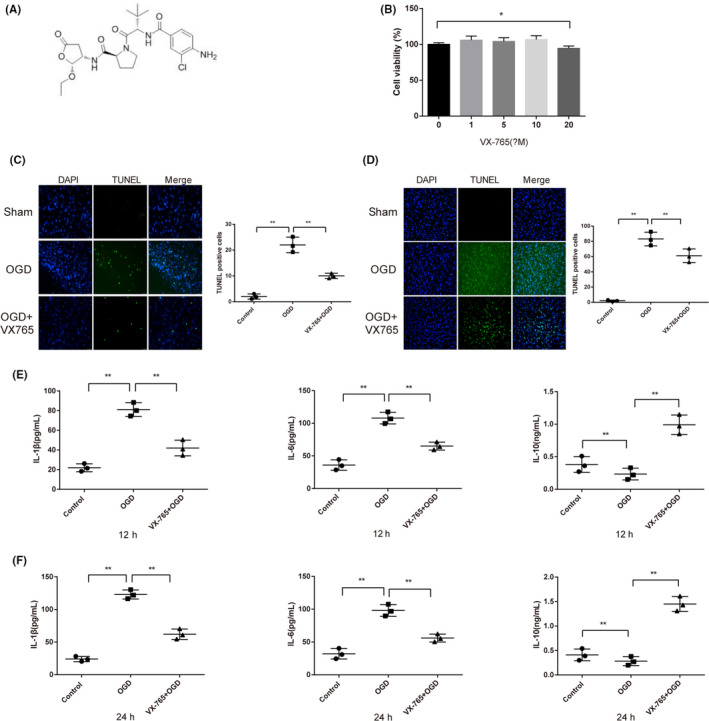
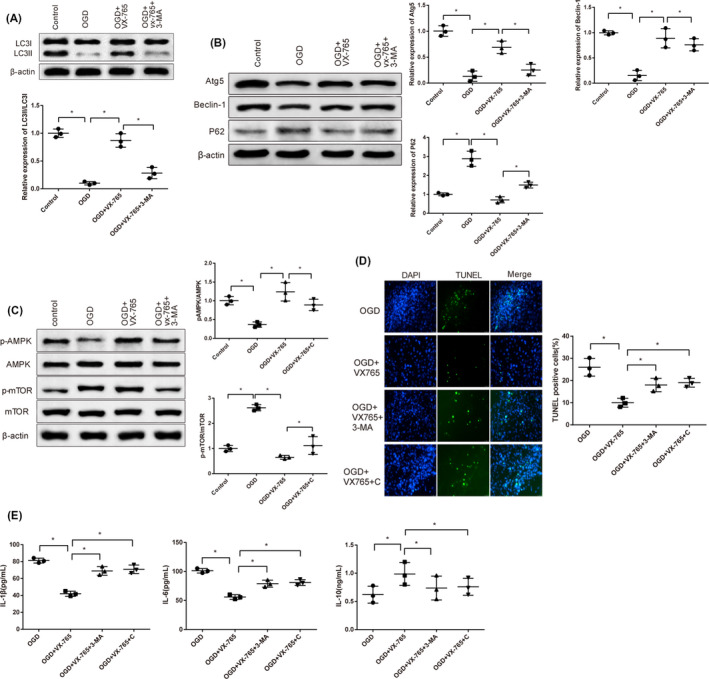
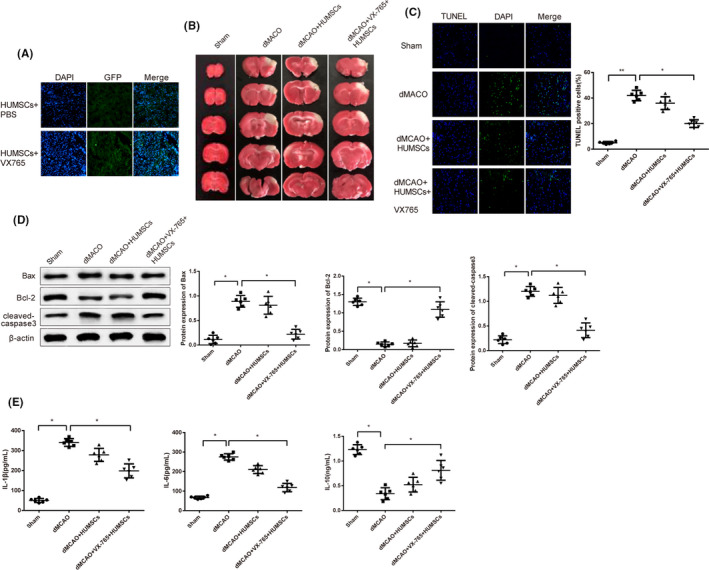
Materials and methods: Mouse models of ischemic stroke were established using the distal middle cerebral artery occlusion (dMCAO) method. The dMCAO mice were accordingly transplanted with HUMSCs, VX-765-treated HUMSCs, or VX-765 + MHY185-treated HUMSCs. The HUMSCs were inserted with green fluorescent protein (GFP) for measurement of transplantation efficiency which was determined by immunofluorescence assay. Oxygen-glucose deprivation (OGD) was applied to mimic ischemic environment in vitro experiments, and the HUMSCs herein were transfected with AMPK inhibitor Compound C or autophagy inhibitor 3-MA. MTT assay was used to test the toxicity of VX-765. TUNEL staining and ELISA were applied to measure the levels of apoptosis and inflammatory cytokines (IL-1β, IL-6, and IL-10), respectively. The expressions of autophagy-associated proteins, AMPK, and mTOR were detected by Western blotting. TTC staining was applied to reveal the infarct lesions in the brain of dMCAO mice.
Results: The pro-inflammatory cytokines, TUNEL-positive cells, and p-mTOR were decreased while the anti-inflammatory cytokine, autophagy-related proteins, and p-AMPK were increased in HUMSCs treated with VX-765 under OGD condition. Different expression patterns were found with the above factors after transfection of 3-MA or Compound C. The pro-inflammatory cytokines, TUNEL-positive cells, and infarct sections were decreased while the anti-inflammatory cytokine and autophagy-related proteins were increased in dMCAO mice transplanted with VX-765-treated HUMSCs compared to those transplanted with HUMSCs only. The autophagy was inhibited while p-mTOR was up-regulated after transfection of MHY.
Conclusion: VX-765 protects HUMSCs against stroke-induced apoptosis and inflammatory responses by activating autophagy via the AMPK/mTOR signaling pathway in vivo and in vitro.
Keywords: VX-765; autophagy; human umbilical mesenchymal stem cells; stroke.
© 2020 The Authors. CNS Neuroscience & Therapeutics published by John Wiley & Sons Ltd.
Conflict of interest statement
The authors have no potential conflicts of interest.
Figures

References
Publication types
MeSH terms
Substances
LinkOut - more resources
Full Text Sources
Medical
Miscellaneous
