


The "BURP" maneuver improves the glottic view during laryngoscopy but remains a difficult procedure
- PMID: 32459108
- PMCID: PMC7273868
- DOI: 10.1177/0300060520925325
The "BURP" maneuver improves the glottic view during laryngoscopy but remains a difficult procedure
Abstract
Objective: We investigated the "BURP" maneuver's effect on the association between difficult laryngoscopy and difficult intubation, and predictors of a difficult airway.
Methods: Adult patients who underwent general anesthesia and tracheal intubation from September 2016 to May 2018 were included. The "BURP" maneuver was performed when glottic exposure was classified as Cormack-Lehane grade 3 or 4, suggesting difficult laryngoscopy. The thyromental distance, modified Mallampati score, and interincisor distance were assessed before anesthesia.
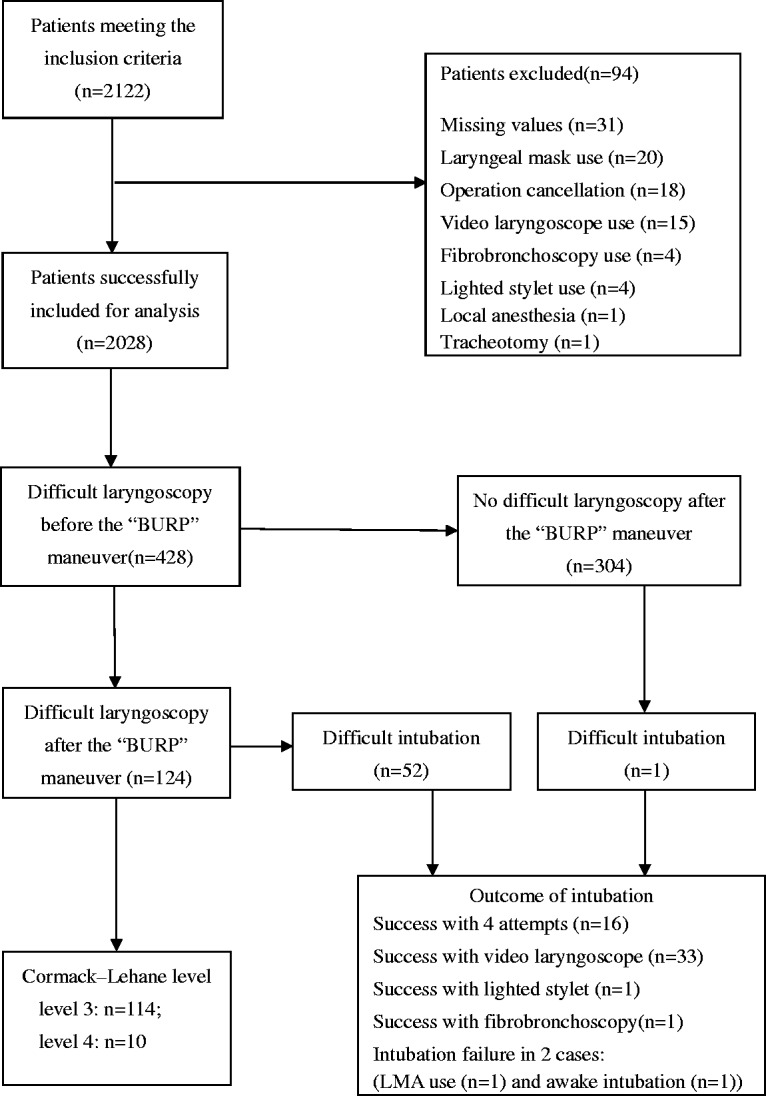
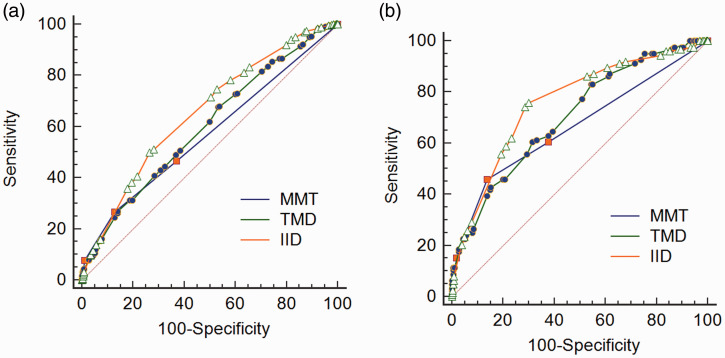
Results: Among this study's 2028 patients, the "BURP" maneuver decreased difficult laryngoscopies from 428 (21.1%) to 124 (6.1%) cases and increased the difficult intubation to difficult laryngoscopy ratio from 53/428 (12.4%) to 52/124 (41.9%). For laryngoscopies classified as difficult without the "BURP" maneuver, the area under the curve (AUC) of the thyromental distance, modified Mallampati score, and interincisor distance was 0.60, 0.57, and 0.66, respectively. In difficult laryngoscopies using the "BURP" maneuver, the AUC of the thyromental distance, modified Mallampati score, and interincisor distance was 0.71, 0.67, and 0.76, respectively.
Conclusions: The "BURP" maneuver improves the laryngoscopic view and assists in difficult laryngoscopies. Compared with difficult laryngoscopies without the "BURP" maneuver, those with the "BURP" maneuver are more closely associated with difficult intubations and are more predictable. Trial registration: www.chictr.org.cn identifier: ChiCTR-ROC- 16009050.
Keywords: airway management; difficult laryngoscopy; difficult tracheal intubation; intubation; laryngoscopic view; “BURP” maneuver.
Figures
References
-
- Weiser TG, Haynes AB, Molina G, et al. Estimate of the global volume of surgery in 2012: an assessment supporting improved health outcomes. Lancet 2015; 385: S11. - PubMed
-
- Yao W, Wang B. Can tongue thickness measured by ultrasonography predict difficult tracheal intubation? Br J Anaesth 2017; 118: 601–609. - PubMed
-
- Yao W, Zhou Y, Wang B, et al. Can mandibular condylar mobility sonography measurements predict difficult laryngoscopy? Anesth Analg 2017; 124: 800–806. - PubMed
-
- Wilson ME, Spiegelhalter D, Robertson JA, et al. Predicting difficult intubation. Br J Anaesth 1988; 61: 211–216. - PubMed
-
- Takahata O, Kubota M, Mamiya K, et al. The efficacy of the “BURP” maneuver during a difficult laryngoscopy. Anesth Analg 1997; 84: 419–421. - PubMed
Publication types
MeSH terms
LinkOut - more resources
Full Text Sources
