


Incidence of Treatment for Opioid Use Disorder Following Nonfatal Overdose in Commercially Insured Patients
- PMID: 32459355
- PMCID: PMC7254182
- DOI: 10.1001/jamanetworkopen.2020.5852
Incidence of Treatment for Opioid Use Disorder Following Nonfatal Overdose in Commercially Insured Patients
Abstract
Importance: Timely initiation and referral to treatment for patients with opioid use disorder seen in the emergency department is associated with reduced mortality. It is not known how often commercially insured adults obtain follow-up treatment after nonfatal opioid overdose.
Objective: To investigate the incidence of follow-up treatment following emergency department discharge after nonfatal opioid overdose and patient characteristics associated with receipt of follow-up treatment.
Design, setting, and participants: A retrospective cohort study was conducted using an administrative claims database for a large US commercial insurer, from October 1, 2011, to September 30, 2016. Data analysis was performed from May 1, 2019, to September 26, 2019. Adult patients discharged from the emergency department after an index opioid overdose (no overdose in the preceding 90 days) were included. Patients with cancer and without continuous insurance enrollment were excluded.
Main outcomes and measures: The primary outcome was follow-up treatment in the 90 days following overdose, defined as a combined outcome of claims for treatment encounters or medications for opioid use disorder (buprenorphine and naltrexone). Analysis was stratified by whether patients received treatment for opioid use disorder in the 90 days before the overdose. Logistic regression models were used to identify patient characteristics associated with receipt of follow-up treatment. Marginal effects were used to report the average adjusted probability and absolute risk differences (ARDs) in follow-up for different patient characteristics.
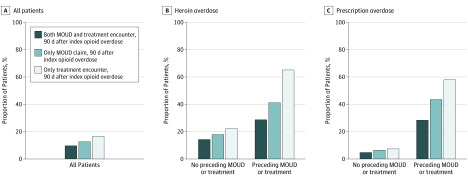
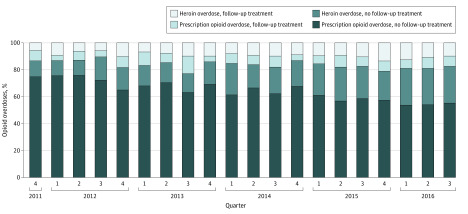
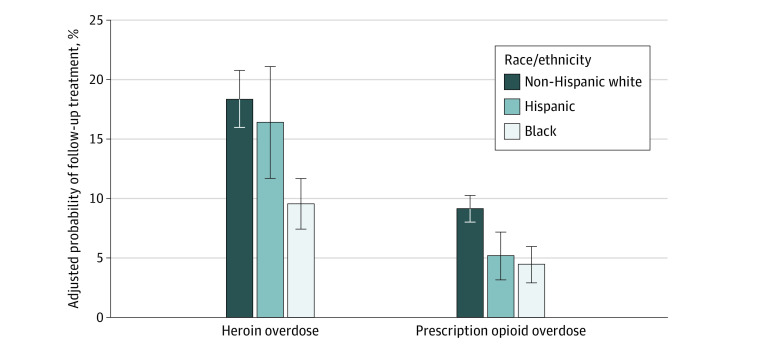
Results: A total of 6451 patients were identified with nonfatal opioid overdose; the mean (SD) age was 45.0 (19.3) years, 3267 were women (50.6%), and 4676 patients (72.5%) reported their race as non-Hispanic white. A total of 1069 patients (16.6%; 95% CI, 15.7%-17.5%) obtained follow-up treatment within 90 days after the overdose. In adjusted analysis of patients who did not receive treatment before the overdose, black patients were half as likely to obtain follow-up compared with non-Hispanic white patients (ARD, -5.9%; 95% CI, -8.6% to -3.6%). Women (ARD, -1.7%; 95% CI, -3.3% to -0.5%) and Hispanic patients (ARD, -3.5%; 95% CI, -6.1% to -0.9%) were also less likely to obtain follow-up. For each additional year of age, patients were 0.2% less likely to obtain follow-up (95% CI, -0.3% to -0.1%).
Conclusions and relevance: Efforts to improve the low rate of timely follow-up treatment following opioid overdose may seek to address sex, race/ethnicity, and age disparities.
Conflict of interest statement
Figures
Comment in
-
Missed Opportunities to Save Lives-Treatments for Opioid Use Disorder After Overdose.JAMA Netw Open. 2020 May 1;3(5):e206369. doi: 10.1001/jamanetworkopen.2020.6369. JAMA Netw Open. 2020. PMID: 32459351 Free PMC article. No abstract available.
References
Publication types
MeSH terms
Substances
LinkOut - more resources
Full Text Sources
Medical
